
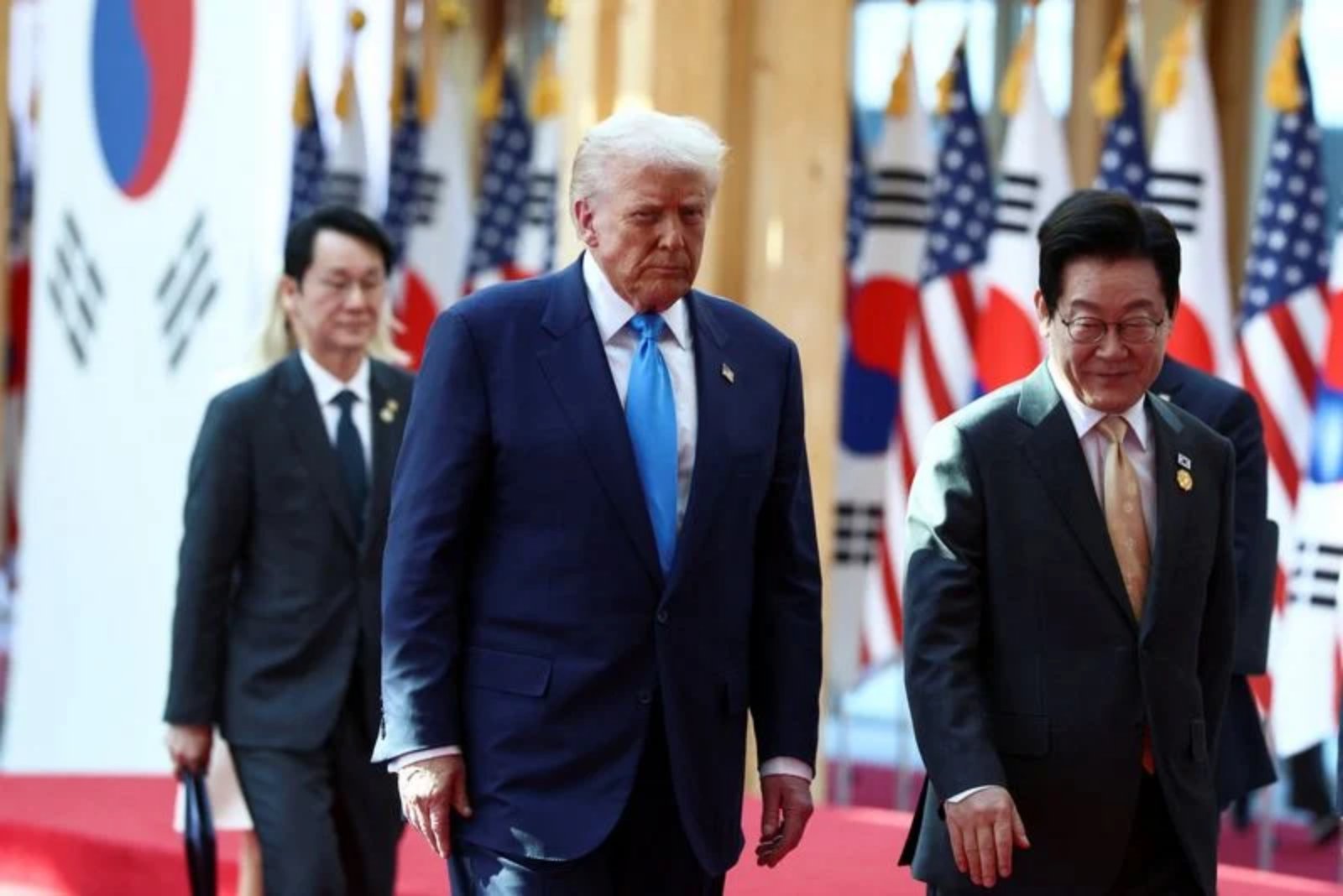
South Korean President Lee Jae Myung said on Friday that during a sideline conversation at the G7 summit in France U.S. President Donald Trump indicated he would consider a stepped approach to the North Korean nuclear issue that focuses first on stopping further nuclear and missile advances, while not abandoning the ultimate goal of denuclearisation.
Speaking at a press briefing after returning to Seoul, Lee recounted that Trump told him it was "time to pay attention" to North Korea and appeared inclined to reopen lines of communication with North Korean leader Kim Jong Un, although Trump expressed frustration over how best to proceed.
Lee described his proposal as a sequential framework - short term, medium term and long term - rather than insisting on immediate, comprehensive denuclearisation. "Without giving up on denuclearisation, I explained that we should go step by step - short term, medium term and long term - rather than immediately," Lee said.
According to Lee, the short-term objectives he outlined to Trump include preventing North Korea from producing additional nuclear material, stopping transfers of weapons or weapons-related materials abroad, and curbing further development of intercontinental ballistic missile (ICBM) technologies. Lee said Trump responded that such an approach "could be one way" and that he would give the idea careful consideration.
Lee warned that sanctions and pressure alone would not resolve the issue, noting his assessment that Pyongyang already appeared to possess a number of nuclear weapons and was producing enough fissile material to assemble about 10 to 20 nuclear weapons a year. He said North Korea's ICBM technology was close to a final stage, including re-entry capability, and that military cooperation between North Korea and Russia over the war in Ukraine had sharply reduced the effectiveness of sanctions.
Trump previously held unprecedented talks with Kim during his first term, but the two leaders' second summit in Hanoi in 2019 collapsed amid disagreements over the sequence of denuclearisation steps and sanctions relief. Since then, Lee noted, Pyongyang has taken a harder line, declaring its nuclear status irreversible and non-negotiable.
Lee also recounted a separate exchange with Trump on shipbuilding. The U.S. president asked whether South Korea could quickly build 10 U.S. warships. Lee said he replied that it was possible and that Seoul would do its best. This follows a trade deal with Washington under which South Korea has agreed to make $150 billion in shipbuilding investments in the United States led by South Korean companies.
The meeting between Lee and Trump included a 90-minute seating at a G7 dinner, which Lee said allowed for more extensive conversation than would typically occur in a formal summit setting. Lee's trip to Europe lasted 10 days; besides attending the G7 summit he held both formal and informal talks with multiple leaders, including German Chancellor Friedrich Merz, Italian Prime Minister Giorgia Meloni and Canadian Prime Minister Mark Carney.
Separately during his visit, Lee said he raised the possibility of Pope Leo visiting the Demilitarized Zone that separates the two Koreas and, if feasible, travelling to North Korea. Lee said the pontiff responded that he would actively consider and pursue the idea.
Context and implications
Lee's account frames a possible shift toward a more gradual, staged diplomatic path that aims to limit North Korea's near-term nuclear and missile capacity while maintaining the longer-term aim of complete denuclearisation. The proposal seeks to address immediate technical and transfer risks while acknowledging the political difficulties of securing irreversible disarmament in the near term.
Lee's comments also highlight practical cooperation items that could have economic consequences, notably a large-scale shipbuilding investment plan tied to a trade deal with the United States and a specific U.S. request for warship construction capacity from South Korea.
Lee's Vatican meeting proposal adds a diplomatic element that, if pursued, would be an unusual effort to involve the pontiff in Peninsula outreach.