
Note: Wording in the first paragraph is corrected to clarify that the Chinese drills extend towards, and not to, disputed areas of the South China Sea.
China said on Friday it recently conducted military activities including live-fire drills in waters east of the Philippines' Luzon Island, a development that coincides with the annual Balikatan military exercises hosted by Manila and Washington. The Balikatan exercises have drawn more than 17,000 troops from the United States, the Philippines and allied partners, and this year include combat troops from Japan for the first time.
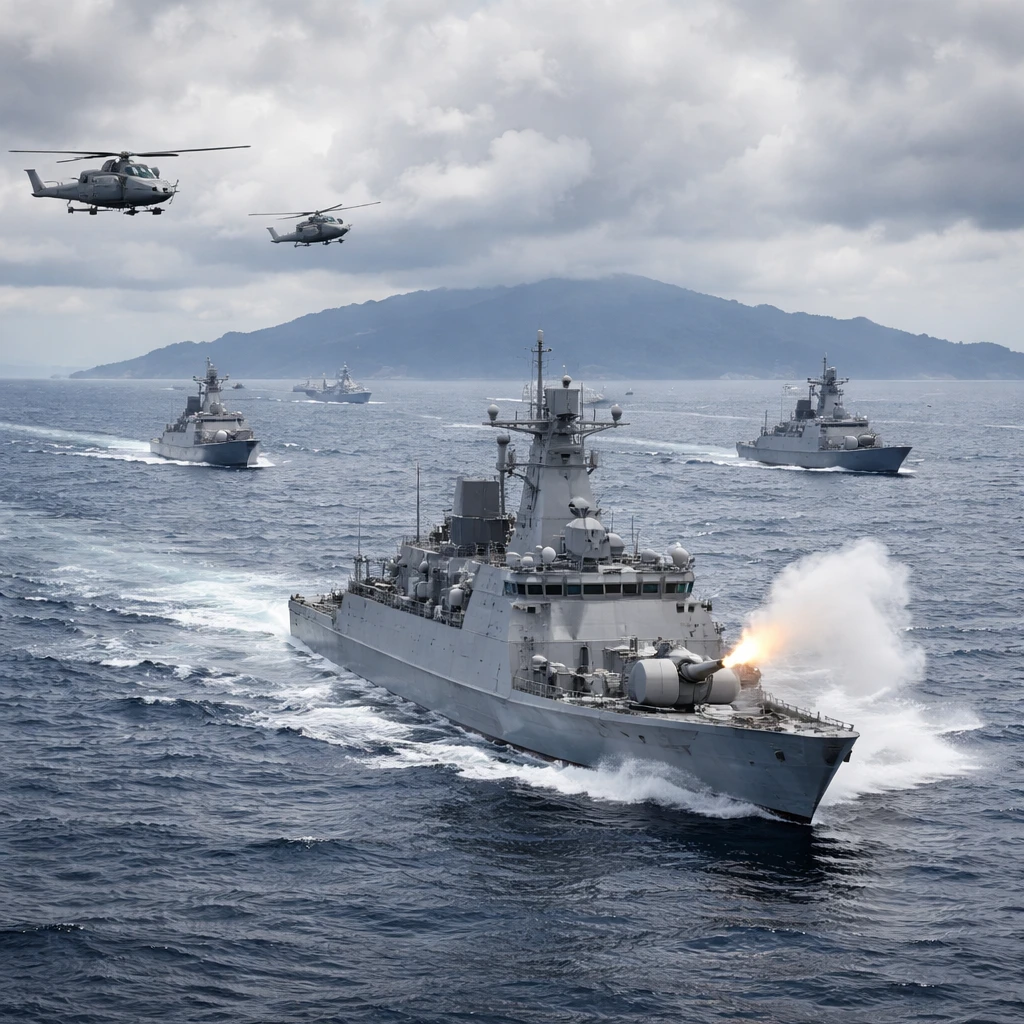
In a statement, the Chinese military's Southern Theater Command - STC - reported that its Naval Task Group 107 carried out a range of operations. The STC said the activities emphasized live-fire shooting, coordination between sea and air assets, rapid maneuvers and maritime replenishment drills, describing the sequence as a test of integrated joint combat capabilities.
"[The exercises were a] necessary operation" in response to the current regional situation and were in full compliance with international law and practice, the STC said.
The Chinese military did not disclose further details on the exact timing or location of the drills. It added in its statement that "Forces of the STC will regularly conduct corresponding military operations based on the need of the security situation to safeguard national sovereignty and security as well as regional peace and stability."
The Philippine embassy in Beijing did not immediately respond to requests for comment on the Chinese exercises.
The Balikatan exercises are scheduled to run from April 20 to May 8 and include operations on Luzon. Among the activities planned by the Philippines and the United States are maritime strike drills on the island of Itbayat, the northernmost inhabited island of the Philippines, located about 155 km (96 miles) from Taiwan. The Philippines and U.S. will hold those maritime strike drills for the first time there.
In addition, the exercises include counter-landing live-fire drills in the Philippine province of Zambales on the South China Sea. Zambales sits roughly 230 km (143 miles) from Scarborough Shoal, a strategic atoll that is controlled by China and has been at the center of maritime disputes.
China has repeatedly criticized the Philippines for conducting defence exercises with allied partners, saying such activities risk raising tensions in the region. The two countries have been engaged in a series of maritime confrontations in recent years as Beijing asserts claims to nearly the entire South China Sea, a waterway that the Chinese statement noted supports more than $3 trillion of annual commerce.
Beijing has signalled a long-term push to strengthen its maritime capabilities. The Chinese statement and separate commentary by senior officials indicate efforts to grow the marine economy, expand naval forces and enhance technological capabilities relevant to maritime power.
At a cabinet meeting on Friday, China's Premier Li Qiang called for measures to reinforce China’s maritime capabilities and technological innovation, as well as efforts to protect maritime rights and strategic security, according to official accounts referenced by the military statement.
The overlapping timing of China's announced drills and the Balikatan exercises highlights continuing friction in the waters surrounding the Philippines. The limited information released by the Chinese military - notably the absence of precise locations and times for the exercises - leaves open questions about the operational scope and duration of the activities beyond the general description supplied by the STC.
As the Balikatan drills proceed, which include ground, maritime and air elements, regional observers and officials in the parties involved will be monitoring movements and public statements. For now, Chinese and Philippine-U.S. accounts reflect competing security postures and a public messaging of deterrence and operational readiness.