
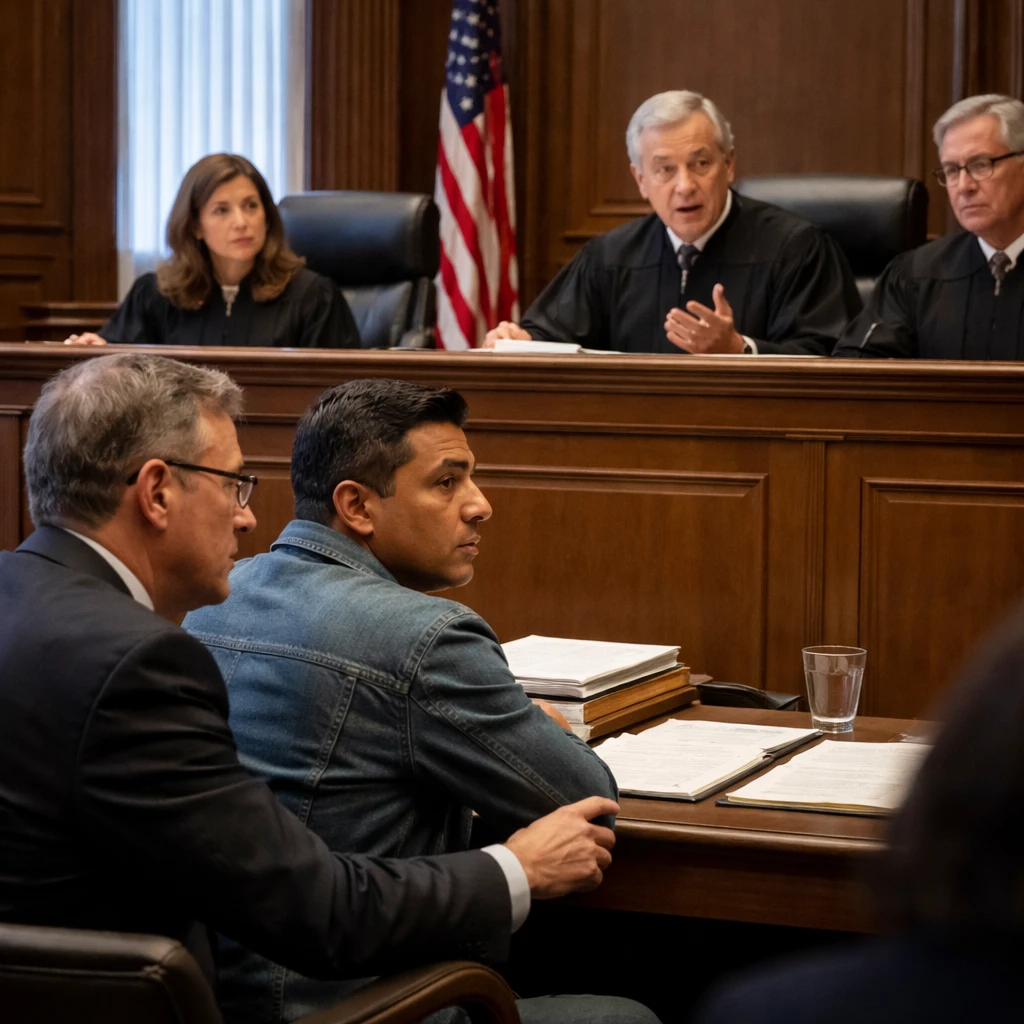
A three-judge panel of the U.S. Court of Appeals for the Second Circuit in New York on Tuesday rejected the Trump administration’s approach of subjecting the majority of people arrested in its immigration enforcement efforts to mandatory detention without a chance to seek release on bond.
Writing for the panel, U.S. Circuit Judge Joseph Bianco said the administration had adopted a new interpretation of a longstanding federal immigration statute that the court found incorrect. Bianco noted that while other appellate courts have reached contrary conclusions, the Second Circuit was aligning itself with more than 370 lower-court judges nationwide who have held the administration’s application of the law to be improper.
The ruling affirmed a decision by a New York trial judge that produced the release of Ricardo Aparecido Barbosa da Cunha, a Brazilian national who immigration officials arrested last year while he was driving to work after living in the United States for over 20 years. The decision preserves the lower-court order releasing him.
Bianco, a judge appointed by President Trump, warned that accepting the government’s reading of the statute would amount to endorsing what he described as "what would be the broadest mass-detention-without-bond mandate in our Nation’s history for millions of noncitizens."
At issue is the administration’s break with a long-standing interpretation of federal immigration law. Last year, the U.S. Department of Homeland Security asserted that noncitizens already residing in the United States - not only those arriving at ports of entry - qualify as "applicants for admission" and therefore are subject to mandatory detention while their immigration cases proceed. Under federal law, "applicants for admission" are ineligible for bond hearings while their cases move through immigration courts.
The Board of Immigration Appeals, which operates within the Department of Justice, issued a September decision adopting that interpretation, and immigration judges employed by the department subsequently began ordering mandatory detention under the new reading of the statute.
The Second Circuit’s decision comes after two other appeals courts produced contrary rulings, overturning lower-court decisions that had favored detainees denied bond hearings. Those divergent appellate outcomes raise the prospect that the U.S. Supreme Court may ultimately resolve the dispute.
Michael Tan, an attorney for Barbosa at the American Civil Liberties Union, praised the court’s decision in a statement, saying, "The court was right to conclude the Trump administration can’t just reinterpret the law at its own whim."
The U.S. Department of Justice, which is defending the policy in court, did not provide a response to a request for comment.
Background and immediate effect
The Second Circuit’s ruling preserves the lower-court order that led to the release of an individual arrested in an interior enforcement action after decades of residence in the United States. It also places the court at odds with other federal appellate panels that have reached different conclusions, creating a split in the federal circuit courts.
The split increases the likelihood that the Supreme Court will be asked to address whether the category of "applicant for admission" can be extended to noncitizens already present in the United States for the purpose of imposing mandatory detention without bond.