
Hook & thesis
Abercrombie & Fitch has executed a textbook retail turnaround over the last 12-18 months: sales recovery at Abercrombie and Hollister, strong free cash flow generation, and a balance sheet with effectively no financial leverage. At a current price around $92.49, the stock trades with depressed multiples relative to historical expectations yet ahead of a reset low, making it a compelling tactical long while the company navigates new cost pressures.
That said, the rally is no sure thing. Management has warned of heavier capital expenditures and tariff-related headwinds, and recent guidance left investors underwhelmed. The trade here is asymmetric: buy the operational momentum now with a tight stop, and rethink the position if margins deteriorate or guidance slips further.
What the company does and why investors should care
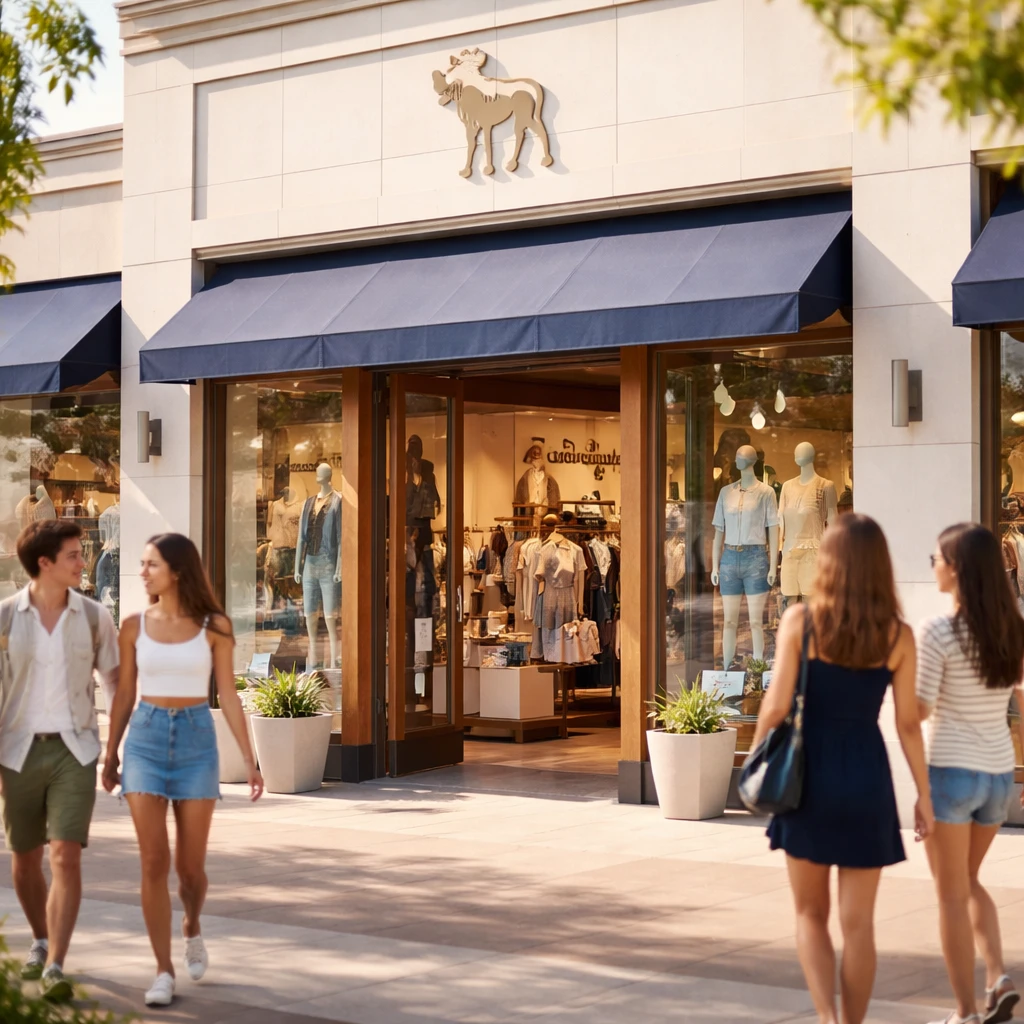
Abercrombie & Fitch Co. is a global apparel retailer operating primarily under two consumer brands: Abercrombie and Hollister. The business spans the Americas, EMEA, and APAC with a broad footprint of physical stores complemented by ecommerce. For investors, two fundamentals matter most: top-line growth in core brands and margin recovery driven by product mix plus inventory discipline. If management can protect gross margin while scaling digital and international sales, cash flow can remain robust and support buybacks or investment in experience and stores.
Hard numbers that back the thesis
- Market capitalization is approximately $4.16 billion with enterprise value near $3.50 billion, which reflects the company's strong cash position and lack of net debt.
- Profitability is real: trailing metrics show a return on equity north of 36% and return on assets of roughly 14.3% - evidence the business is generating attractive returns on invested capital.
- Cash generation is solid: free cash flow was roughly $378 million, and price-to-free-cash-flow sits near 11.3x, indicating the market isn't paying a premium for the cash profile.
- Valuation looks reasonable: EV/EBITDA near 4.1 and price-to-earnings near 8.4 imply the market is pricing slower growth or margin compression, not high single-digit growth and margin expansion that powered prior gains.
- Operational momentum: the company reported a strong third quarter with $2.36 adjusted EPS and $1.29 billion in sales, and the Hollister brand continues to show improved velocity (news around the 03/26/2026 Hollister marketing push helps seasonal engagement).
Technical and market structure context
Technically, the stock sits close to its 50-day moving average (~$92.29) and is below the 10-day (~$95.02), indicating short-term consolidation after a move higher from the November lows of $65.45. Momentum indicators are mixed (RSI around 48; MACD showing bearish momentum), so a measured entry rather than a momentum chase is warranted. Short interest is non-trivial but modest in duration (days-to-cover generally around 2-2.5), meaning short squeezes are possible but not extreme.
Valuation framing
Abercrombie trades at below-market multiples relative to stronger growth apparel peers but also below where it traded when margin expansion was clearer. EV/Sales of ~0.66 and EV/EBITDA ~4.1 suggest the market is not ascribing much premium to continued margin improvement. That sets up a scenario where modest multiple expansion or a re-acceleration in same-store sales could create meaningful upside. Conversely, any surprise to gross margins or a sustained increase in capex would justify the discounted multiple the market currently assigns.
| Metric | Value |
|---|---|
| Market cap | $4.16B |
| Enterprise value | $3.50B |
| EV/EBITDA | 4.1x |
| P/E | ~8.4x |
| P/FCF | ~11.3x |
| Free cash flow | $378M |
| ROE | ~36% |
Catalysts to watch (2-5)
- Next quarterly report: an upside in revenue or stable-to-improving gross margins will likely trigger a multiple re-rate given the cheap starting point.
- Guidance clarity on capital expenditure: management signposting the purpose and duration of higher capex will matter — temporary investments (store refresh, IT) are viewed differently than permanent cost increases.
- Holiday season cadence and international rollouts: continued momentum in Hollister and the opening of new full-price stores (example: lease announced for Town Center of Virginia Beach) would support thesis.
- Share activity: signs of renewed buybacks or opportunistic capital allocation would reinforce investor confidence.
Trade plan (actionable)
Trade direction: Long
Entry price: $92.50
Target price: $115.00
Stop loss: $80.00
Time horizon: mid term (45 trading days) - I expect the trade to play out over several weeks as earnings clarity, holiday merchandising cadence, and any margin commentary either confirm the recovery or expose new pressure points. The 45 trading day horizon gives time for one earnings cycle or two material news events while keeping the position nimble.
Rationale: entry near $92.50 buys the company at a low multiple with proven cash generation. The $115 target (~24% upside) is reachable via modest multiple expansion and continued top-line resilience. The $80 stop limits downside to roughly 13.5% and is below near-term technical support and the recent consolidation band; a break below $80 would signal that the market doubts the sustainability of margin recovery.
Risks and counterarguments
Below are the principal risks to the trade. Each is realistic and could quickly change the investment case.
- Margin compression from costs and tariffs - Management has flagged rising capex and tariff pressures; if gross margins start to roll backward, the current valuation will look optimistic and the stock can re-rate lower fast.
- Disappointing guidance - The stock has previously moved lower after lukewarm forward guidance despite good trailing results. Another cautious guide would likely trigger further downside.
- Retail bifurcation and consumer mix shift - The broader retail market is bifurcating toward discount channels. If consumers shift meaningfully away from mid-premium brands, sales momentum could slow.
- Execution risk on higher capex - Capital spends that fail to drive traffic or improve margins will drag on free cash flow and force a revaluation.
- Macro shock - A broad market risk-off, sticky inflation, or a consumer confidence decline would compress multiples across retail and could hit ANF disproportionately.
Counterargument to my thesis
One plausible counterargument is that the easy margin gains are already behind ANF and that the company now faces a structural rise in working capital and capex (store refreshes, supply chain reshoring) that will sustainably depress free cash flow. If that proves true, the market is correctly pricing a lower multiple and the conservative path is to avoid initiating long exposure until management demonstrates margin stability post-investment. This scenario is why I place a tight stop at $80 and limit the horizon to a mid-term trade: the upside depends on continued cash conversion, which is testable soon.
What would change my mind
I would reduce or abandon the long stance if any of the following occur: a) upcoming quarter shows sequential gross-margin deterioration, b) guidance calls for prolonged elevated capex with limited ROI visibility, or c) comparable-store sales roll negative across the core brands. Conversely, sustained margin expansion or clear return-of-capex-to-profitability would prompt adding to the position with an eye toward a multi-quarter hold.
Conclusion
Abercrombie & Fitch is a classic tactical opportunity: operational improvements and clean capital structure have driven real free cash flow, but the story hinges on whether the company can absorb higher costs and convert near-term capital spending into durable gains. The valuation offers a margin of safety, and the trade proposed here captures upside while limiting exposure to an earnings-driven re-rate. Treat this as a disciplined swing trade - buy the recovery at $92.50, use a tight stop at $80.00, and re-evaluate at the next earnings or guidance update.
Key points
- High-quality cash generation (free cash flow ~ $378M) and no net debt create a safe base for upside if momentum continues.
- Valuation measures (EV/EBITDA ~4.1, P/E ~8.4) leave room for multiple expansion on stable results.
- Main risk is margin pressure from tariffs and higher capex; this is actionable and monitored via guidance.
- Trade plan: long at $92.50, target $115.00, stop $80.00, mid-term (45 trading days).