
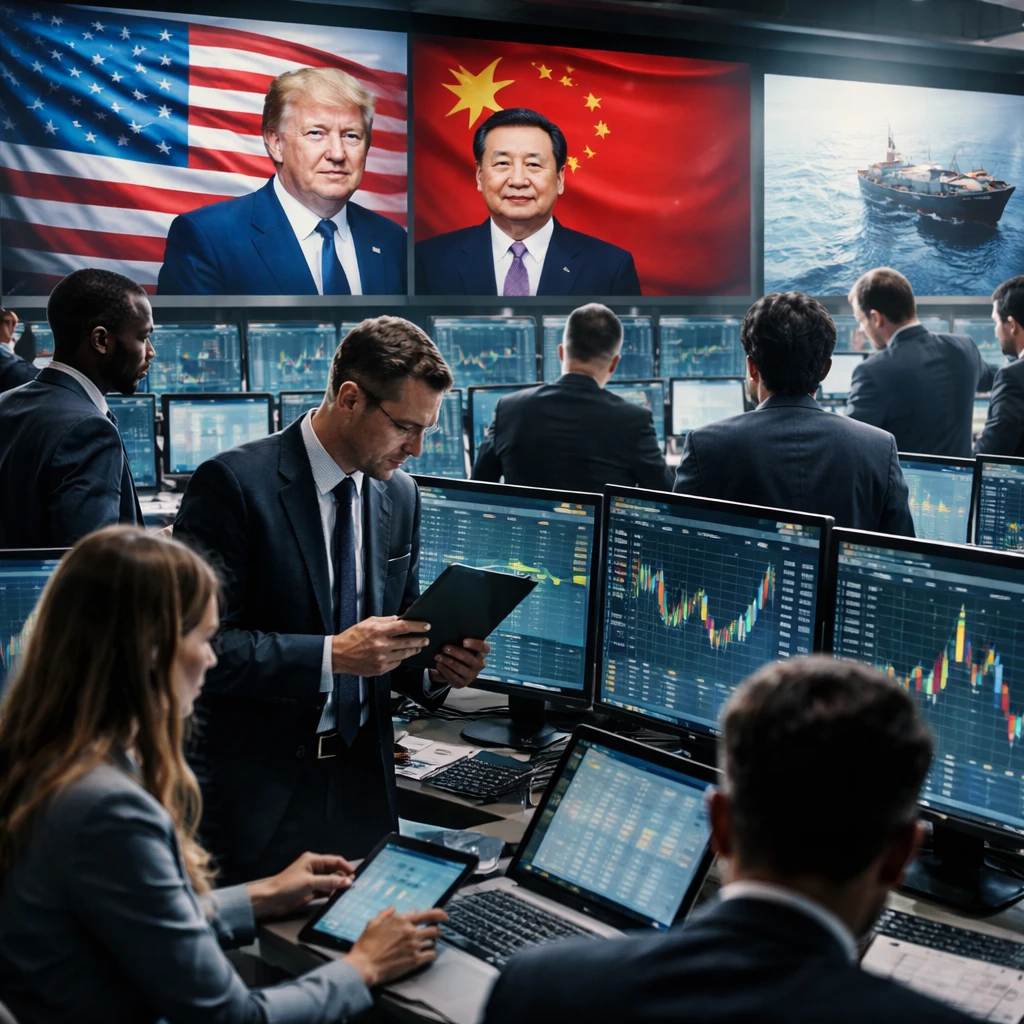
Futures linked to Canada’s main equity index were trading higher on Thursday as investors reacted to a summit between U.S. President Donald Trump and Chinese President Xi Jinping and continued to factor in inflationary risks tied to an energy shock.
By 08:45 ET (12:45 GMT), the S&P/TSX 60 index standard futures contract was up by 8 points, the equivalent of roughly 0.4%.
On Wednesday, the Toronto Stock Exchange’s S&P/TSX composite index closed down 0.7% at 34,041.43. That drop followed a session in which the index had recorded its best closing level in three weeks.
Market participants are pricing in the prospect of two interest-rate increases from the Bank of Canada as they assess inflationary pressure stemming from an energy-price shock after the outbreak of conflict involving Iran.
U.S. markets and tech-driven sentiment
Equity futures on Wall Street were also firmer on Thursday morning. In the prior session, the benchmark S&P 500 reached a new all-time high, the Nasdaq Composite rose 1.2%, and the Dow Jones Industrial Average eased 0.1%.
Reports indicated the U.S. had cleared about 10 Chinese companies to acquire Nvidia’s H200 AI chip, though deliveries have not yet occurred, according to a Reuters account cited by people familiar with the matter. Nvidia CEO Jensen Huang was traveling with President Trump to China, a development that raised hopes markets might see progress toward enabling H200 sales in that market.
Analysts at Vital Knowledge observed that many chipmakers rallied after news of Huang joining Trump on the trip, but noted that software and services stocks did not participate in the same way and that underlying price action was less robust, pointing to lagging performance in the equal-weight S&P index.
Deutsche Bank strategists characterized the market mood as dominated by positive sentiment around the largest technology companies and said the market was awaiting news from the first Trump-Xi meeting.
Inflation data and the economic calendar
Sentiment appeared to largely absorb hotter-than-expected U.S. producer price index readings, which represented the second consecutive upside surprise in inflation figures. Vital Knowledge analysts noted that some observers interpreted the PPI rise as driven by the Iran conflict, implying that readings might cool again if a deal ends the fighting.
The U.S. economic schedule for Thursday featured April retail sales as the main data point. The U.S. Census Bureau reported retail sales increased 0.5% month-on-month in April, in line with consensus expectations but down from a 1.6% rise in March.
Labor-market data released by the Department of Labor showed initial jobless claims for the previous week rose to 211,000, above the consensus projection of 205,000. Continuing claims increased by 24,000, reaching 1.782 million.
Diplomacy, business leaders and market implications
President Trump called the talks with Xi "extremely positive and constructive" while addressing attendees at a state banquet in Beijing, describing Xi as a "friend" and characterizing his reception in China as "magnificent." Trump said the discussions had been "all good" for both countries and extended an invitation for Xi to visit the U.S. in September. He framed the meeting as offering an opportunity to build increased cooperation and prosperity.
Xi said he and Trump had an "in-depth exchange of views," emphasizing that the two nations should aim to be partners rather than rivals and that stability in ties depends on "mutual respect." Neither leader provided substantive public details about the conversations, which are expected to touch on topics such as trade, Taiwan, and artificial intelligence.
U.S. Treasury Secretary Scott Bessent told CNBC he expected an announcement about significant Chinese orders for Boeing aircraft during Trump’s visit, and Boeing shares rose after that comment. Bessent also said he was not aware of the Reuters report on Nvidia and described the discussions around the H200 chip as a Commerce Department matter. Nvidia shares moved modestly higher in premarket trading following the developments.
Energy, oil prices and the global outlook
While political leaders and senior business figures, including Nvidia’s Huang and Tesla’s Elon Musk, gathered in China, the global economy faced uncertainty as the Strait of Hormuz remained closed. That waterway is critical to global energy shipments, accounting for about one-fifth of world oil flows.
Brent crude futures were trading above $105 a barrel, compared with a pre-conflict level near $70 a barrel. The jump in oil prices has amplified inflation concerns across many countries, a dynamic reflected in recent U.S. consumer and producer price readings.
Policy developments and safe-haven assets
The U.S. Senate confirmed Kevin Warsh as chair of the Federal Reserve on Wednesday, moving him into the central bank leadership role at a moment when policymakers face elevated price pressures that could complicate arguments for aggressive near-term rate cuts. Warsh succeeds Jerome Powell as Fed chair.
Gold prices were broadly steady but under pressure from market bets that interest rates will remain higher for longer, a stance that generally weighs on non-yielding assets such as bullion. The U.S. dollar was largely flat; investors have been seeking the greenback as a haven during the Iran conflict, and some market observers have argued that the U.S., as a significant energy producer, could be partially sheltered from the effects of higher global energy prices.
What to watch next
- Market reaction to any announcements from the Trump-Xi discussions, especially on trade, AI technology access, and aircraft procurement.
- Follow-up inflation readings and oil-price movement given their influence on central bank expectations and real-economy costs.
- Corporate responses from companies named in official statements or reports, notably Boeing and Nvidia, as more information emerges about sales approvals and order confirmations.
Investors remain sensitive to the overlapping themes of geopolitics, energy-driven inflation, and central-bank policy, all of which are shaping risk premia and sector performance in North American equity markets.