
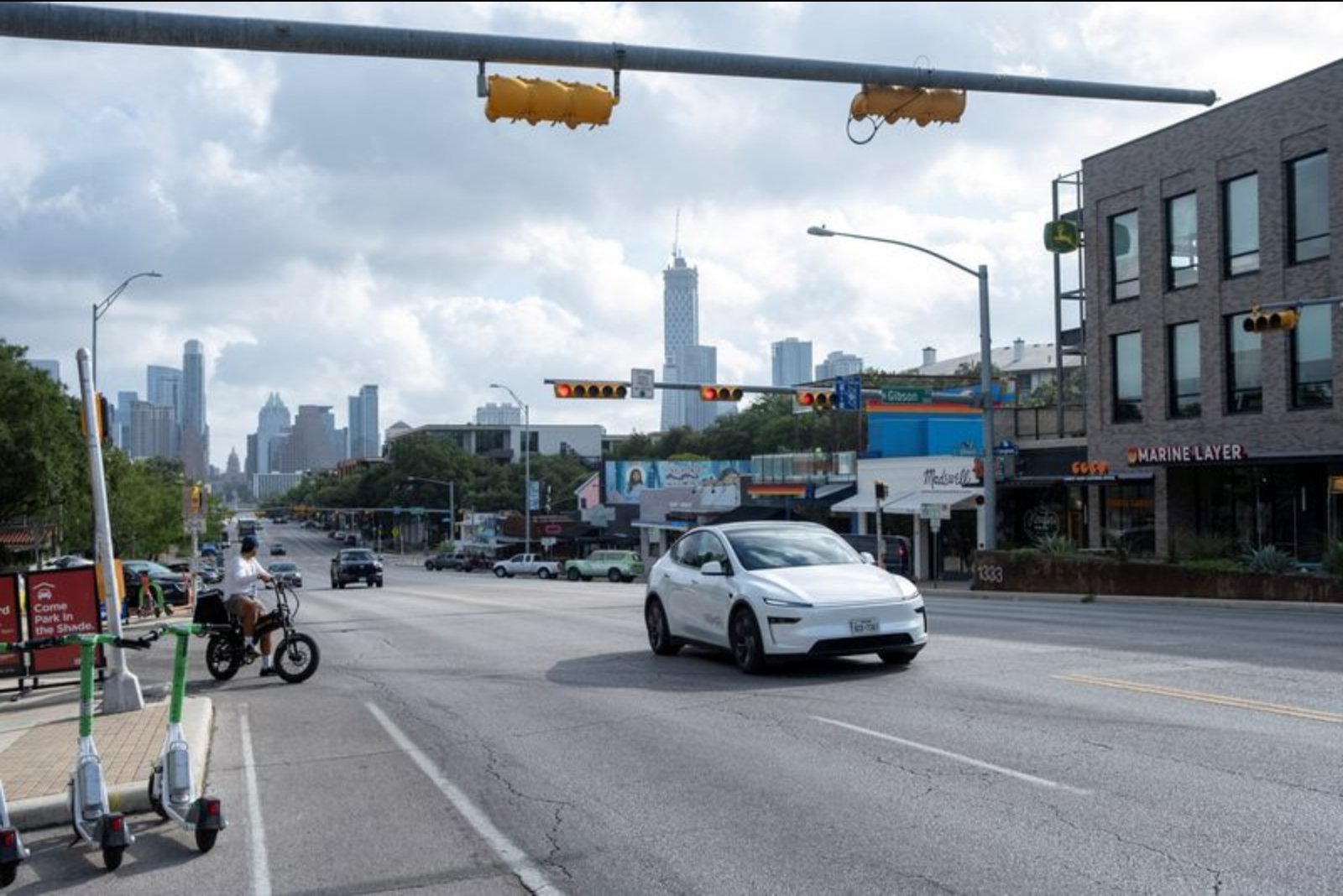
Tesla’s push to deploy autonomous ride-hailing services is moving at a more deliberate pace than many investors expected, according to comments from the company’s CEO and responses from Wall Street analysts. During Tesla’s first-quarter earnings call, Elon Musk adopted a notably cautious tone about the timing and scale of the firm’s robotaxi program.
Musk told investors he hoped to have robotaxis and driverless vehicles operating in "a dozen or so states" by the end of the year, and emphasized that the company is taking a "cautious approach" to prevent injuries or fatalities. He did not add specifics about an expansion to Dallas and Houston that the company had announced on social media the prior weekend.
The stance marks a departure from comments Musk made last July, shortly after launching a limited pilot robotaxi network in Austin, Texas, when he said robotaxis would be available to "half the population of the U.S. by the end of the year" and would increase at a "hyper-exponential rate." Musk has also previously projected a faster timeline for autonomous deployment.
Timelines revised and production ramp expectations
On the earnings call, Musk clarified that robotaxis are unlikely to be "super material this year," but said they "will be material probably in a significant way next year." That contrasted with an April 2025 earnings call in which he said robotaxis would become material to Tesla’s results by the "middle of next year."
Tesla plans to center its robotaxi business on the Cybercab, a two-seater designed for full autonomy without a steering wheel or pedals. Musk said production of the Cybercab has begun, while underscoring that initial manufacturing "will be very slow." He predicted "exponential" growth of Cybercab units "towards the end of the year and certainly next year," and said the model would eventually represent "most of our production long term."
Musk also reiterated a change in deployment logic, saying it does not make sense to roll out driverless vehicles widely ahead of a forthcoming software update that is intended to improve safety. "The limiting factor for expansion is really rigorous validation, making sure things are completely safe," he said.
Analysts respond to the tempered messaging
Several analysts said the comments signal that Tesla is grappling with the operational challenges of launching autonomous vehicles at scale. William Blair described the call as "low energy" and said Musk took on an "unfamiliar tone - reserved and cautious - about his usual favorite subjects." The firm added that the "robotaxi rollout has been far slower than expected."
Morningstar analyst Seth Goldstein characterized the company’s posture as prudent, noting that the stakes are high and suggesting Tesla would avoid deploying technology before it is "extremely safe" and the company is "100% confident." Morgan Stanley analysts, who have been supportive of Tesla’s self-driving plans, wrote that robotaxi progress is "slower than investor expectations," which curbs the "near-term upside" for the stock.
Barclays pointed out that Tesla still has only a "nominal number of driverless vehicles" and said investors are awaiting a more meaningful increase. In the wake of the earnings call, Tesla shares were down more than 3% in afternoon trading on Thursday.
Track record and investor tolerance
Analysts also referenced Musk’s history of optimistic driverless timelines. Musk himself acknowledged in January 2025 that he had been labeled "the boy who cried wolf" on self-driving projections, adding "There’s a damn wolf this time, and you can drive it." Despite missed targets in the past, some investors may remain patient.
Garrett Nelson of CFRA Research said investors will likely tolerate missed expansion targets so long as Tesla can demonstrate the robotaxi business is "scalable" in several markets. "People who have been following the story for years know that things happen on Elon time," Nelson said.
What remains unchanged and what is uncertain
- Tesla retains its stated ambition to build a large-scale autonomous ride-hailing business centered on the Cybercab.
- Management now signals a more cautious deployment schedule driven by safety validation and a pending software update.
- Analysts and investors are watching for demonstrable scaling in early markets before assigning additional near-term value to the robotaxi opportunity.
Some promotional content included in materials around coverage asked whether TSLA is a bargain and pointed readers to a Fair Value calculator that uses multiple valuation models to assess the stock; that material was presented separately from the company comments and analyst reactions summarized above.
Bottom line
Musk’s more restrained public assessment reflects an emphasis on safety validation and a slower initial production cadence for the Cybercab. While management still expects the business to become commercially meaningful, the timing has shifted later than some investors anticipated, prompting a reassessment of near-term upside by market participants.