
Summary
As conflict in the Middle East interrupts established trade channels and raw material flows, Chinese buyers have increasingly turned to India for cotton yarn. Spinning mills in Gujarat are seeing a notable rise in export demand, higher utilization rates and larger order books, while some other Indian textile regions face logistical disadvantages and cost pressures.
Supply shock and shifting flows
India, the world's second-largest cotton producer after China, is benefiting from shifts in global supply lines triggered by the Middle East war. China depends on imports for about 15% of its raw cotton needs and roughly 20% of its yarn consumption, and disruptions to trade routes have reduced cotton supplies from alternative suppliers. That contraction in available supply has made India a closer and more attractive sourcing point for Chinese buyers, traders in India said.
At the same time, delays in shipments originating from the United States and Brazil have accelerated Chinese purchases of imported yarn. A concurrent currency movement - the rupee weakening about 7% against the yuan this year - has further improved the price competitiveness of Indian yarn for Chinese importers.
Surge in exports and mill operations
Spinning mill operators in Gujarat report sharp increases in export business. Ripple Patel, managing director of Fiotex Cotspin, said his company's export order book has expanded by 40% in recent months. Patel added that Fiotex's plant is running at 100 percent capacity utilization, up from 90 percent earlier, and that export orders are already secured through June.
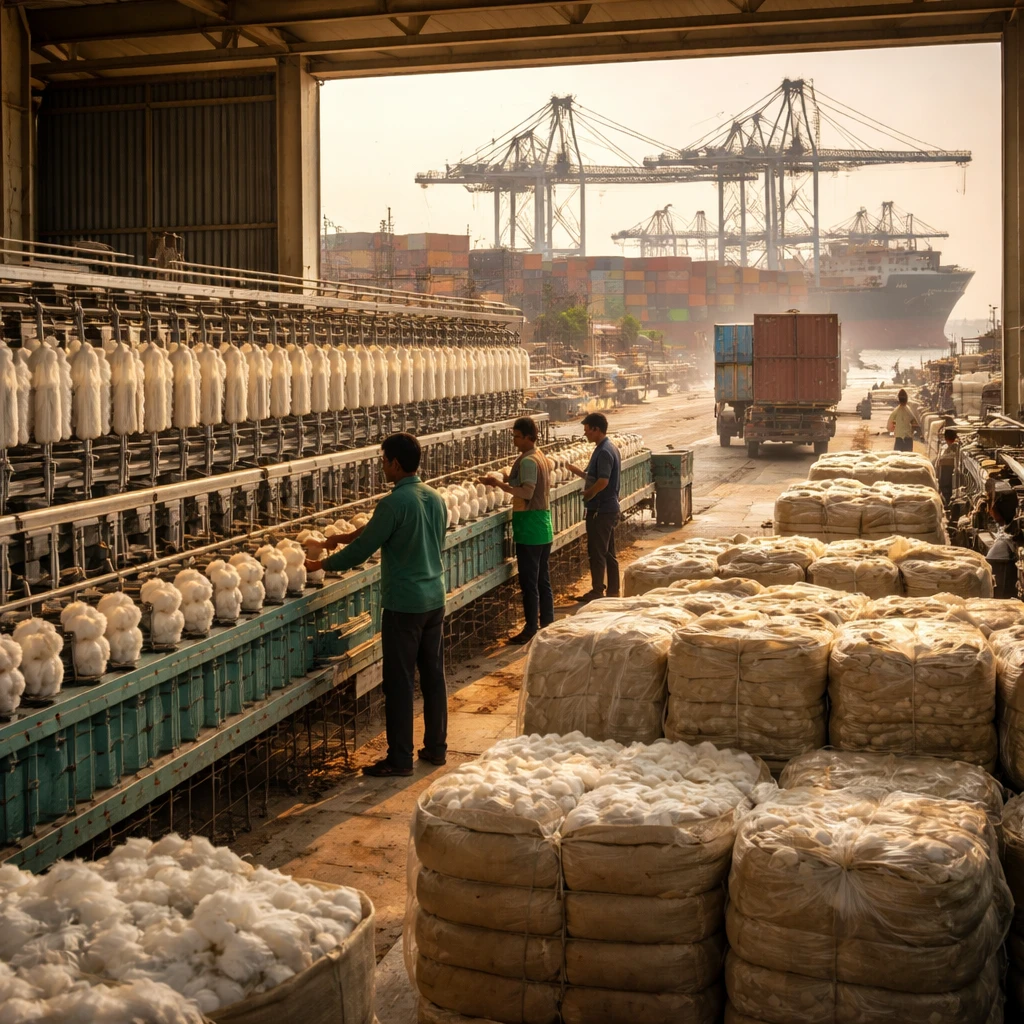
Industry representatives quantify the export rise in container terms. Rahul Shah, co-chair of the Textiles Committee at the Gujarat Chamber of Commerce and Industry, said around 1,500 containers - carrying roughly 30,000 tonnes of cotton yarn - have been dispatched from India to China each month since November, compared with an average of about 300 containers previously. That represents a near five-fold increase in monthly containerized shipments.
Shah said the war's effect on polyester supplies has made cotton comparatively more attractive, and that the weaker rupee has further bolstered shipments. He expects many spinning mills in Gujarat to continue exporting similar volumes through April and May to capture the sustained demand from China.
Regional advantages and constraints
Gujarat's mills are best positioned to exploit the current demand spike because of their proximity to cotton-growing areas and port facilities, allowing lower inland transport costs and faster turnaround to export channels. By contrast, mills in the southern state of Tamil Nadu face higher logistics costs because they must source raw cotton from western and central India. Vishnu Prabhu, joint managing director at garment maker K.M. Knitwear in Tamil Nadu, which also runs a spinning mill for backward integration, said the added cost of moving cotton to ports reduces the favorability of exports for those operations.
Many Indian manufacturing hubs have endured disruptions such as shortages of commercial gas and rising input costs for items like plastics and industrial spare parts. However, industry executives noted that spinning mills have largely avoided fuel-related interruptions because they primarily operate on grid or solar electricity.
Outlook and operational notes
Producers in Gujarat are scaling up exports to capitalize on an unusual alignment of higher Chinese demand, constrained alternative supplies, and a more favorable currency rate. China’s National Textile and Apparel Council declined to comment on the trend in imports from India. While Gujarat mills are positioned to sustain elevated export volumes in the near term, regional differences in raw material sourcing and transport costs will continue to shape which Indian hubs benefit most from the shift.