
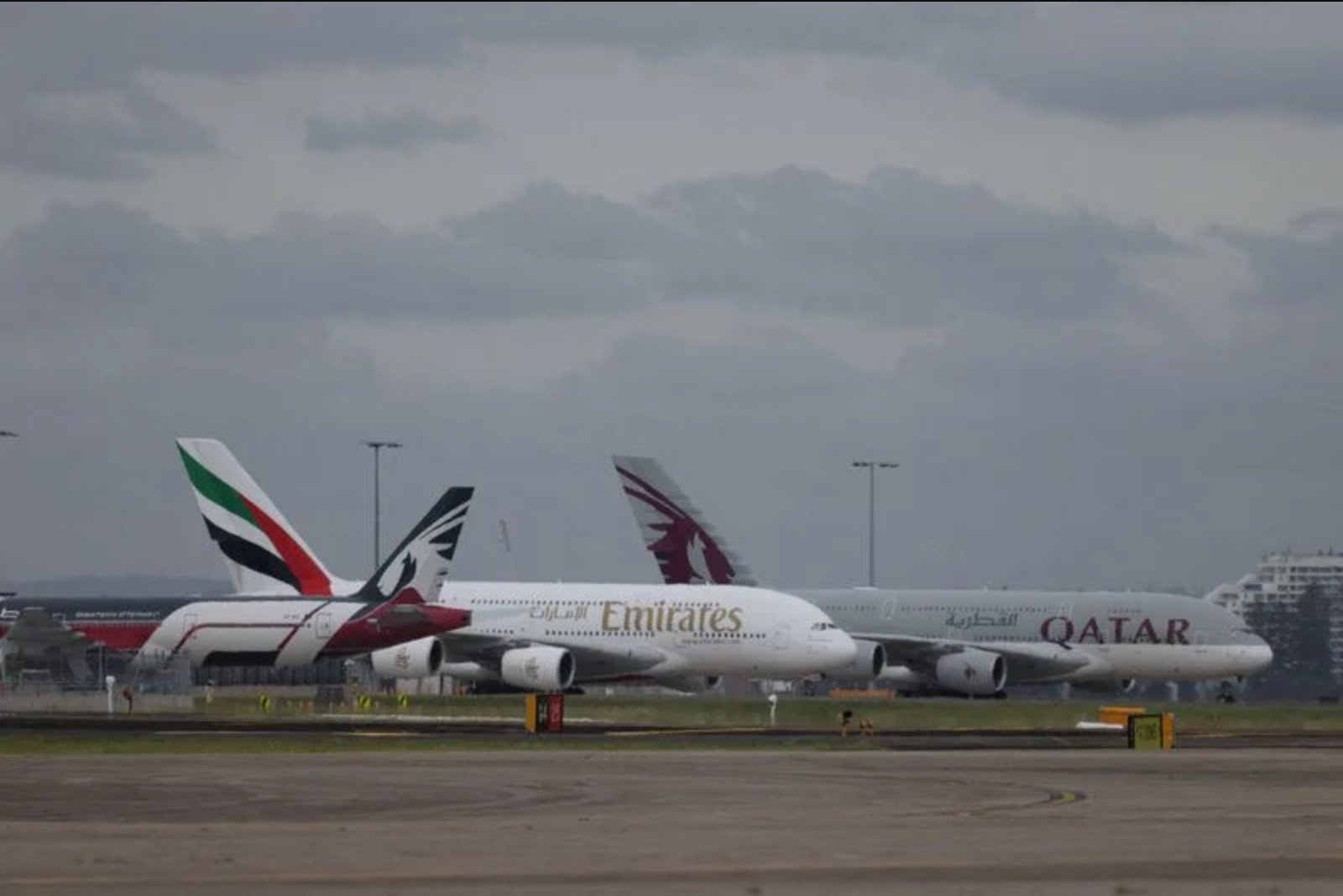
Gulf airlines are regaining capacity after a period of significant disruption driven by the Iran conflict, according to flight-tracking metrics and statements from aviation strategists. Data from Flightradar24.com indicates that, on aggregate, the region's major carriers are operating about 82% of the flight volume seen on February 27, the day before hostilities began.
Certain national carriers have already exceeded their pre-war flight counts in recent days. Gulf Air and Kuwait Airways were reported to be above 100% of the February 27 level. Among the region's largest operators, Emirates, Qatar Airways and Etihad - commonly described as the three biggest Gulf carriers - were noted as being above or near 90% of that pre-conflict benchmark.
There has been significant variation in recovery trajectories. Etihad and Qatar Airways had fallen to levels as low as 40-50% about a month ago before staging a comeback. Emirates, which has undertaken substantial measures to maintain services, has generally held higher and longer. Flightradar24.com separately records Emirates at approximately 86% of its pre-conflict flight volume.
More granular figures released in recent tracking show Etihad and Gulf Air at about 93% of their February volumes, while Kuwait Airways and Qatar Airways had reached roughly 86% and 87%, respectively. Smaller or lower-cost operators are recovering at a slower pace: Air Arabia was operating at near 75% and Flydubai at about 57% of February 27 levels.
Diplomatic developments and immediate outlook
The recovery in flight activity follows announcements of an interim agreement between the U.S. and Iran, signed on Wednesday, intended to bring an end to the near four-month conflict. The two sides are expected to discuss implementing the ceasefire on Friday. Aviation experts say a sustained end to hostilities would likely reopen regional airspace and permit carriers to resume previously restricted routings.
"If it gets back to normal, I just see them acting as normal, coming back in full force," said James Halstead, managing partner at Aviation Strategy, referring to the behavior he expects from Gulf carriers should the region's skies reopen fully.
Safety warnings and travel advisories remain
Despite improving flight counts, safety concerns persist. Drone and missile strikes during the conflict repeatedly forced diversions of Gulf-bound flights, narrowing safe route options to a few approved corridors. As a consequence, many European and Asian carriers sharply curtailed or temporarily halted services to the region, and numerous travel warnings have stayed active.
Australia relaxed its travel advice this week for several Middle Eastern countries, a development that could support transit activity through Gulf hubs. By contrast, the European Union Aviation Safety Agency (EASA) has retained its warning against flights to the region due to conflict-related risks. EASA told Reuters it will take recent developments into account when it reassesses its zone warning, which is valid until June 24, but added that it is still "too early to determine whether the observed de-escalation will result in a sustained reduction of risks to civil aviation."
Individual carriers are taking steps to reassure and support passengers. Emirates has emphasized efforts to reaffirm safety and reliability to travelers, while Etihad plans to offer complimentary medical travel insurance to visitors to Abu Dhabi from July through December.
Broader economic and industry effects
The conflict's fallout has reached beyond airlines. The Gulf has invested heavily in tourism infrastructure, airports and events to position itself as a global transport and leisure hub, and a full reopening of airspace would benefit those economic plans. Meanwhile, airlines worldwide faced operational and cost pressures tied to the crisis.
Jet fuel costs spiked during the period of heightened tensions, squeezing carriers without hedges and increasing operating expenses. Those prices have since begun to ease, but the temporary surge contributed to significant industry-wide financial reassessments. Airlines grounded aircraft in some cases and used unusual repositioning strategies, including extended repositioning flights, to manage fleets amidst restricted routings.
The International Air Transport Association (IATA), representing more than 370 airlines and approximately 85% of global air traffic, materially revised its 2026 profit outlook in light of the conflict. IATA nearly halved a previous 2026 profit forecast and now projects a combined net profit for the industry of $23 billion, down from an earlier estimate of about $41 billion and below the $45 billion recorded in 2025.
What this means for markets and travelers
Restoration of flight volumes toward pre-conflict levels signals a partial normalization for regional aviation, but lingering regulatory warnings, travel advisories and the need for passenger reassurance mean a full return to normal operations is contingent on sustained de-escalation. For now, recovery is uneven across carriers and routes, and the industry continues to weigh the financial impact of months of disrupted operations and elevated fuel costs.
As carriers adjust schedules and services to match recovering demand, observers will be watching whether regulatory bodies relax restrictions and whether passenger confidence follows the improved operational metrics.