
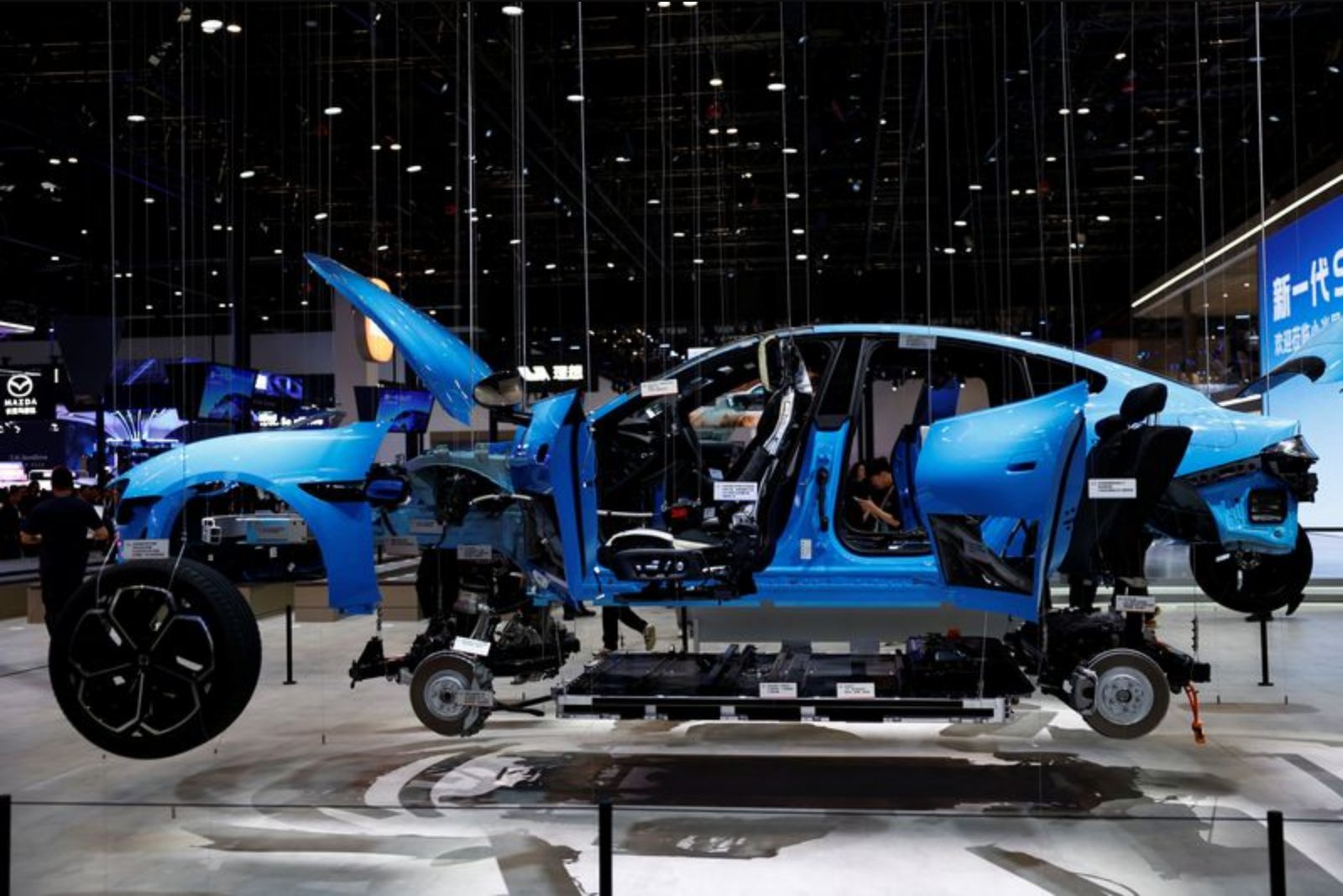
BEIJING, April 24 - Over a quarter of a century after establishing a dominant position in the electric vehicle market, China’s carmakers are now moving at pace toward a new technological frontier: embedding artificial intelligence so that cars evolve from internet-connected platforms into self-reasoning machines running on domestic chips and software.
The government's most recent five-year plan set out an "AI Plus" blueprint that aims to install AI systems across manufacturing, healthcare and many other sectors of the economy. A clear element of that national strategy is to lessen reliance on high-end semiconductors - a trade bottleneck the industry says is largely controlled by the U.S.
Industry leaders say lines between tech companies and automakers are fading. "There’s no longer a distinction between a technology company and a car company," Nissan Motor China chief Stephen Ma said on the sidelines of the Beijing Auto Show. "The AI-developed vehicle is much faster and it’s quicker in China."
In the days running up to and during the auto show, Chinese automakers and their suppliers announced investment plans and rolled out a wave of AI-enhanced systems. While some of the initial applications appear incremental, analysts and industry officials contend the long-term implications could be vast.
"There is no transition," Francois Roudier, secretary general of the International Organisation of Motor Vehicle Manufacturers, said in Beijing. "It’s a revolution."
From voice and task-driven assistants to vision-based navigation
Several companies demonstrated how AI is being applied inside and around the vehicle. Xpeng described an updated AI model that lets drivers issue natural commands such as, "park near the entrance to the shopping center," rather than selecting a precise spot on a map. The company says its vehicles can navigate using cameras even in the absence of preloaded mapping or coordinates.
Xiaomi, which entered the EV market three years ago, unveiled an updated AI model after midnight on Thursday. Xiaomi has said its HyperOS operating system for cars will enable drivers to delegate complex tasks - from making restaurant reservations and placing coffee orders to compiling notes from the road. The system is also designed to sense when drivers appear stressed or agitated and to alter cabin lighting and music in response to help with the arrival home.
"So much focus on AI in other parts of the world has been on how can we use it to improve business? That’s not what Chinese automakers are talking about," Dan Hearsch, global co-leader for automotive at advisory firm AlixPartners, said. "The AI they’re building in is going to make the car easier to drive, easier to interact with, easier to do all of the things that otherwise take effort."
Big tech and chipmakers push computing and integration
Huawei, which has broadened its business beyond telecommunications into chips, AI and connected cars, said it will invest more than $10 billion over the next five years to boost computing power for smart driving. While automotive sales are a relatively small part of Huawei’s overall portfolio, the company said the segment is its fastest-growing.
Horizon Robotics, a Chinese chipmaker that competes with Qualcomm, introduced its Starry 6 processor just before the auto show. The company says the processor integrates cockpit and driving functions and can support up to 12 screen displays in a single vehicle.
Chip independence and a domestic supply push
A number of Chinese electric vehicle manufacturers have been designing their own chips to reduce reliance on Nvidia. Firms named in that effort include Xpeng, Li Auto, BYD, Geely and Leapmotor. NIO, which spun off its own chip unit, has said developing in-house semiconductors can lower costs and lift earnings by replacing Nvidia solutions, CEO William Li said. "We are open to the whole industry and we welcome them to use (our chips)," Li told reporters.
In other examples of industry alignment with national priorities, state-owned Dongfeng Motor - one of the Big Four carmakers in China - said it will build vehicles using what it called "embodied AI technology" consistent with the country's long-term industrial plans. Dongfeng has been collaborating with Huawei on smart driving systems to better compete with private sector rivals. "When the nation calls, Dongfeng answers," Chairman Yang Qing said.
The influx of announcements at the auto show underscores a coordinated push by China’s auto, technology and chip industries to turn vehicles into AI platforms and to substitute foreign semiconductor components with domestically developed chips. Some industry executives and analysts describe the change as revolutionary rather than incremental, while firms across the private and state sectors are signaling alignment with Beijing’s strategic objectives.