
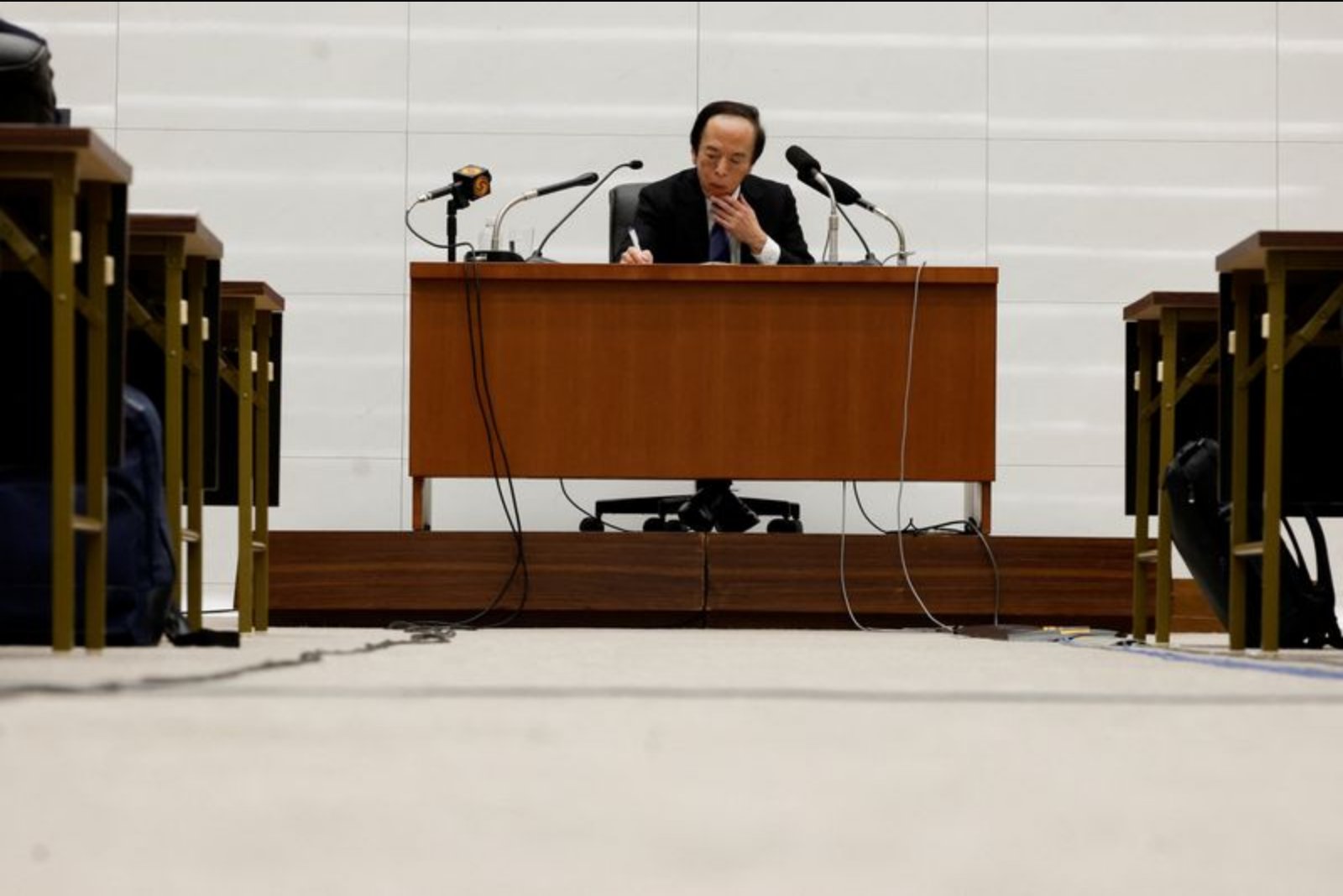
The Bank of Japan opted to keep its policy rate unchanged on Tuesday, but internal divisions were evident as three of the nine board members preferred an immediate increase in borrowing costs. The central bank also raised its price projections markedly and emphasised vigilance against the possibility that a supply shock could lead to an overshoot in inflation - signalling a clear prospect of higher rates in coming months if price pressures intensify.
Uncertainty from Middle East conflict
At his post-meeting news conference, conducted in Japanese, Governor Kazuo Ueda said the uncertainty stemming from the Middle East conflict had reduced the likelihood that the BOJ would hit its earlier forecasts. He said the shock produced both a large downside risk to growth and an upside risk to inflation, particularly for fiscal 2026.
"Given high uncertainty surrounding the Middle East conflict, the likelihood of achieving our forecasts has diminished. On the other hand, there is both big downside risk to growth and upside risk to inflation mainly for fiscal 2026. At present, it’s hard to judge the duration and impact on the economy and prices now. The BOJ wants to spend a bit more time scrutinising how the Middle East conflict affects the economy and prices, and whether growth and inflation risks could change."
Ueda underlined the difficulty of assessing how long the disruption will last and what precise effect it will have on domestic economic activity and prices. The bank intends to monitor developments closely rather than assuming current conditions will persist.
Cost pressures for oil-related goods
The governor warned that, with underlying inflation nearing the BOJ’s 2% threshold, firms might be more inclined to pass on higher expenses linked to oil-related products. He said policymakers need to watch data carefully to avoid lagging behind an evolving cost-push environment.
"With underlying inflation approaching 2%, we need to be mindful that companies may more actively pass on rising costs for oil-related goods. We would like to carefully gauge various data to ensure we’re not behind the curve."
Criteria for future tightening
On the timetable for any subsequent rate increase, Ueda rejected the notion of a preset horizon. He said the BOJ had no fixed idea of how many months it would require to determine whether conditions warranted another hike.
"We don’t have any preset idea on how many months we would need (to gauge whether conditions for another rate hike could fall into place)."
This reflects a data-dependent approach: the bank will weigh incoming evidence on inflation dynamics and the persistence of any supply-driven price jumps before acting.
Revised price forecasts and inflation expectations
Ueda said the BOJ had revised up its price forecasts significantly, attributing the change largely to higher crude oil prices that could temporarily elevate prices across a broad range of goods and services. He stressed that underlying inflation remains slightly below 2% but is expected to move gradually toward that level.
"Our price forecasts have been revised up significantly. This reflects our view that rising crude oil prices could temporarily push up prices for a wide range of goods and services. Underlying inflation still remains slightly below 2% and will gradually accelerate towards that level... As for medium- and long-term inflation expectations, that varies on which data you look at. But we can say it’s not completely anchored at 2% and tends to fluctuate."
He noted that measures of medium- and long-term inflation expectations differ across datasets and are not uniformly anchored at 2%, but instead show some variability.
Decision rationale and the path ahead
Ueda explained that Tuesday’s decision reflected a judgement that central banks should look through temporary, supply-driven inflation shocks. However, he warned that if those shocks produced second-round effects that lifted underlying inflation, the BOJ would raise interest rates.
"Our decision today is based on the view that central banks should look through temporary supply shock-driven inflation. But if such shock brings about second-round effects on underlying inflation, we must raise interest rates."
He added that headline inflation could rise sharply in the near term without an immediate corresponding increase in underlying inflation. Still, as firms become more willing to lift wages and prices, monetary authorities must steer policy to prevent medium- and long-term inflation expectations from rising enough to cause an overshoot in underlying inflation.
"Headline inflation may rise rather sharply for the time being but that doesn’t mean underlying inflation will heighten immediately. With companies becoming more keen to raise wages and prices, however, we must guide policy appropriately, so that medium- and long-term inflation expectations heighten clearly and lead to an overshoot in underlying inflation."
The governor’s comments leave the BOJ on a cautious, data-driven course: keeping policy unchanged for now while signalling readiness to tighten if temporary price shocks feed through into persistent inflationary pressures.