
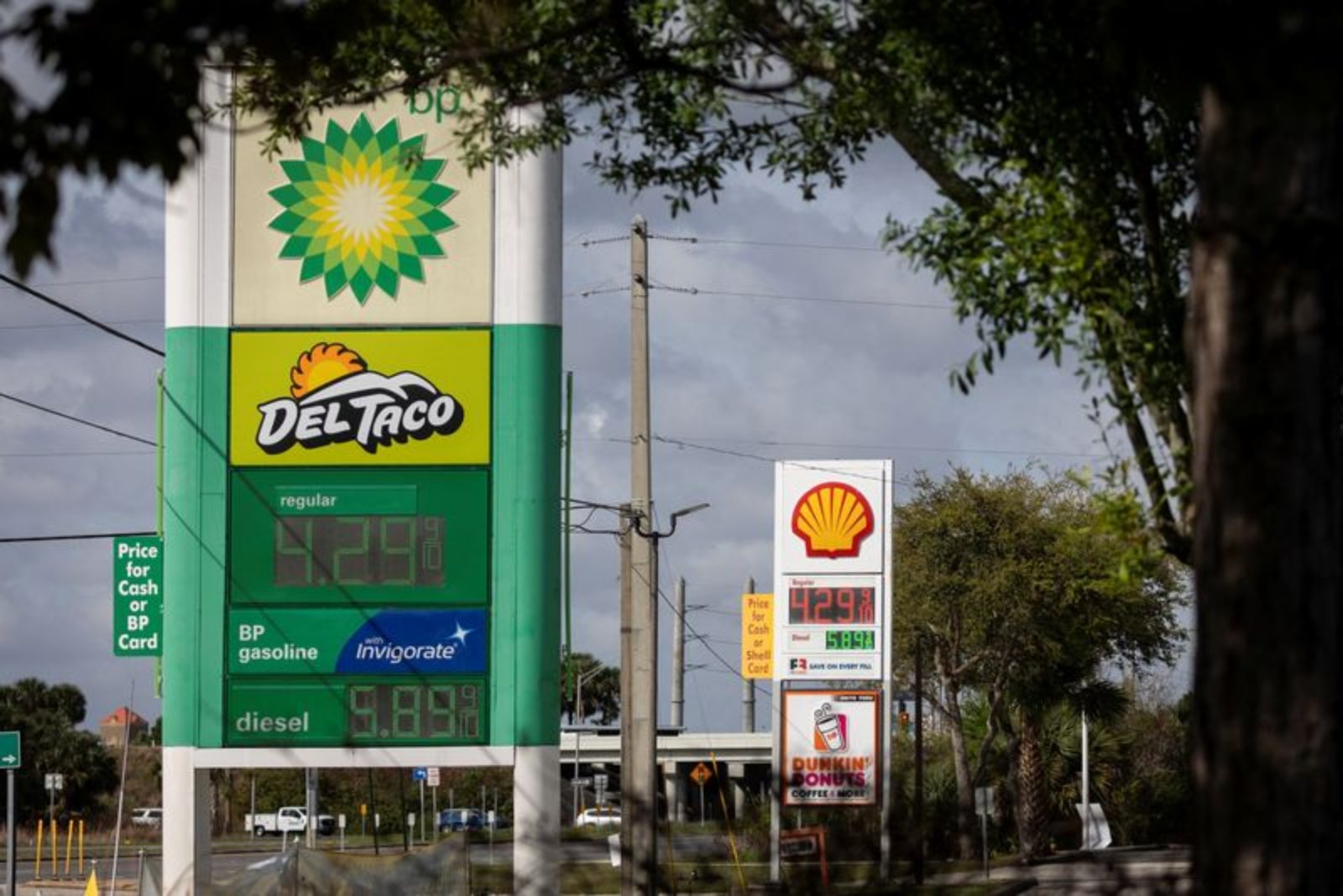
Motorists from New England to the Gulf Coast report altering driving patterns and vehicle choices as the conflict involving Iran pushes fuel costs higher. In Boston, Pat Ouedraogo has curtailed longer trips and is buying only a few gallons at a time, while aspiring law student Skyler Burke travels farther to reach cheaper pumps. In Houston, auto broker David Wright has moved from a gas-guzzling race car to an all-electric vehicle.
These individual decisions reflect a wider picture: energy market observers describe the six-week-old Iran war as among the most disruptive oil-supply shocks on record, with major production facilities damaged and a key shipping passage effectively closed. The resulting squeeze on supply has translated into higher prices at the pump for American consumers.
At a Shell station where he refueled, Ouedraogo noted the difficulty of confronting steep costs: "It’s a situation where you feel powerless about these prices," he said while paying $4.99 a gallon. Data from fuel price tracker GasBuddy showed average U.S. gasoline prices at $4.16 a gallon and diesel at $5.67 on Friday, levels not seen since the global energy disruptions that followed Russia’s February 2022 invasion of Ukraine.
GasBuddy’s Patrick De Haan estimated that, since the war began, U.S. gasoline and diesel spending for the March 1 to April 10 period this year has risen by about $10.4 billion compared with the same period last year.
High diesel has hit trucking operators particularly hard. Houston-based trucker Eddie Esquivel said his weekly fuel bill has nearly doubled, rising to roughly $1,600-$1,700 from $800-$900 before the conflict. "These prices are hitting real hard. Diesel was $2-something a gallon. Now, it could hit $6," Esquivel said at a QuikTrip filling station in South Houston. He added that recurring costs such as truck payments, tires and oil changes compound the pressure: "This is killing us."
The ripples extend beyond individual haulers. Observers say Iran’s blockade of the Strait of Hormuz has curtailed flows of Middle Eastern oil to Asian and European markets, reinforcing upward pressure on global fuel prices. As the world’s largest fuel consumer, the United States experiences particular sensitivity to pump prices, which carry outsize weight in political and economic calculations.
Political consequences are already visible. Voters are weighing soaring living costs against previous campaign promises of cheaper energy. One motorist outside Denver, Kari DyLong, expressed her disaffection while filling her pickup: "I definitely won’t be voting for (the Republican) party or anyone affiliated with this president right now who is in office at all." DyLong described cutting back on personal outings and relying more on home-based activities because she must allocate a larger share of her paycheck to commute 40 minutes each way to her job as a sales manager for craft brewer Oskar Blues.
Officials and analysts caution that elevated gasoline prices could persist even after a U.S. military role in Iran is scaled back. Delegations from the United States and Iran are scheduled to meet in Pakistan for talks aimed at achieving a permanent ceasefire following a fragile two-week truce announced earlier this week. Even if a truce is extended or formalized, market participants warned that oil and fuel prices are unlikely to revert quickly to pre-war levels.
Rystad analyst Wei Ren Gan described expectations for a continuing geopolitical risk premium: "Rather than a rapid recovery to pre-war levels, prices are likely to soften gradually and could remain relatively higher than pre-war benchmarks." Macquarie analysts estimated that roughly 2 million barrels per day of Middle Eastern refining capacity have been knocked out of service because of damage sustained during the fighting.
There are early signs of demand destruction in U.S. consumption data. Gasoline usage in the week before Easter was reported at 8.6 million barrels per day, down 9% from the same period last year. Consumer hardship is visible in other indicators as well: pawn loan transactions have risen 9% as gas prices surpassed $4 a gallon, according to pawn loan provider EZCORP.
For many Americans, the hit to household budgets is leading to behavioral adjustments. In Denver, DyLong said she avoids weekend trips and concentrates activities at home to reduce fuel use. Skyler Burke’s decision to drive farther for lower pump prices and Wright’s switch to an electric vehicle both reflect attempts to stretch household dollars and manage exposure to volatile fuel costs.
From a market perspective, the combination of supply disruptions, constrained refining output and elevated geopolitical risk is creating a policy and pricing environment that could keep energy costs elevated through the summer travel season. Analysts expect that consumers will continue to face higher prices when driving or flying, and that the effects will be felt across sectors reliant on transportation, including retail goods distribution and services that depend on passenger mobility.
In the near term, expenditures for gasoline and diesel at these higher prices are adding a notable burden to households and businesses alike. The near-term path of prices remains subject to the course of diplomatic negotiations, the physical state of regional refining and shipping infrastructure, and the extent to which consumers continue to change behavior in response to pump costs.
As households and commercial operators adjust, sectors with limited ability to pass through input-cost increases - such as independent retailers and smaller logistics operators - may face particular stress. Companies and managers with stronger pricing power, more efficient distribution, or the ability to shift to lower-cost energy sources likely will fare better in an environment where fuel costs remain elevated.