
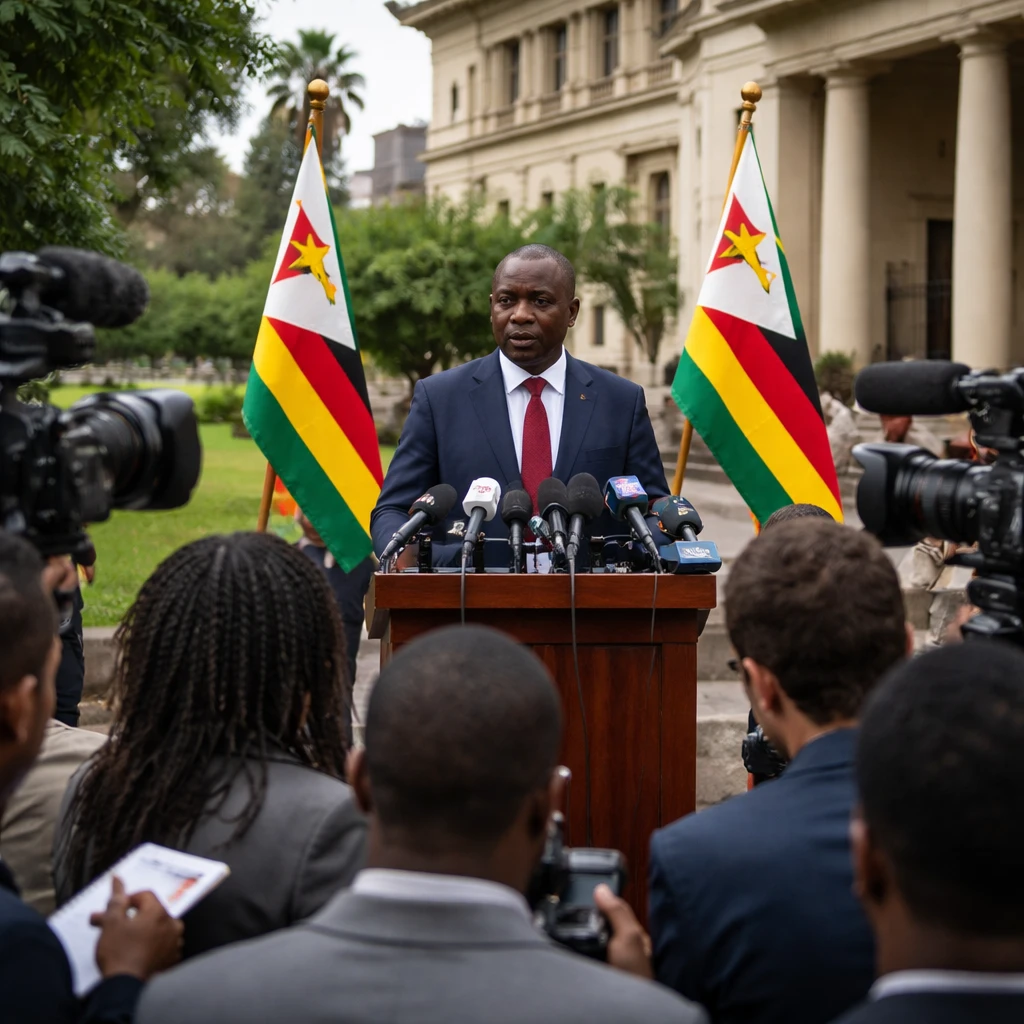
Zimbabwe has terminated talks on a proposed five-year bilateral health agreement that would have delivered $367 million in U.S. support, saying the offer asked the country to hand over sensitive biological and epidemiological data without reciprocal benefits.
Government spokesperson Nick Mangwana said the proposed arrangement was "asymmetrical," adding that Zimbabwe was being pressed to provide biological resources and data "over an extended period, with no corresponding guarantee of access to any medical innovations - such as vaccines, diagnostics, or treatments - that might result from that shared data." He said Washington was not offering reciprocal sharing of its own epidemiological information.
In a separate statement, Mangwana said the financial assistance came with conditions that he characterized as touching national security, data sovereignty and access to strategic resources. "When financial assistance is contingent upon concessions that touch upon national security, data sovereignty, or access to strategic resources, it fundamentally alters the nature of the relationship from one of partnership to one of unequal exchange. This we cannot accept," he said, without specifying what he meant by "strategic resources."
The United States embassy in Harare confirmed that Washington's health assistance to Zimbabwe will be wound down. U.S. Ambassador to Zimbabwe Pamela Tremont said: "We will now turn to the difficult and regrettable task of winding down our health assistance in Zimbabwe."
Under the proposed Memorandum of Understanding, the $367 million would have been allocated over five years toward public health priorities including HIV/AIDS treatment and prevention, tuberculosis, malaria, maternal and child health, and preparedness for disease outbreaks. With talks ended, those planned programs will not proceed under this bilateral framework.
On the same day as the announcement, Zimbabwe declared an immediate suspension of exports of all raw minerals and lithium concentrates. The government noted that Zimbabwe is a producer of minerals including gold, platinum and lithium; Mangwana did not elaborate on how this export suspension links to the health agreement discussions beyond his broader concern about access to strategic resources.
The move in Harare follows regional developments: late last year a Kenyan court suspended a separate health funding agreement with the United States worth more than $1.6 billion. That suspension came after a consumer protection group brought a case citing concerns about the safety of citizens' health data while the matter is heard.
Mangwana framed the decision as part of a wider continental reassessment of terms for international partnerships. "This growing continental reflection should not be misconstrued as anti-American sentiment," he said. "On the contrary, it is a sign of Africa’s maturation as a geopolitical actor, one that seeks partnerships based on equality rather than patronage."
Both governments have signaled immediate changes in their engagement: Zimbabwe has halted the bilateral negotiation process, and the U.S. has begun steps to withdraw its health assistance commitments that were contingent upon an agreed Memorandum of Understanding. Details on the operational impact for existing programs and beneficiaries were not provided in the statements issued by either side.
What was proposed
- The Memorandum of Understanding would have provided $367 million over five years.
- Funds were earmarked for HIV/AIDS, tuberculosis, malaria, maternal and child health, and outbreak preparedness.
Official positions
- Zimbabwe: The deal required prolonged sharing of biological resources and epidemiological data without guaranteed access to resulting medical innovations.
- U.S. embassy: Washington will wind down its health assistance to Zimbabwe following the breakdown in talks.
As both governments adjust their next steps, uncertainty remains about how program funding and public-health activities in Zimbabwe will be maintained or restructured absent this agreement.