
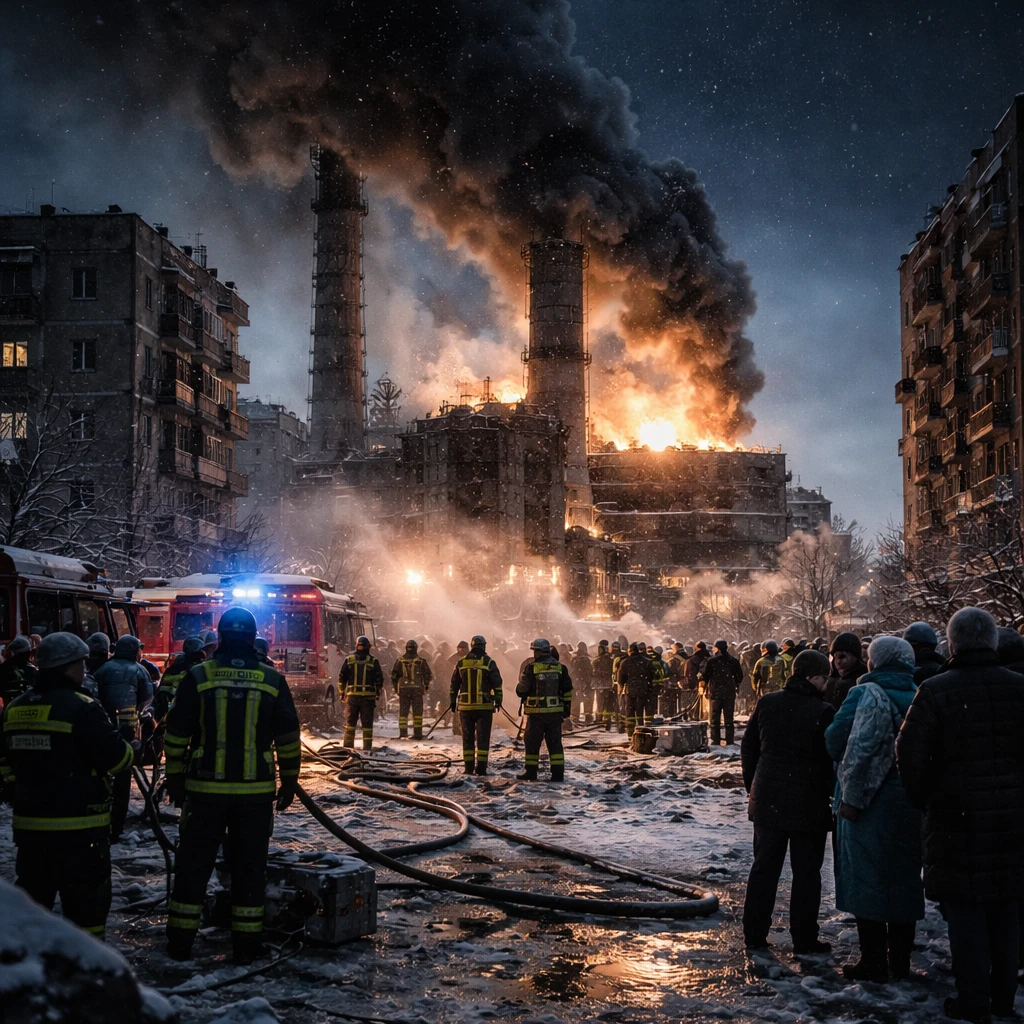
President Volodymyr Zelenskiy accused Russian forces on Tuesday of taking advantage of a temporary pause on strikes against energy targets - an initiative prompted by the United States - to build up munitions and then unleash a heavy assault on Ukraine that included hundreds of drones and an unprecedented tally of ballistic missiles.
The bombardment, which Ukrainian officials said involved 450 drones and more than 70 missiles, damaged power plants and apartment blocks and left many city residents without heating amid severely cold weather. Kyiv said at least 12 people were wounded. The strikes came one day before a second round of trilateral talks, brokered by the United States, was due to begin in Abu Dhabi.
Zelenskiy published a post on X describing the strikes as "a deliberate attack against energy infrastructure, involving a record number of ballistic missiles." He added: "The Russian army exploited the U.S. proposal to briefly halt strikes - not to support diplomacy but to stockpile missiles."
U.S. reaction and political remarks
Washington had promoted a short-lived moratorium on attacks targeting energy facilities to reduce hardship during winter and to support diplomatic efforts. U.S. President Donald Trump, speaking at the White House, said Russian President Vladimir Putin had agreed to a pause that expired on Sunday. "It was Sunday to Sunday, and it opened up and he hit them hard last night," Trump told reporters. "He kept his word on that ... we’ll take anything, because it’s really, really cold over there. But it was on Sunday, and he went from Sunday to Sunday." When asked whether he was disappointed, Trump said: "I want him to end the war."
Human toll and infrastructure damage
Authorities reported that at least 12 people were wounded in the wave of attacks. An early evening strike in Zaporizhzhia killed two 18-year-olds and injured nine others, according to officials. Kyiv Deputy Prime Minister Oleksiy Kuleba said 1,142 apartment buildings in the capital remained without heating. In Kharkiv, officials said about 270,000 residents were living in apartments without heat.
Kharkiv’s mayor, Ihor Terekhov, wrote on Telegram that the aim appeared to be "to cause maximum destruction and leave the city without heat in severe cold," and reported that a thermal plant in the city had been badly damaged. Energy Minister Denys Shmyhal said a power plant in Kyiv’s eastern suburbs had also been seriously damaged, and that officials were considering how to reallocate resources to restore heating.
The strikes occurred as temperatures hovered around -20 Celsius (-4 Fahrenheit), and much of Ukraine was enduring a fresh wave of cold after what experts described as the coldest January in six years. Residents described the emergency in personal terms: Kyiv resident Natalia Hlobenko, 35, recounted rushing to cover her 11-year-old son before an explosion sent shards of glass through her apartment. She asked through tears, "Where is this ceasefire?" and added, "Honestly, how much can we take?"
Negotiations and diplomatic tension
The new strikes coincided with the second round of U.S.-brokered trilateral talks scheduled in Abu Dhabi for Wednesday and Thursday. The first round of talks in late January produced no progress on territorial questions. Moscow had demanded that Kyiv cede additional land in eastern Ukraine, a demand Kyiv has rejected.
Zelenskiy said the work of Ukrainian negotiators would be "adjusted accordingly" after the attack, without providing details. He also said Ukraine would approach Washington to discuss further consequences for Russia. In his nightly video address he stated: "We expect a response from the United States to the Russian strikes. It was America’s proposal to stop strikes on energy infrastructure during diplomatic efforts and the cold winter period." He added that Ukraine had been expected to make concessions, but that it was also Russia’s role to make concessions, primarily "to stop the aggression." Zelenskiy asked: "If the United States and Europe did not have the power to stop Russian strikes, then who will believe there is the power to guarantee that the war will not reignite again?"
Ukraine’s lead negotiator said Ukrainian officials would first hold bilateral talks with U.S. officials in Abu Dhabi to discuss U.S. security guarantees for any peace agreement and a post-war reconstruction package, before engaging in a trilateral session that would include Russian negotiators.
Dispute over the moratorium
Both sides had said the previous week that they were halting strikes on each other’s energy infrastructure, but they disagreed on how long the moratorium would last. The Kremlin said the pause expired on Sunday, while Kyiv maintained it should have remained in effect until Friday.
The disputed timeframe for the moratorium and the subsequent wave of attacks have heightened pressure on Ukraine to reach a peace deal even as Russian strikes on the energy system appear aimed at compelling Ukrainian acceptance by worsening conditions on the home front.
Territory remains sticking point
Territorial concessions remain the principal obstacle in talks. Moscow is demanding control of the remaining 20% of the Donetsk region that it has not been able to take since the 2022 invasion; Kyiv rejects yielding those areas. Both sides have blamed one another for the failure to reach a deal so far.
For now, Ukraine is coping with the immediate impact of the strikes: gutted energy infrastructure, disrupted heating for tens of thousands of households, and an intensification of diplomatic urgency as negotiators prepare to reconvene in Abu Dhabi.
Context for readers
The sequence of events outlined above reflects an escalation that combines military strikes on civilian energy systems with simultaneous diplomatic engagement, creating acute humanitarian challenges during extreme winter cold and complicating negotiations that remain deadlocked over territorial demands.