
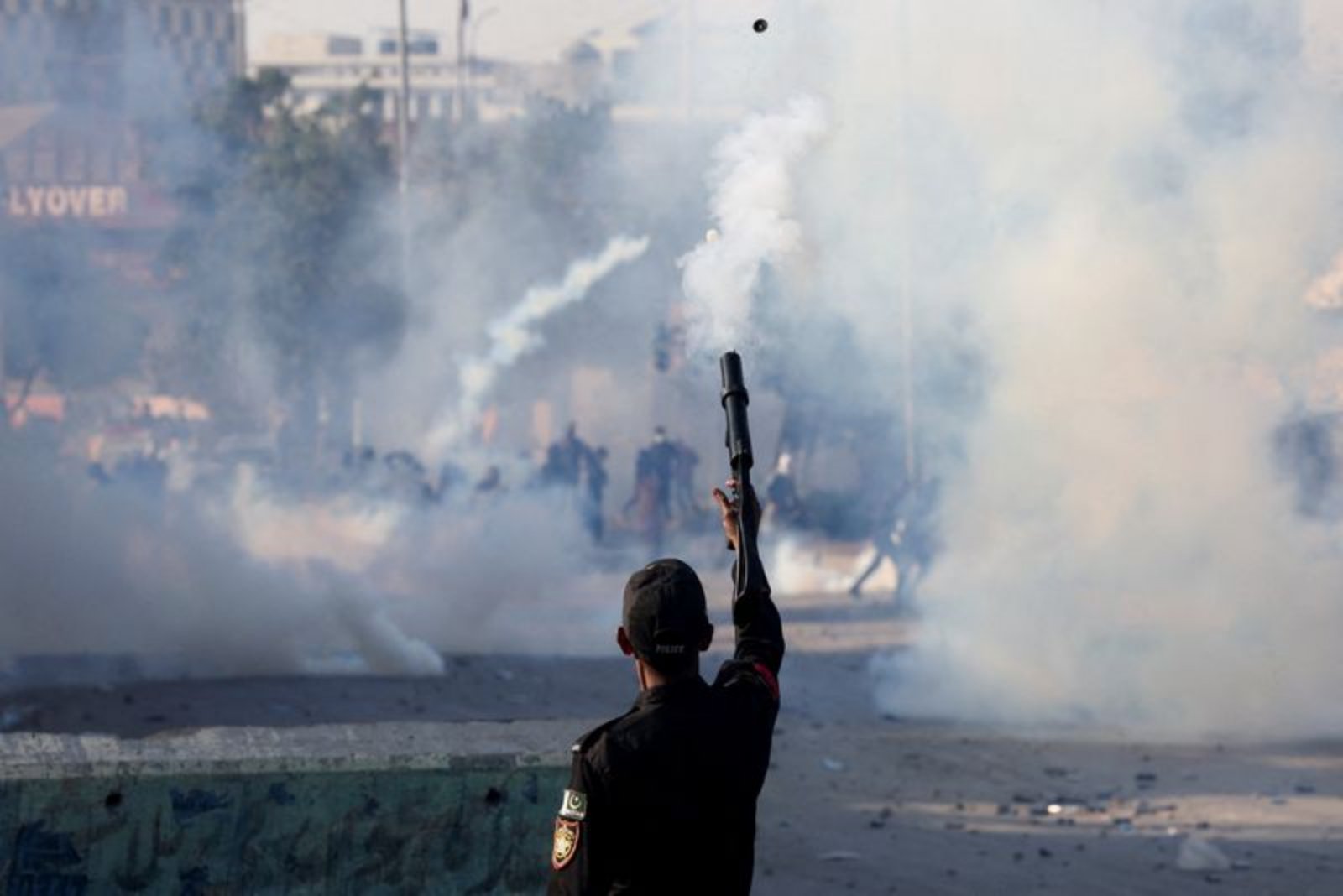
Demonstrations sparked by the U.S.-Israeli bombing campaign in Iran spread to multiple countries on Sunday, producing deadly violence in Pakistan and confrontations with security forces in Iraq, while Iranian exiles in Western cities celebrated the reported death of Iran's Supreme Leader Ayatollah Ali Khamenei.
Authorities say at least 23 people were killed in Pakistan during protests, with fatalities reported in three distinct locations: 10 in the southern port city of Karachi, 11 in the northern city of Skardu where a U.N. office was set ablaze, and two in the capital Islamabad.
In Karachi, demonstrators gathered at the U.S. consulate and chanted slogans including "Death to America! Death to Israel!" Witnesses reported gunfire and the use of tear gas in nearby streets. Local government spokesman Sukhdev Assardas Hemnani said consulate security staff opened fire after a crowd breached the outer wall. He added that demonstrators set a vehicle on fire outside the main gate and clashed with police.
"We are in constant touch with consulate officials. They are all safe," Hemnani said.
Police reported 34 people injured in the unrest across Pakistan, and Karachi's Civil Hospital said that those killed and injured there had been struck by gunfire. The provincial government of Sindh announced an inquiry into the violence.
North of Karachi, in Skardu - a city in Gilgit Baltistan where Shi'ites are the plurality - a U.N. building was set on fire during large protests. Local government spokesperson Shabbir Mir said, "A large number of protesters have gathered outside the U.N. office and burned down the building." The count of 11 deaths in Skardu was provided by a government official and an intelligence official, both speaking on condition of anonymity.
In Islamabad, police blocked roads leading to the Red Zone, the area that houses diplomatic missions, after thousands of demonstrators tried to march toward the enclave. Officials said police used tear gas and live ammunition when the crowd attempted to advance, an action that killed two people and wounded nearly 10, according to two officials who spoke on condition of anonymity.
Interior Minister Mohsin Naqvi appealed for calm and urged protesters to remain peaceful. "We stand with you," he said, adding that every Pakistani was as grief-stricken as the people of Iran.
Across Pakistan other cities saw demonstrations as well. In Lahore, authorities said hundreds gathered outside the U.S. consulate with some small clashes between police and protesters and the use of tear gas by police to disperse them. Protesters carried black flags and chanted anti-American and anti-Israel slogans.
The U.S. Embassy in Islamabad posted on social media that it was monitoring reports of demonstrations and advised U.S. citizens to take basic security precautions. Officials at the consulate in Karachi and the embassy in Islamabad did not provide additional comment when contacted.
In Baghdad, Iraq's security forces moved to break up a large pro-Iranian demonstration outside the Green Zone diplomatic compound, firing tear gas and using stun grenades to disperse the crowd gathered near the U.S. embassy.
Elsewhere where Iran retains influence, protests also occurred. In Kano, Nigeria, thousands demonstrating peacefully carried Iranian flags and portraits of Iran's Supreme Leader.
In contrast to the unrest in Pakistan and Iraq, Western cities with substantial populations of Iranian exiles saw scenes of celebration. In Paris, thousands gathered in jubilant crowds holding flags associated with Iran's pre-revolutionary monarchy, some carrying red roses and bottles of champagne. Portraits of relatives who died under Iran's clerical rule were on display, and some demonstrators waved Israeli, American and French flags.
In Lisbon, exiled Iranians assembled outside the Iranian embassy and described extended celebrations. "We had a party last night, up to 3 a.m. We danced, we chanted, we sang and sang, and that was really amazing," said Maximilien Jazani, 57. He added that Iranians "want to go to vote and to choose the kind of government they want."
The events underscore a sharp divide in global reactions to the strikes: violent confrontations and deadly clashes in countries with significant Shi'ite populations such as Pakistan and Iraq, and public rejoicing among exiled Iranians in Western capitals. Authorities in affected areas are continuing to probe the incidents and monitor security risks as demonstrations evolve.