
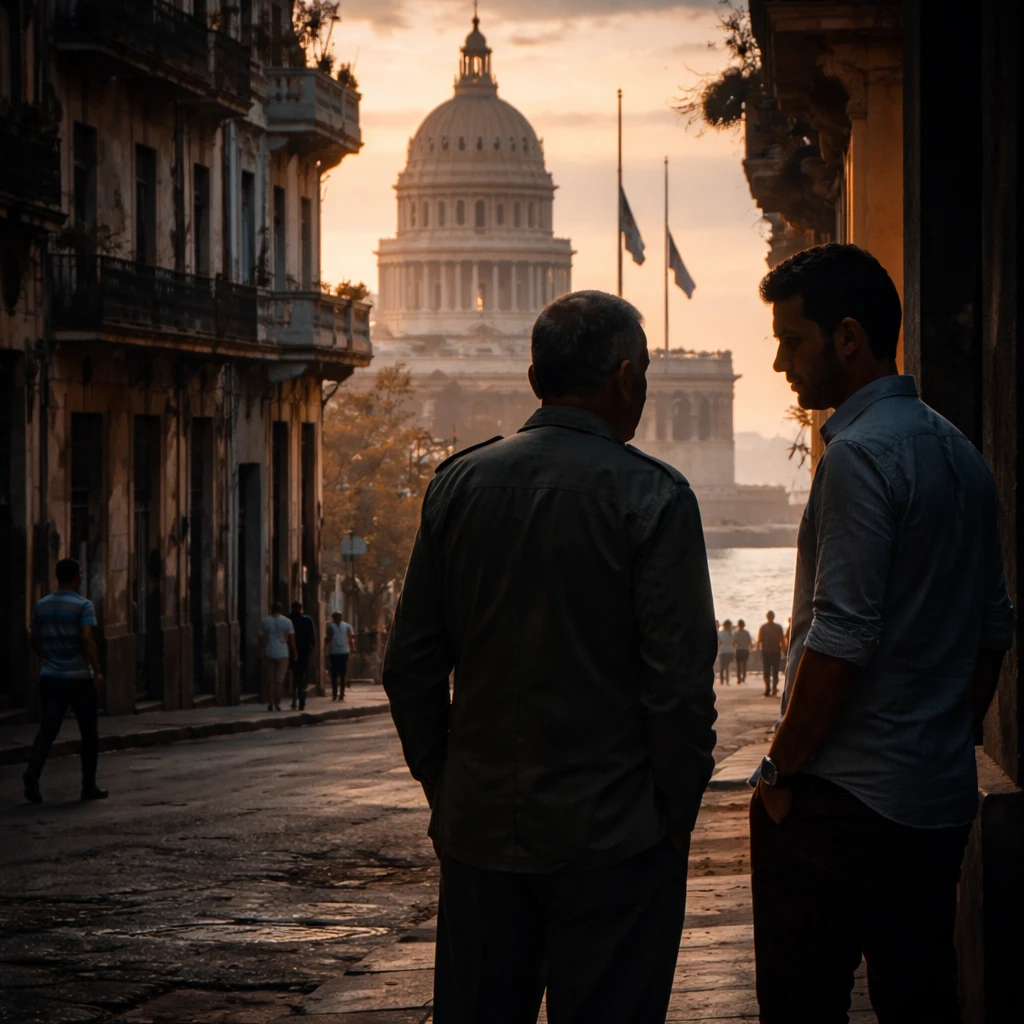
U.S. statements claiming high-level engagement with Cuban representatives have set off a debate over who in Havana might be speaking with Washington. The Cuban government has publicly denied that formal negotiations are taking place, but has not directly refuted press reports identifying Raul Guillermo Rodriguez Castro - the grandson of former Cuban President Raul Castro - as a potential interlocutor.
The question of who is speaking for Cuba is important at a time when U.S. policy toward the island has tightened. Washington has imposed severe measures on the Cuban economy, including an almost complete oil blockade, and the diplomatic landscape shifted further after U.S. forces captured Venezuelan President Nicolas Maduro on January 3, removing a significant Cuban ally from power.
Raul Castro's continuing role in Cuban affairs looms large in any assessment of possible channels to Washington. Raul Castro rose through the ranks alongside his brother Fidel in the 1959 revolution and served for decades as a loyal defense minister. He took the presidency first on an interim basis in 2006 when Fidel fell ill and then permanently in 2008 when Fidel retired. After Fidel's death in 2016, Raul was widely viewed as the unifying figure among those committed to the revolution.
Even after stepping down as president in 2018 and relinquishing party leadership in 2021, Raul Castro has retained influence. He carries the title army general and has been described by others as continuing to guide major decisions. At President Miguel Diaz-Canel's 2018 swearing-in ceremony, Diaz-Canel said Raul Castro "will lead the most important decisions for the present and future of the nation." That influence was visible as recently as December 2025, when Raul proposed delaying the Communist Party congress indefinitely because of Cuba's economic crisis, a motion that the party's Central Committee approved unanimously.
Much of the press attention has focused on Raul Guillermo Rodriguez Castro, a 41-year-old widely known by the nickname "El Cangrejo," or "The Crab," a reference to a physical condition affecting his hand. Rodriguez Castro is commonly described as one of his grandfather's closest confidants. He served as Raul Castro's bodyguard and was frequently seen at his side during Raul's presidency, sometimes wearing the interior ministry's military uniform.
Media accounts report that Rodriguez Castro holds the rank of lieutenant colonel. The Cuban government did not immediately respond to queries about his biography or any possible role in negotiations. On February 18, Axios, citing three unnamed sources, reported that Rodriguez Castro was holding secret talks with U.S. Secretary of State Marco Rubio. Several days later, on February 26, the Miami Herald, citing unnamed sources, said that officials close to Rubio met with Rodriguez Castro on the sidelines of a regional Caribbean Community conference in St. Kitts and Nevis.
Separately, a U.S. House member told the Miami Herald that the Trump administration has been carrying out secret, high-level conversations with several individuals within Raul Castro's inner circle, characterizing them as comparable to prelude talks conducted prior to operations related to Venezuela earlier in the year.
Rodriguez Castro's family background places him at a crossroads of political and economic power. He is the son of Raul's daughter Deborah Castro Espin and the late General Luis Alberto Rodriguez Lopez-Calleja. The elder Rodriguez Lopez-Calleja was head of GAESA, the military-run conglomerate that during Raul Castro's presidency assumed control of major sectors of the Cuban economy, including hotels, banking, logistics and retail. He died in 2022 of a heart attack at age 62. Some media reports have suggested that Rodriguez Castro may have taken a role in his late father's business interests, though he has not spoken publicly or given interviews.
If Rodriguez Castro is functioning as a back channel to Washington, observers note a parallel with earlier covert diplomacy. During the Obama administration, Raul Castro's son Alejandro Castro Espin reportedly played a discreet but pivotal role in secret negotiations that signaled a significant shift in U.S.-Cuba relations. Family ties have appeared to matter in these informal conduits: neither Rodriguez Castro nor Alejandro Castro Espin held formal diplomatic posts during the periods when they were reported to be engaged in such work.
Alejandro Castro Espin, now about 60, is believed to have been sidelined after his father left office, though he may have been promoted within the Interior Ministry to one-star general. The comparison to Alejandro's previous role underscores that informal networks, rather than formal diplomatic channels, have sometimes been the vehicle for breakthroughs between Washington and Havana.
Despite the reported contacts, official Cuban statements have been categorical in denying that authorized talks are under way. At the same time, the country's leadership has not explicitly refuted all media claims about meetings involving figures close to Raul Castro.
The broader context for any such contacts is a severe economic and political strain. Cuba faces a deepening economic crisis, and the government's decision to delay a key party congress was publicly justified by those conditions. Meanwhile, U.S. measures including restrictions on fuel supplies further strain the island's already fragile economy. The removal of a major regional partner earlier in the year has diminished Havana's strategic options and may increase the value of informal contacts that could open channels for negotiation or relief.
At present the precise nature, if any, of conversations between U.S. officials and figures in Raul Castro's circle remains unresolved. Reported meetings and family connections highlight plausible pathways, but official denials and the opacity of both Havana's internal decision-making and Washington's outreach leave key questions unanswered.
Summary
U.S. officials have indicated discussions with senior Cuban figures, while Havana denies formal talks. Media reports name Raul Guillermo Rodriguez Castro, grandson of Raul Castro, as a possible interlocutor. These developments occur against a backdrop of tightened U.S. sanctions and the earlier capture of Venezuelan President Nicolas Maduro, which removed a critical Cuban ally.
Key points
- Reports tie U.S. outreach to Raul Guillermo Rodriguez Castro, a 41-year-old grandson of Raul Castro who served as his bodyguard and is said to hold a lieutenant colonel rank. Sectors impacted: political leadership and defense-affiliated enterprises.
- GAESA, the military conglomerate once led by Rodriguez Castro's late father, controls major economic sectors - hotels, banking, logistics and retail - potentially making any intermediary influential for economic discussions. Sectors impacted: tourism, finance, logistics and retail.
- U.S. policy has tightened, including an almost total oil blockade, and the capture of Venezuelan President Nicolas Maduro earlier in the year removed a key ally for Cuba, adding pressure to Havana's economic situation. Sectors impacted: energy and overall macroeconomic stability.
Risks and uncertainties
- Official contradictions - Havana denies formal talks even as media outlets report meetings - create uncertainty about the existence and scope of any negotiations. This uncertainty affects markets tied to potential sanctions relief or policy shifts, including tourism and trade.
- Heightened U.S. sanctions, notably an oil blockade, exacerbate Cuba's economic crisis and risk further destabilizing energy-dependent sectors and supply chains.
- The removal of Venezuela's leader earlier in the year reduces Cuba's external support options, increasing the island's vulnerability to U.S. pressure and raising uncertainty for sectors reliant on Venezuelan cooperation.