
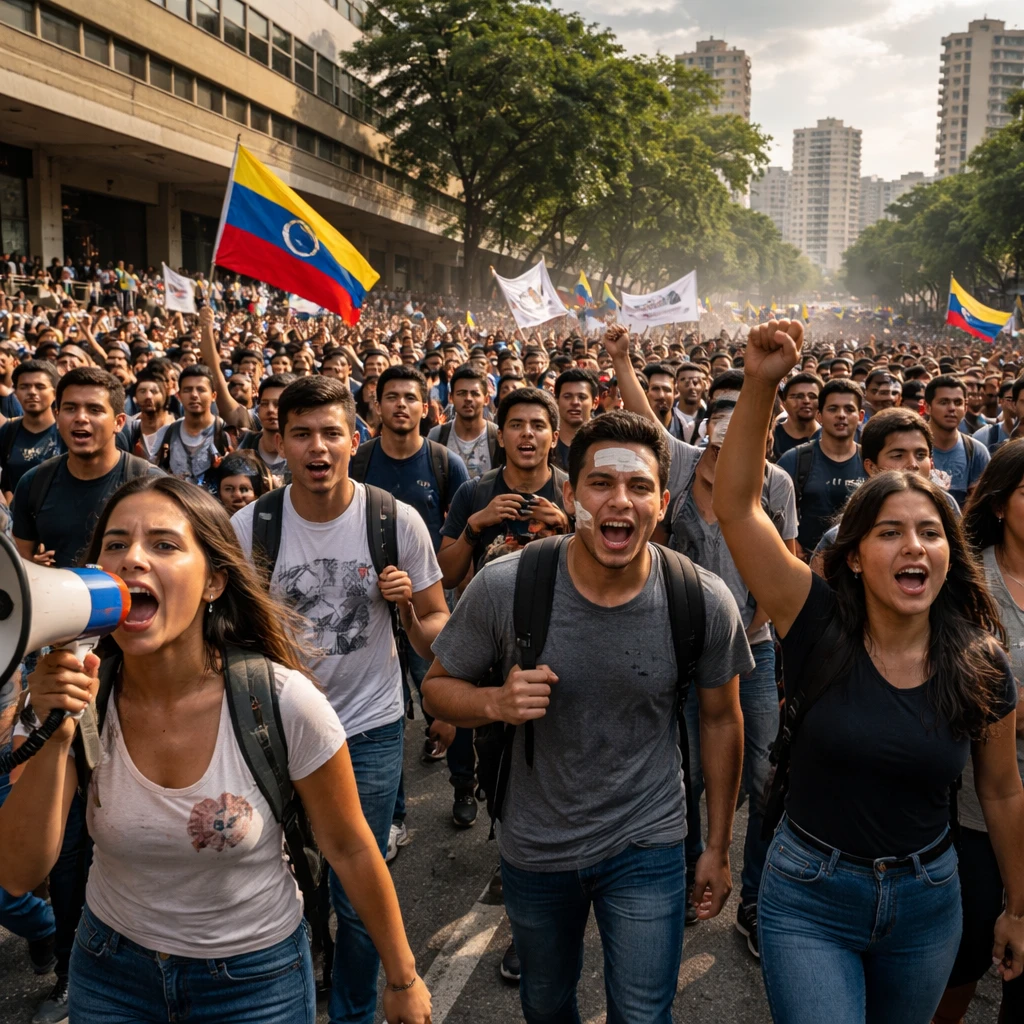
March 14 - In mid-February, a scene that had been all but unthinkable for years unfolded in Caracas. Hundreds of students from the Central University of Venezuela left the relative safety of campus and moved into a street nearby, chanting for the release of those jailed under the previous government. The decision to leave campus matters because remaining inside university grounds had historically offered a degree of protection from the repression that followed protests. Students who took demonstrations into public streets previously faced detention, beatings or worse.
Those risks were not abstract. International bodies have condemned torture of detainees in Venezuela, citing methods that include electric shocks, asphyxiation and deliberate deprivation of sleep. Against that backdrop, the mid-February march carried weight beyond its size. Paola Carrillo, 22 and a member of the student union, told the crowd: "I was born in 2003 and all I knew was fear…until today." She later added: "We are fighting for the freedom we want." The emotional response of the assembled students reflected a break with a decade-long pattern in which campus-based activism dominated because it reduced exposure to state security forces and allied violent groups.
University students once led the mass anti-government demonstrations of roughly a decade ago. Those protests gradually diminished as a wave of repression followed, including arrests of students and professors and attacks by ruling-party allied motorcycle gangs that resulted in hundreds of deaths. Economic collapse also pushed many young people out of classrooms and into the workforce. Smaller protest waves in 2019, 2024 and early 2025 were rapidly quashed. Yet the mid-February mobilization signals that a new cohort of young activists has entered the political arena.
Ten student activists from four universities across the country told reporters they now feel a tangible sense of possibility after Nicolas Maduro was removed from power by a U.S. military operation on January 3, even though elements of the government he led remain. The students ranged in age from 22 to 27 and all have only ever lived under the socialist Chavismo government that began in 1999. For many, public protest has not previously seemed viable. Carrillo, who is completing a law degree and was only a child when the last large wave of student protests took place, said: "I hadn’t done anything like this before, and I think now is the moment even though it’s frightening." She described her aim as encouraging peers to speak out so that others who feel similarly know they are not alone.
Government offices that typically field press inquiries did not respond to questions related to these student actions. Neither the communications ministry nor the attorney general’s office answered requests for comment for this report.
A broader agenda
Student demands extend well beyond the immediate call for prisoner releases. Activists say they want repeal of laws governing hate speech and terrorism that they view as instruments of repression, along with free and fair elections and what they call "reinstitutionalization" - a process intended to repair state institutions the students say have been hollowed out by the ruling party. They are also pushing for increased university budgets and higher salaries for professors, who the students say earn as little as $4 a month.
At the Central University of Venezuela, Miguelangel Suarez, 26 and president of the student federation, recounted confronting Interim President Delcy Rodriguez after she attended a campus event in January. Suarez said he told fellow students: "Look, I’m going to confront Delcy Rodriguez." About 20 others stood up to join him. He characterized the group’s willingness to take that step as evidence of a changed paradigm since January 3.
The encounter was notable because Rodriguez, a 56-year-old lawyer and graduate of the Central University, rarely takes unscripted public questions. She primarily appears at pro-government functions. Suarez said Rodriguez told the group they were preventing her from speaking. He responded that the students remained open to dialogue. "As a graduate, and as someone with such important responsibilities, she should come and talk with us about the many problems facing universities," Suarez said. Suarez is scheduled to graduate in December with a degree in political and administrative studies.
Political alignment and voting potential
Although the students criticize the government, many are not formally aligned with opposition parties and have not yet mobilized as part of any electoral effort promised by the United States. Carlos Melendez, a sociologist and director of the non-governmental Observatory of Universities, estimates that about 1.3 million students are eligible to vote in a country of roughly 28 million. He said the current wave of activism is emblematic of students who want to both pursue academic study and play a role in the nation’s political direction. Melendez said their participation is a response to government policies rather than party indoctrination, and characterized their aim as pushing for democratic restoration.
Reactions to the removal of Maduro
Across campuses, students said they felt relief that Maduro was no longer in power but also expressed reservations about how his ouster took place. Maikel Carracedo, 27, a law student at the University of Zulia in Maracaibo, said he woke to a phone call informing him of a U.S. operation in Caracas. He told reporters that his first reaction was to brew a cup of coffee, describing it as "My first coffee in freedom."
Even where jubilation existed, many young people voiced disappointment that the change did not come through a domestic, democratic process. "We truly hoped that change would come in a much more democratic, peaceful way," Carracedo said. "Nobody wants their country to be bombed or attacked, but that’s what happened. Most people weren’t injured, it was surgical. And I’m genuinely glad because the dictator’s departure was quite significant."
Carrillo echoed that sentiment, saying that many young Venezuelans would have preferred a different path to transition. "Deep down there is frustration that it couldn’t be done by us and that the situation, the circumstances, the regime, led us to this point where someone else had to do it for us," she said. She also criticized what she called indirect administration by a third country over Venezuela and its resources.
In public statements since Maduro’s removal, U.S. President Donald Trump has praised Delcy Rodriguez for stabilizing the country and for steps to open Venezuela to oil and mining interests. Maduro denied allegations that he presided over a dictatorship and had claimed he was fairly elected to a third term in 2024, an assertion rejected by opposition groups and international observers who said an opposition coalition candidate won that election.
Personal consequences of detention
For some students, the issue of detained peers is deeply personal. Jose Castellanos, 22, an economics student at Lisandro Alvarado Central Western University in Lara state, was detained in October 2025 and held for nearly four months on charges of terrorism, inciting hate and treason which he denies. Authorities said he had hung a banner reading "Freedom… it’s happening" on a university building. Castellanos was arrested along with his brother, a communications student and reporter, and their mother. All three have since been released.
Speaking at a march in Barquisimeto in February, Castellanos said: "Being in prison made me mature. It gave me more courage and strength to fight for the country’s freedom, for democracy." He added that students would continue demonstrating peacefully, saying: "We will continue peacefully in the streets, with the truth on our side, demanding our rights as Venezuelans."
Student federation leader Miguelangel Suarez said that at least two Central University of Venezuela students and two professors were released from detention in February, including Jesus Armas, a professor, human rights activist and opposition member arrested in December 2024 on terrorism charges he denies.
From fear to greater openness
Several students described a sense of personal transition, moving from uncertainty and fear to a feeling of newfound freedom to speak. Luigi Lombardo, 26 and a social sciences education student at the University of Carabobo, said Maduro’s capture marked "the end for us of a long and painful era." Lombardo emphasized tangible university concerns that students now feel freer to raise publicly - shortages of transportation funding, the need for increases in student grants and the push for decent salaries for professors. He said there is now space to register discontent and to seek reconciliation.
Across institutions and regions, student leaders appear determined to press for a broad agenda that includes immediate humanitarian measures such as releases of detainees and longer term structural reforms to university funding and national governance. Their willingness to move demonstrations from campus into public spaces signals both a break with past constraints and a readiness to leverage visibility in support of institutional change.
While the students voiced relief at Maduro’s departure, they also underscored that many Venezuelans wish the change had come through domestic, democratic processes rather than military intervention. That ambivalence coexists with an active political posture centered on opening avenues for dialogue, greater transparency and what students describe as reinstitutionalization of public life.
Whether this renewed student activism translates into sustained civic participation, political influence at the ballot box, or tangible improvements in university funding and salaries remains uncertain. For now, students across Venezuela are visibly reclaiming streets and campuses that for years have been defined by fear.