
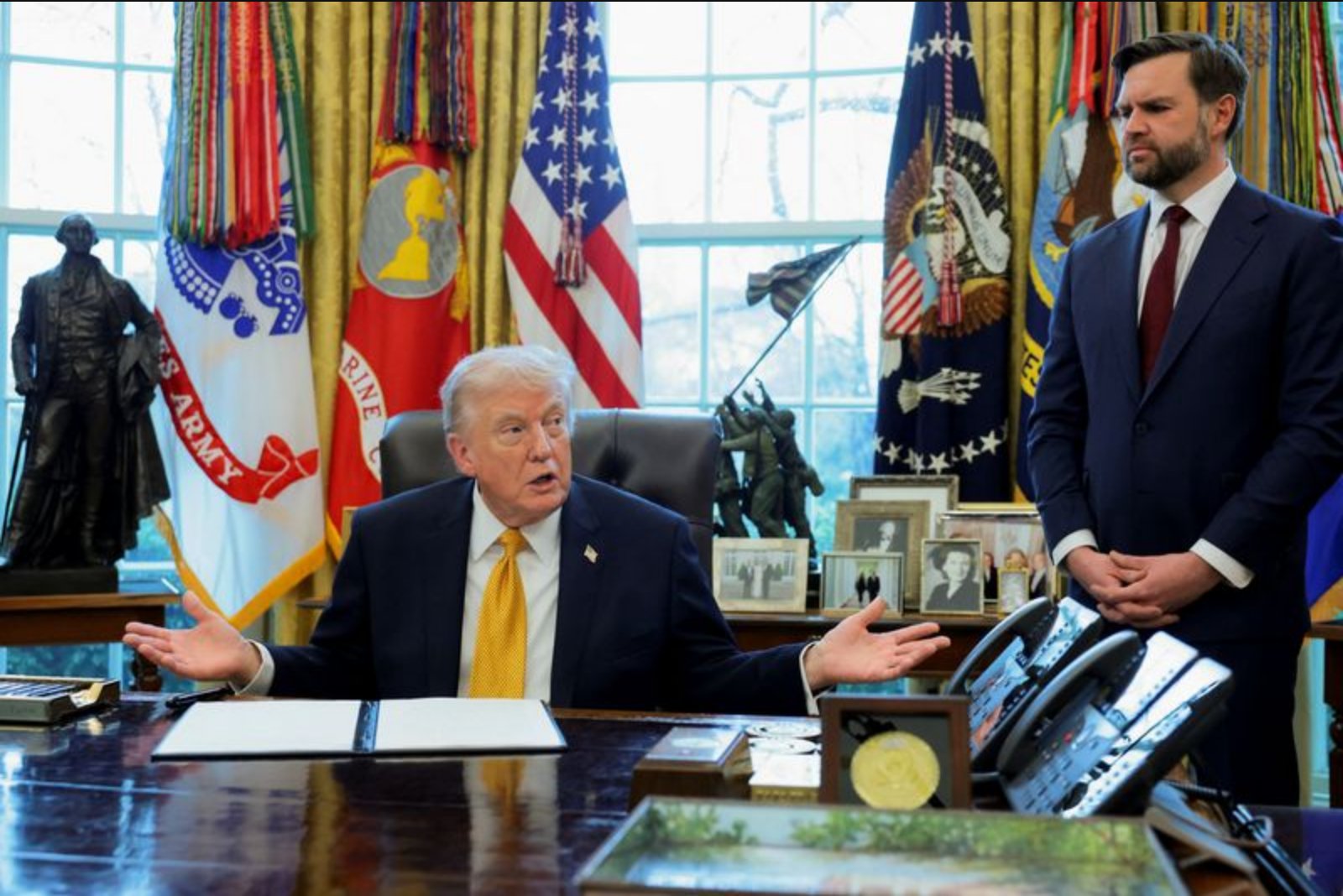
Vice President JD Vance publicly affirmed his support for President Donald Trump’s approach to the war in Iran on Monday, saying he trusts the president to prevent the repetition of past errors. His remarks, delivered while standing alongside Trump at an Oval Office event, were framed in part to counter questions about whether Vance’s known anti-war and isolationist instincts place him at variance with the president.
Since the conflict began on February 28, Vance had not offered an unambiguous public endorsement. That absence of a clear statement fueled speculation about a potential policy split, particularly after Mr. Trump recently described Vance as "philosophically a little bit different" and suggested he was "maybe less enthusiastic" about attacking Iran. Reporters pressed Vance on Monday, asking if he was "onboard" with the war and whether he had any "hesitation."
Vance responded by reiterating a shared principle with the president that Iran should not obtain a nuclear weapon, and by stressing his confidence in Trump’s judgment. "I think one big difference is...we have a smart president whereas in the past, we’ve had dumb presidents and I trust President Trump to get the job done, to do a good job for the American people, and to make sure that the mistakes of the past are not repeated," Vance said.
The vice president’s statement came against the backdrop of his previously stated skepticism about U.S. military interventions. Vance, who served in the U.S. Marine Corps roughly two decades ago, has long been identified with anti-war and isolationist views. He was once a self-described "never-Trumper," and in an opinion piece published in the Wall Street Journal in early 2023 he wrote that one of Mr. Trump’s strongest foreign-policy outcomes during his first term from 2017 to 2021 was that he did not start new wars.
Vance has also publicly criticized the United States sending "billions of dollars worth of weapons" to aid Ukraine in its defense against Russia’s invasion, reflecting his broader caution about prolonged foreign engagements and large-scale military assistance.
What are the best investment opportunities in 2026? The original reporting included a promotional passage about data-driven investing and an institutional-grade product, noting that better data can help investors identify opportunities more reliably. That passage asked readers to consider tools that combine detailed data with AI-powered insights to inform investment decisions and suggested using such tools to evaluate 2026 opportunities.
The vice president’s remarks on Monday were thus an attempt to both affirm alignment with the president’s central objective of preventing an Iranian nuclear weapon and to reduce public attention on any perceived philosophical distance between them.