
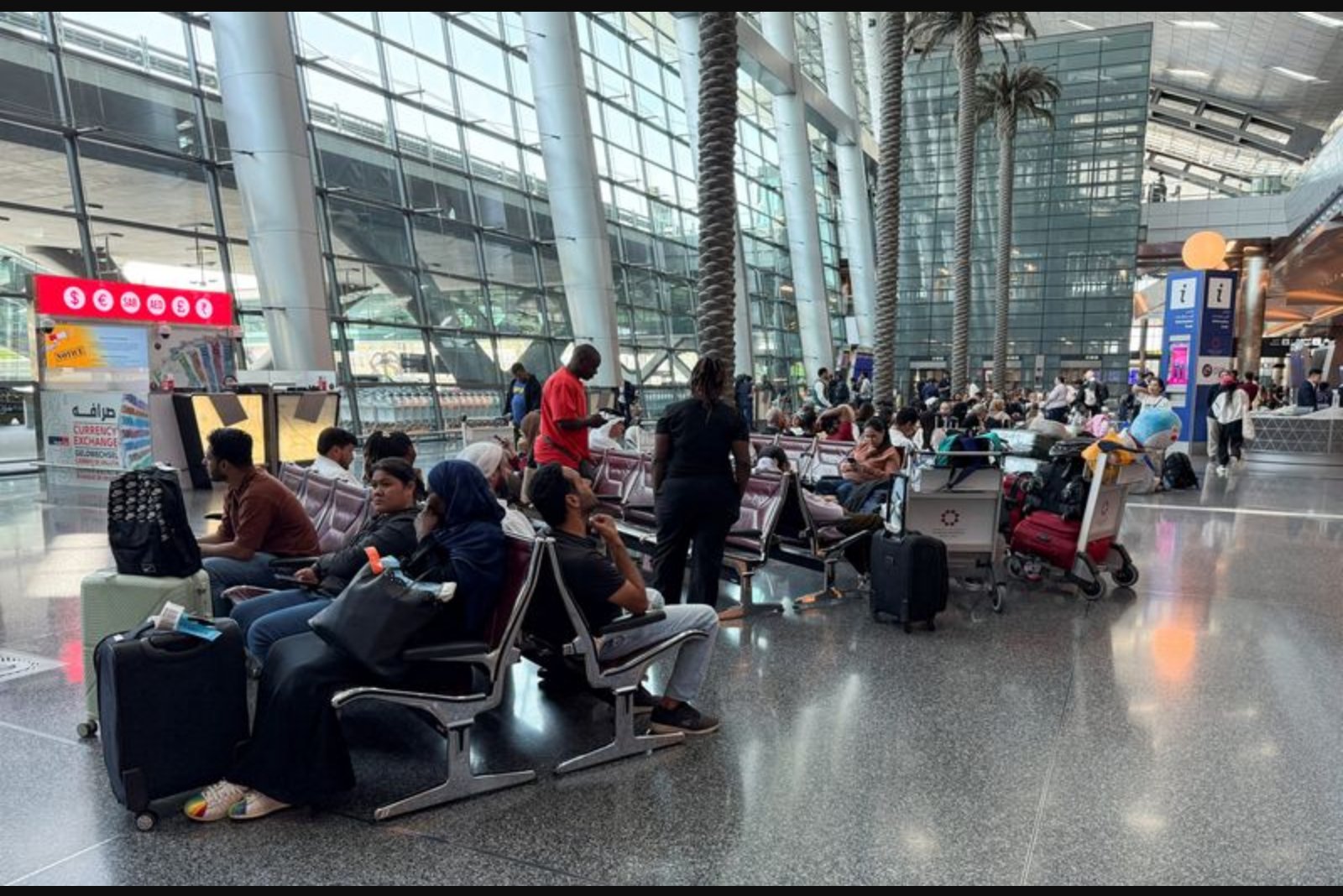
The U.S. Department of State on Monday urged U.S. citizens to depart immediately from over a dozen countries in the Middle East, directing them to use available commercial transportation "due to safety risks," Mora Namdar, the department's assistant secretary for consular affairs, said.
Monday's advisory updated prior travel guidance and covers Bahrain, Egypt, Iran, Iraq, Israel, the West Bank and Gaza, Jordan, Kuwait, Lebanon, Oman, Qatar, Saudi Arabia, Syria, the United Arab Emirates and Yemen. The department had in recent days already raised travel warnings for several countries in the region to recommend against travel.
The U.S. Embassy in Amman, Jordan, announced earlier on Monday that its personnel had departed the site "due to a threat." Separately, the State Department has activated an inter-agency emergency task force to manage developments and coordinate the United States' response to the conflict, a U.S. official said.
On Saturday, the United States and Israel carried out a barrage of strikes on various targets in Iran, killing many top officials, including Supreme Leader Ayatollah Ali Khamenei. Tehran responded with its own strikes at multiple U.S. and Israel sites across the regions.
U.S. President Donald Trump said on Monday that the conflict had been projected to last four to five weeks but that it could go longer. The fighting, which launched the region into war and left scores of people dead, has been followed by a rise in energy prices as Iranian officials threatened to fire on any ship that tries to pass through the Strait of Hormuz, a crucial shipping lane for global oil flows.
In response to the jump in energy costs, U.S. Treasury Secretary Scott Bessent and Energy Secretary Chris Wright are expected on Tuesday to announce steps intended to mitigate the impact of rising prices. That plan was described by Washington's top diplomat, Marco Rubio, who said: "We anticipated this could be an issue, and Secretary Wright and Bessent will begin to roll out those steps, starting tomorrow, to mitigate, to mitigate against the impact that could have." Rubio's remarks came ahead of a briefing of congressional leaders about the strikes.
The State Department's call for immediate departures adds to a series of rapid developments across diplomatic and security channels, and it signals elevated concern for U.S. citizens and personnel in multiple countries in the region. The activation of the inter-agency task force is intended to centralize U.S. government planning and response while officials prepare measures aimed at limiting disruptions to energy markets.
Context limitations: Information on operational details of the task force, the specific mitigation steps to be announced by U.S. officials, and travel logistics for departing U.S. citizens were not provided in the advisory or by officials quoted in the advisory.