
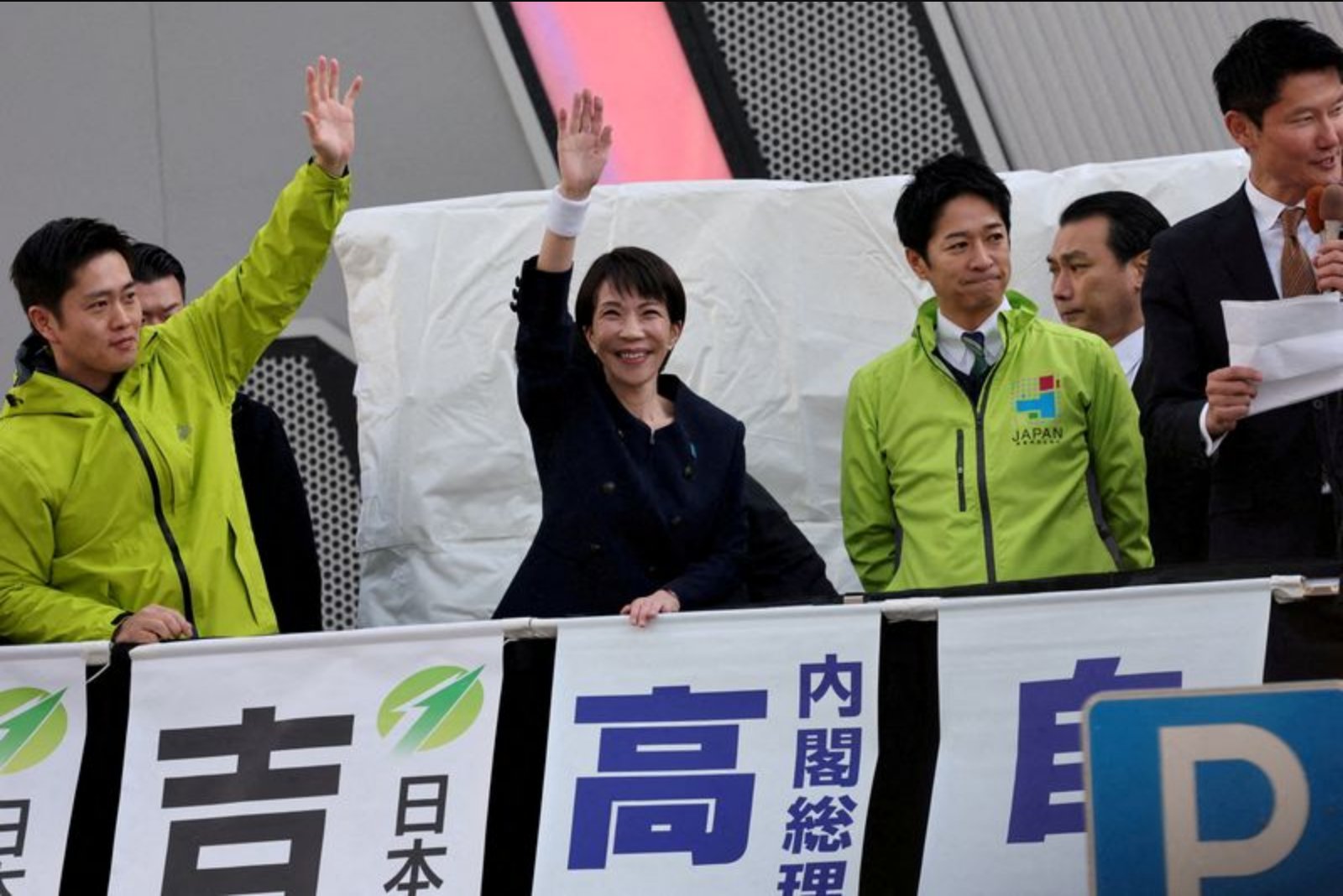
In the days surrounding Japanese Prime Minister Sanae Takaichi’s February election victory, a group of social media accounts tied to a China-linked misinformation campaign intensified criticism of her conservative positions and hardline stance toward Beijing, according to an analysis published by a U.S. national security research institute.
Researchers identified 35 accounts on X and nine channels on Tumblr that circulated allegations of corruption and framed Takaichi as illegitimate and militaristic. The accounts characterized the prime minister as a reckless, "cult-backed" leader steering Japan toward conflict, Maria Riofrio, a researcher with the Foundation for Defense of Democracy’s Center on Cyber and Technology Innovation, told the institute’s analysts.
Riofrio said those 44 accounts form part of a larger network of at least 327 X and other social media accounts that, since December or earlier, have pursued messaging favorable to Beijing’s positions or attacked Beijing’s adversaries. The network has also targeted human rights groups and attempted to influence politics in Japan, the United States, the Philippines and parts of Latin America, according to the FDD analysis.
A spokesperson for Prime Minister Takaichi said the office is aware of "suspicious foreign social media accounts" posting content related to Japan’s elections. "We consider this to be a national security threat that undermines the very foundations of democracy, including the fairness of elections and freedom of the press. We believe that countermeasures must be urgently prioritized," the spokesperson added.
Responding to the FDD analysis, Liu Pengyu, a spokesperson for the Chinese Embassy in Washington, called the research "groundless." "The Chinese government consistently opposes and combats the use of fake accounts and other tactics to manipulate public opinion or spread disinformation," Liu said in a statement to Reuters. "We urge the relevant parties to stop making unfounded accusations and smearing others based on speculation."
Riofrio said the most recent campaign was identified as a distinct cluster because of its coordinated pro-China narratives and repeated use of overlapping hashtags and message content. She said the cluster likely belongs to a long-running set of Chinese information operations that internet security analysts refer to as Spamouflage or Dragonbridge.
While direct engagement with the accounts' material is low, the messages still reach users' social media feeds and operators employ algorithmic tactics to increase visibility. One cited example accused Takaichi of belonging to a cult; that post received only two likes but was viewed more than 1,000 times, Riofrio noted.
"The activity demonstrates China has the political will to interfere in Japanese elections and internal affairs," Riofrio said, adding that the broader cluster has run similar campaigns targeting other countries, including the United States.
The Foundation for Defense of Democracies is a Washington-based nonprofit that describes its mission as "strengthening U.S. national security and reducing or eliminating threats posed by adversaries and enemies of the United States and other free nations," according to its website.
Attacks on U.S. leadership and Asia-Pacific nations
The FDD analysis reported additional activity from the network directed at U.S. President Donald Trump. Nearly half of the identified 327 accounts attacked Trump by advancing the narrative that his drug and border policies have exacerbated the United States’ fentanyl crisis, reversing gains attributed to the Biden era, while also deflecting blame away from China.
Riofrio described a coordinated messaging sequence in early February that concerned Trump and fentanyl. In that sequence, six accounts with fewer than 10 followers each generated hundreds of likes, retweets and replies and had amassed nearly 18,000 views as of February 12, she said.
One account in the network, FentanylFreeA, which Riofrio said was created in December 2025, appears to mimic the U.S. Drug Enforcement Agency’s Fentanyl Free America campaign by using a similar name and identical imagery. The account attacked both the United States and India, which it blamed as the source of fentanyl precursor drugs. Neither the White House nor the Drug Enforcement Administration responded to a request for comment, the FDD report said.
According to the analysis and statements from internet security experts cited within it, the operations known as Spamouflage or Dragonbridge have been active since at least 2017 and have repeatedly targeted audiences around the world.
A spokesperson for Google’s Threat Intelligence Group described Dragonbridge as the most prolific pro-PRC information operations operator it tracks as of early 2026, citing its "massive scale and assertive narrative agenda." The Google spokesperson said Dragonbridge continues to focus on the United States, overseas dissidents, government critics and international NGOs, and has become more assertive in the Asia-Pacific. Targets listed by the spokesperson included Japan's political leadership, Japan-Taiwan relations, Vietnam over its South China Sea activities, India and the Philippine administration.
OpenAI also reported disruption of activity in mid-October, saying it had disrupted attempts by a Chinese law enforcement official to help plan a multi-stage information attack on Takaichi.
What the analysis shows
The FDD research identifies a set of relatively small, often low-follower accounts that coordinate messaging to magnify particular narratives. Despite limited visible engagement on some posts, view counts and algorithmic placement can extend reach beyond immediate interactions. The campaigns identified by Riofrio span multiple platforms and geographies and include both criticism of political leaders and narrative-driven targeting of policy issues, such as fentanyl in the United States.
Observers quoted in the analysis say these characteristics are consistent with long-running, state-aligned information operations that have evolved in scale and geographic focus in recent years.
Key takeaways
- Dozens of X accounts and Tumblr channels targeted Japanese Prime Minister Sanae Takaichi around her February election win, framing her as illegitimate and militaristic.
- The accounts are part of a broader network of at least 327 social media accounts that have pushed pro-China narratives and targeted politics and civil society in multiple countries since December or earlier.
- The network also directed coordinated messaging at U.S. policy and leadership, including claims about President Trump and the fentanyl crisis, and has been linked by analysts to operations known as Spamouflage or Dragonbridge.