
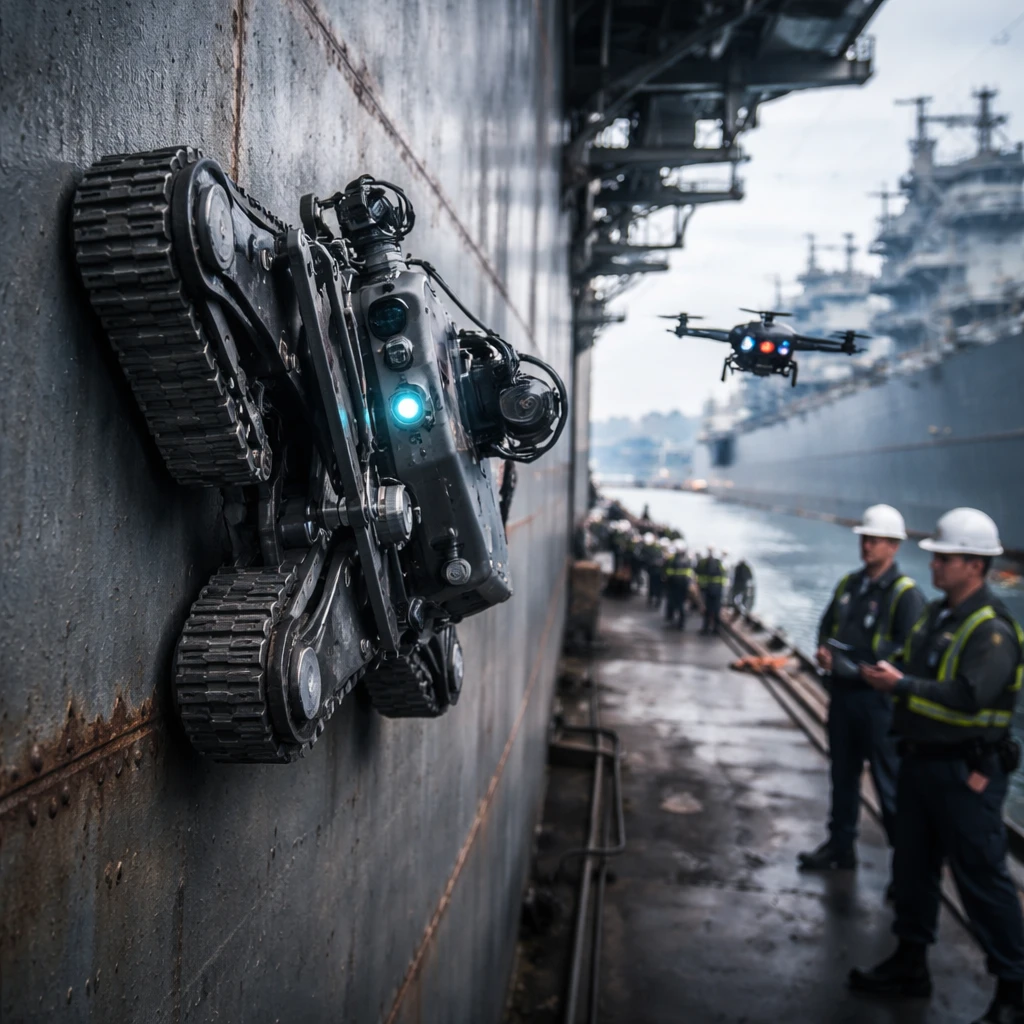
Gecko Robotics has won a multi-million dollar U.S. Navy contract to deploy robotic inspection assets and artificial intelligence across ships assigned to the Pacific Fleet, the Pittsburgh-based company said on March 17. Executives characterized the award as a first-of-its-kind maintenance contract granted to a robotics company.
Under the arrangement, Gecko will place a mix of wall-climbing robots, ballast-tank-crawling units and compact flying robots aboard a subset of Pacific Fleet vessels. The devices capture structural and materials data which are uploaded into Gecko's AI-powered software platform, Cantilever. According to the privately-held firm, the integrated system can detect repairs as much as 50 times faster and with higher accuracy compared with conventional, manual inspections.
The company pointed to an instance where a single robotic survey of a flight deck removed over three months of potential maintenance delays, underscoring the company view that robotics-driven inspections can compress ship repair timelines.
The contract represents a step up in the deployment scale of Gecko's technology. The company currently operates roughly 250 robots across a mix of commercial and government clients and plans to manufacture an additional 50 to 60 units during the current year. The agreement is structured as a five-year indefinite-delivery, indefinite-quantity contract awarded through the U.S. Navy and the General Services Administration.
Work under the program will begin on 18 ships in the Pacific Fleet, with an initial award from the contract valued at up to $54 million. Ship classes specified for inclusion in the program include destroyers, amphibious warships and littoral combat ships.
From a procurement and operations perspective, the deal couples onboard robotic hardware with shore-side analytics. The onboard units collect the raw inspection inputs - visual, structural and material-condition data - while Cantilever performs automated analysis intended to prioritize and quantify repair needs. Gecko describes the combined package as both a data-collection and decision-support capability for naval maintenance planners.
By placing robotic platforms on multiple vessel types, the program is intended to expand the Navy's options for condition-based maintenance, potentially shortening out-of-service periods and focusing repair work where it is most needed, according to company statements.