
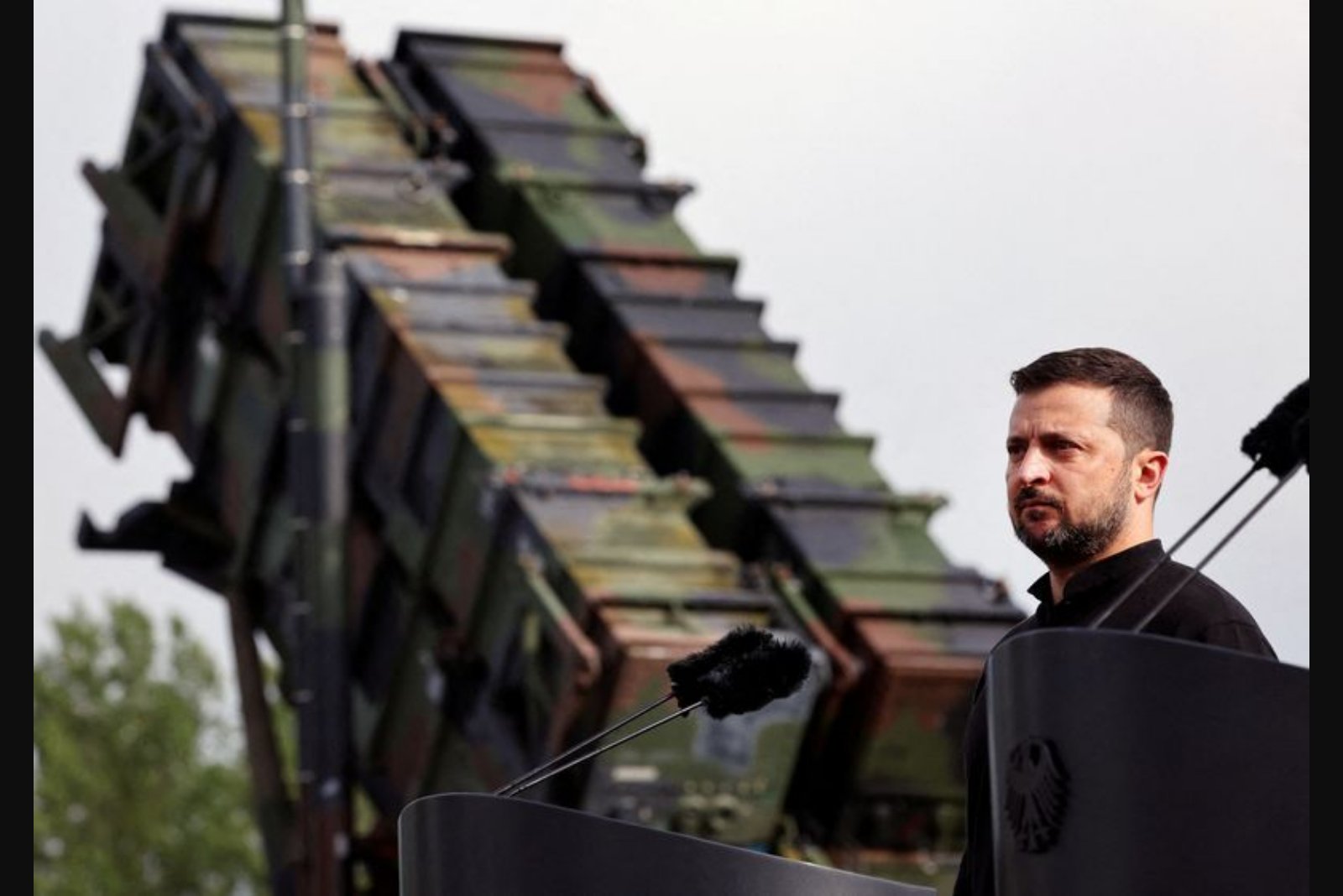
KYIV/WASHINGTON March 4 - The escalation of strikes on and by Iran has multiplied pressure on a finite supply chain for high-end air-defence interceptors, raising the prospect that Ukraine could see a material reduction in deliveries of the PAC-3 Patriot interceptors it depends on to protect energy and military infrastructure.
Since the United States and Israel began their kinetic campaign against Iran last Saturday, Iranian forces have launched hundreds of ballistic missiles and drones at Gulf countries. Most of those incoming threats have been intercepted, including with the PAC-3 Patriot missile interceptors, the same family of interceptors that form a central part of Ukraine’s layered air-defence effort.
The production profile for PAC-3s constrains options. Lockheed Martin currently produces roughly 600 PAC-3 interceptors annually - a cadence that analysts and Ukrainian officials say is insufficient to meet the combined requirements of the United States, its Gulf partners and Ukraine. That arithmetic feeds directly into strategic choices: where to allocate missiles when multiple theatres require them.
"It’s the very simple mathematics of war," said Serhii Kuzan, head of the Kyiv-based Ukrainian Security and Cooperation Center think tank, describing how limited output forces prioritisation among competing needs. Kuzan also noted that alternative systems, such as the Franco-Italian SAMP/T with broadly comparable capability, have not scaled up production fast enough to relieve reliance on PAC-3s.
Analysts with missile expertise emphasize that existing Gulf inventories reduce the looming risk of outright depletion in the near term, but do not eliminate pressure on stocks. Fabian Hoffmann, a doctoral research fellow at Oslo University who studies missile systems, said that Gulf states have been stockpiling Patriots and are therefore unlikely to run to zero immediately. Nevertheless, he added, sustained operations could force more selective employment of interceptors over time as demand persists.
The broader military context sharpens the urgency. Kyiv reports that Russia has fired more than 700 missiles in its winter campaign targeting Ukraine’s energy infrastructure, and on one occasion last month launched 32 ballistic missiles in a single night. That sustained salvoing increases Ukraine’s reliance on limited high-end interceptors to prevent catastrophic damage to electricity grids, water and other critical systems.
Most of the Patriot interceptors in Ukraine are being supplied by European nations through the Prioritised Ukraine Requirements List, or PURL, a NATO-led mechanism created last year to aggregate European purchases of U.S.-made weapons for Ukraine. A person with knowledge of the matter told Reuters that Kyiv’s allies have committed to send 37 PAC-3 missiles since their mid-February meeting. Another source said Italy has explicitly ruled out diverting air-defence capabilities away from Ukraine to support Gulf states.
Still, two European diplomats cautioned that if the Iran conflict becomes protracted, delays to PURL deliveries could worsen as the U.S. draws from its own stockpiles to meet allied needs in the Gulf. A senior U.S. defense official acknowledged that production-related delays have affected PURL supplies in the past and warned the situation could become more acute if the crisis with Iran continues for an extended period. "We can only crank out so much at a time," the official said, underlining the production capacity constraint.
Lockheed Martin is moving to scale PAC-3 production. Under an agreement announced in January, the company plans to increase output to 2,000 PAC-3s annually. However, that ramp-up timetable is not expected to address potential shortfalls this year, leaving a gap between near-term demand and manufacturing capacity.
There is a conditional pathway to easing the pressure on missiles: if U.S. and Israeli operations against Iranian launch systems and stockpiles are able to significantly degrade Iran’s ability to conduct large-scale strikes, demand for interceptors in the Gulf could fall. Mykola Bielieskov of Kyiv’s state-run National Institute for Strategic Studies expressed that possibility, noting that successful strikes against Iranian launchers and stock would reduce the likelihood of sustained high-volume attacks.
Political and diplomatic developments tied to the Iran strikes are already reshaping the Ukraine conflict’s external dynamics. Ukrainian President Volodymyr Zelenskiy warned that a prolonged and intense war involving Iran could reduce the air-defence systems available to Ukraine, and suggested Russia was preparing renewed waves of attacks on infrastructure, logistics nodes and water supplies. His statements also highlighted a divergence with Moscow, as Ukraine has publicly supported U.S. action against Iran while Russia has condemned it.
At the same time, a planned U.S.-mediated round of Ukraine peace talks, expected to convene in Abu Dhabi on Wednesday and Thursday, was not going forward as scheduled due to the attacks on Gulf states in response to the U.S. and Israeli strikes. No alternative venue has been announced. Observers in Kyiv caution that if diplomacy proceeds amid a distracted or preoccupied U.S., Moscow might seek renewed pressure on Ukraine to accept terms Kyiv considers unfavorable.
Operationally on the ground, seasonal weather dynamics present mixed implications. Spring thaw can ease pressure on civilians suffering energy shortages following Russian drone and missile strikes, while muddy terrain may slow mechanized advances. But analysts note that if Ukraine’s air-defence envelope were to degrade materially, military planners would face stark choices about prioritisation.
"Ukraine has to be able to protect not just energy infrastructure, but its industry and its military bases," said Emil Kastehelmi of Black Bird Group, reflecting the hard trade-offs that would follow a severe decline in interceptors available for defence.
Several analysts argue that Ukraine needs to expand its own offensive reach to reduce reliance on missile defence as a long-term strategy. Hoffmann said missile defence should be temporary and aimed at creating the time and space to degrade the adversary’s offensive capabilities. He recommended that Ukraine and partners invest in Ukrainian strike capabilities able to target missile production facilities deep inside Russian territory, noting that current long-range drone payloads are too small to achieve decisive effects.
Ukraine has already demonstrated some capacity for long-range strike. Last month Kyiv said it used a domestically produced FP-5 Flamingo cruise missile to strike the Votkinsk Machine Building Plant, a missile factory in Russia’s Udmurtia region roughly 1,400 km (870 miles) from the Ukrainian border. That operation illustrates the direction of military thinking emphasized by analysts who argue for bolstering offensive options.
Finally, political signals from Washington remain relevant. U.S. President Donald Trump has publicly said that bringing an end to the Ukraine war remains a high priority, and previously advocated for a quick peace deal. Proposals he has supported include the possibility of ceding territory to Russia - an outcome Ukraine has explicitly ruled out. Trump also suggested in October that the U.S. might supply long-range Tomahawk cruise missiles to Ukraine, a proposal that did not materialize amid concerns it would severely strain relations with Moscow.
For now, the convergence of increased intercept demand in the Gulf, limited near-term PAC-3 production capacity, ongoing Russian missile strikes against Ukraine and diplomatic distractions tied to the Iran conflict combine to create a period of heightened uncertainty for Kyiv’s air-defence posture. How these variables evolve in the coming days - whether through successful strikes against Iranian capabilities, accelerated production ramps, or shifting political decisions about priority deliveries - will determine whether the shortage risk becomes a sustained supply crisis or a short-lived strain.
Source limitations and analytic boundaries
This article reports the positions and figures as provided by officials and analysts cited in public statements and briefings. Where sources were described generally in original briefings - for example, as "a source with knowledge of the matter" - those characterisations are preserved here rather than expanded upon.