
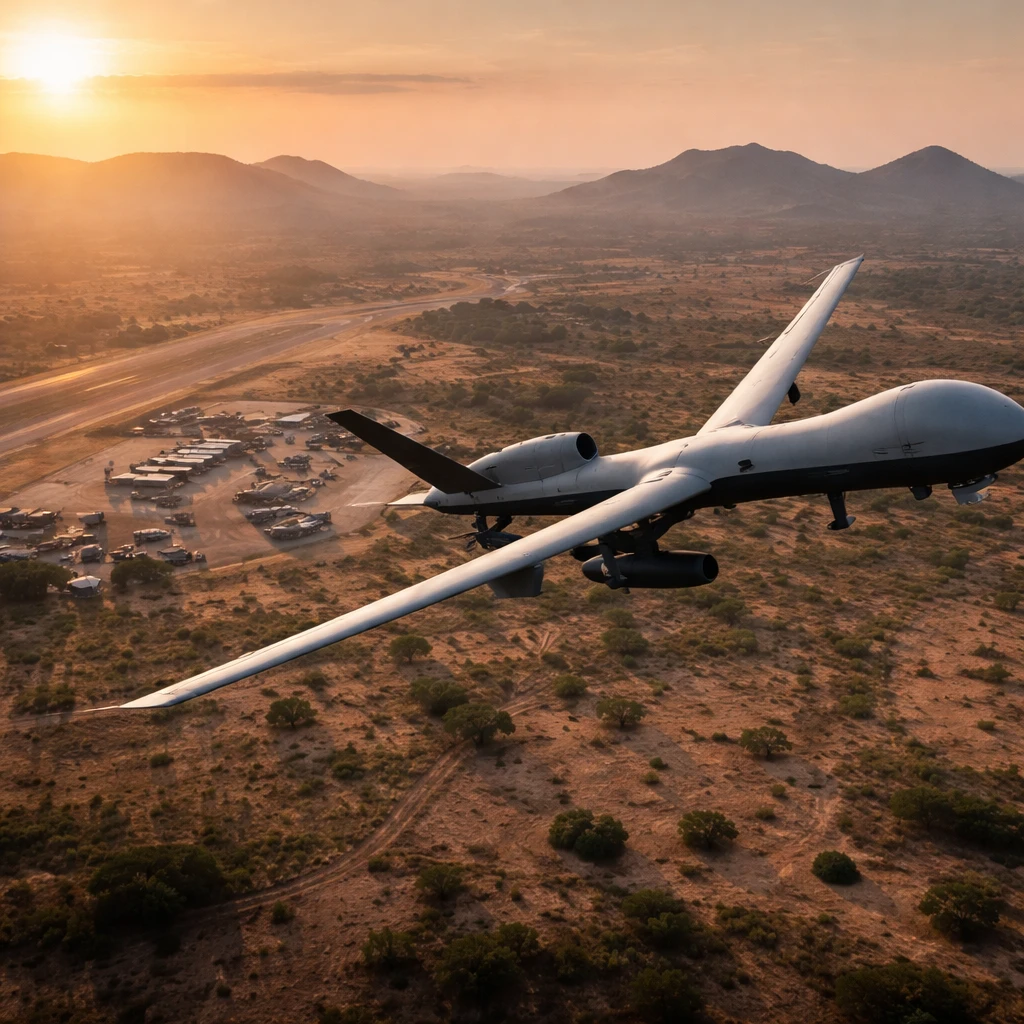
The United States has flown multiple MQ-9 drones into Nigeria and stationed about 200 troops in the country to provide intelligence collection and training assistance to Nigerian forces confronting Islamist militants in the north, U.S. and Nigerian officials said.
Both sets of officials emphasized that U.S. personnel are not embedded within Nigerian frontline units and that the MQ-9s are being employed for intelligence, surveillance and reconnaissance rather than airstrikes. The deployment follows U.S. airstrikes targeting militants in northwest Nigeria in late 2025 and signals an increased U.S. presence in efforts to address Islamic State and al Qaeda-linked insurgencies spreading in parts of West Africa.
A U.S. defence official said the drones and personnel were placed in-country at Nigeria’s request to support intelligence collection. "We see this as a shared security threat," the official said, describing the mission as focused on gathering actionable information rather than conducting offensive strikes.
Major General Samaila Uba, director of defence information at Nigeria’s Defence Headquarters, confirmed that U.S. assets are operating from Bauchi airfield in the northeast. He said the deployment builds on a recently established U.S.-Nigeria intelligence fusion cell that "continues to deliver actionable intelligence to our field commanders." He added: "Our U.S. partners remain in a strictly non-combat role, enabling operations led by Nigerian authorities."
Uba also said the timeline for how long U.S. forces and systems will remain in Nigeria will be determined by agreement between the two countries.
MQ-9 drones, sometimes referred to as Reaper drones, are capable of loitering at high altitude for more than 27 hours and can be used for both intelligence-gathering and airstrike missions. Officials from Nigeria and the U.S. would not point to specific incidents in which U.S.-provided intelligence directly led to Nigerian strikes. Nonetheless, according to Major General Uba, U.S. forces are helping Nigerian authorities to "identify, track and respond to terrorist threats."
Reports last year indicated that aircraft based in Ghana had also been conducting intelligence-gathering flights for the U.S. military over Nigeria. The new deployments complement that activity, according to the officials who spoke about the arrangement.
The U.S. increased involvement comes after the closure in 2024 of a U.S. drone base in neighbouring Niger. The facility, established with roughly $100 million in funding and housing about 1,000 troops, had been used to monitor militants across the Sahel region. Its shutdown followed a request from Niger’s ruling junta for the U.S. forces to leave, a step that was part of a broader regional rejection of western military support in parts of the Sahel.
Events in Nigeria underline the continuing threat posed by militant groups. An assault by suicide bombers on a garrison town in the northeast this week illustrated how a 17-year insurgency can still reach urban centres. At the same time militants have stepped up attacks in the northwest, near the border with Benin and Niger, where an ongoing banditry crisis has raised concerns it might evolve into another operating zone for Islamist groups.
It was not immediately clear who carried out the March 16 attack on the garrison town, and Nigeria’s military said that investigation remains in progress. Uba reiterated that both Boko Haram and ISWAP, an Islamic State-allied faction, "remain a persistent threat, adapting their tactics over time." He added: "We continue to assess that these organisations will seek opportunistic targets and may attempt to demonstrate relevance through high-visibility attacks."
The United States has had a longstanding security relationship with Nigeria, providing training and supplying weapons. U.S. forces said they carried out airstrikes in the northwest on Christmas Day to halt what the U.S. described as targeting of Christians in the region. Nigeria’s government and analysts of the conflict have rejected the notion of a coordinated anti-Christian campaign, saying such a framing oversimplifies a complex crisis.
For now, Nigerian and U.S. officials portray the current deployments as narrowly focused on intelligence and support for Nigerian-led operations, with arrangements, roles and timelines to be agreed between the partners as the security situation evolves.