
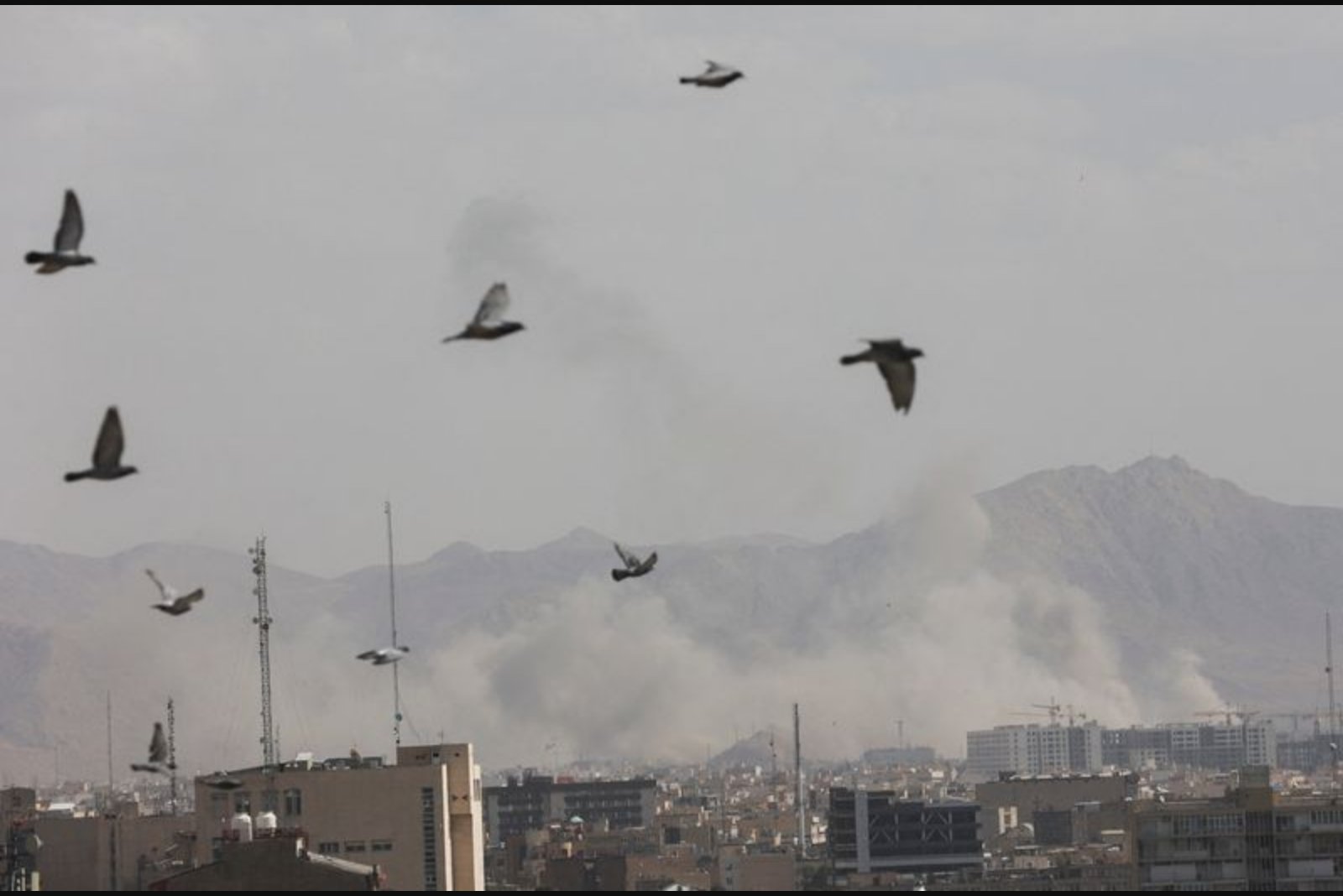
The United States and Israel carried out what officials described as their most far-reaching attacks on Iran in decades on Saturday. Leaders from Washington and Jerusalem said the operation killed Supreme Leader Ayatollah Ali Khamenei, a development later confirmed by Iranian state media.
The U.S. President, who had campaigned for re-election in part as a "peace president" and had previously expressed a preference for diplomatic solutions with Tehran, spoke publicly only briefly prior to the operation. He mentioned the issue during his State of the Union address the previous week and then expanded on the objectives of the strikes in a short video message released on Saturday. In that message he set out several principal aims that underpinned the decision to launch the attacks.
Preventing Iran from acquiring a nuclear weapon
The President reiterated a longstanding U.S. position that Iran must never obtain a nuclear weapon. In his video statement he said Iran can "never have a nuclear weapon" and asserted that last June strikes had "obliterated" Iran's nuclear program. He also stated that Tehran had attempted to rebuild elements of that program.
On Wednesday before the operation, the President claimed Iran would have had a nuclear weapon within two weeks if the United States had not struck three nuclear sites last June. The President framed those earlier strikes as a preemptive measure to stop Iran reaching a weapons capability, a line of argument that officials have previously used to justify kinetic action.
At the same time, the United Nations' International Atomic Energy Agency and the U.S. intelligence community have separately assessed that Iran ended a nuclear weapons development program in 2003. Iran denies ever having sought nuclear weapons and, as a signatory to the Non-Proliferation Treaty, maintains it has the right to enrich uranium for civilian uses. Western governments contend there is no credible civilian justification for the level and nature of enrichment Iran has undertaken, a concern the IAEA has described as serious. The statement also noted that no other country that enriched uranium to similar levels has done so without ultimately acquiring nuclear weapons.
Containing Iran's missile program
In both his State of the Union speech and his Saturday remarks, the President pointed to advances in Iran's missile program and described them as an increasing threat. He said Tehran had attempted "to continue developing long-range missiles that can now threaten our very good friends and allies in Europe, our troops stationed overseas, and could soon reach the American homeland."
The President did not provide detailed evidence to the public to support those assertions. Iranian state media, prior to the strikes, had claimed Tehran was working on a missile able to reach the United States.
Eliminating threats to Americans and allies from Iran and its proxies
The President stated the immediate purpose of the operation was "to defend the American people by eliminating imminent threats from the Iranian regime, a vicious group of very hard, terrible people." He said Iran's actions posed a direct danger to U.S. forces, overseas bases, and allied countries.
To support that characterization, he cited several episodes in Iranian history and proxy activity. His remarks included a reference to Iran's takeover of the U.S. Embassy in Tehran in 1979, which resulted in American hostages being held for 444 days; an attack by Iran-linked proxies on a U.S. Marine barracks in Beirut in 1983 that killed 241 U.S. service members; and what he described as "countless" other actions against U.S. forces and international shipping lanes in the Middle East in recent years. He also pointed to Iran's backing of Hamas, the group that launched a cross-border attack on Israel on October 7, 2023.
Punishing the treatment of protesters
The President reiterated charges he has made about the Iranian government's response to domestic protests. In his State of the Union, he cited a figure of at least 32,000 deaths among protesters over a recent period, a number he repeated in his Saturday statements. The administration acknowledged that some of those figures could not be independently verified in the public domain.
Other groups have reported differing tallies. A U.S.-based monitoring group, which tracks human rights in Iran, reported 7,007 verified deaths and had an additional 11,744 cases under review. Iranian officials released a list they said accounted for 3,117 people killed in unrest; another Iranian official had earlier said authorities had verified at least 5,000 deaths, including approximately 500 security personnel. The range of figures highlights significant discrepancies among counts presented by various parties.
Calls for regime change
Alongside the military action, the President urged the Iranian people to rise up and remove their leadership. He addressed Iranians directly, saying "the hour of your freedom is at hand" and urging them to take over their government when the opportunity presented itself. He described the operation as part of a broader effort and warned that high-intensity, precise bombing would continue "uninterrupted throughout the week or, as long as necessary to achieve our objective of PEACE THROUGHOUT THE MIDDLE EAST AND, INDEED, THE WORLD!"
The President monitored the operation from his Mar-a-Lago resort in Florida. During the afternoon on Saturday he posted that Ayatollah Ali Khamenei had been killed in the strikes. Earlier, Israel's prime minister said the Supreme Leader's compound had been destroyed, and an Israeli official told news agencies that Khamenei's body had been recovered. Iranian state media later confirmed that Khamenei had been killed in the attack.
The scope of the operation, the public framing by the U.S. President, and the reported death of Iran's Supreme Leader represent a significant escalation in a long-standing confrontation. Leaders in Washington and Tel Aviv emphasized a set of objectives tied to nuclear non-proliferation, missile containment, protection of American personnel and allies, response to human rights abuses, and support for an internal change in Iran's governance. Many of the claims and figures cited by various actors remain contested or unverified in public reports, reflecting the uncertain and rapidly evolving information environment surrounding the operation.
Key points
- The United States and Israel conducted a major military operation on Saturday that officials said killed Iran's Supreme Leader Ayatollah Ali Khamenei.
- The U.S. President outlined five main objectives for the strikes: preventing a nuclear-armed Iran, halting missile development, removing threats to Americans and allies, punishing repression of protesters, and encouraging regime change.
- Numbers and assessments cited by different parties - including timelines for Iran's nuclear capability and casualty figures from protests - vary and are contested in public reports.
Economic and market considerations
- Defense and security sectors are directly implicated by the military operation and public statements from government leaders.
- Maritime trade and shipping could be affected given references to threats against international shipping lanes.
- Diplomatic relations and regional stability concerns could influence investor sentiment and risk premia in related markets.