
Overview
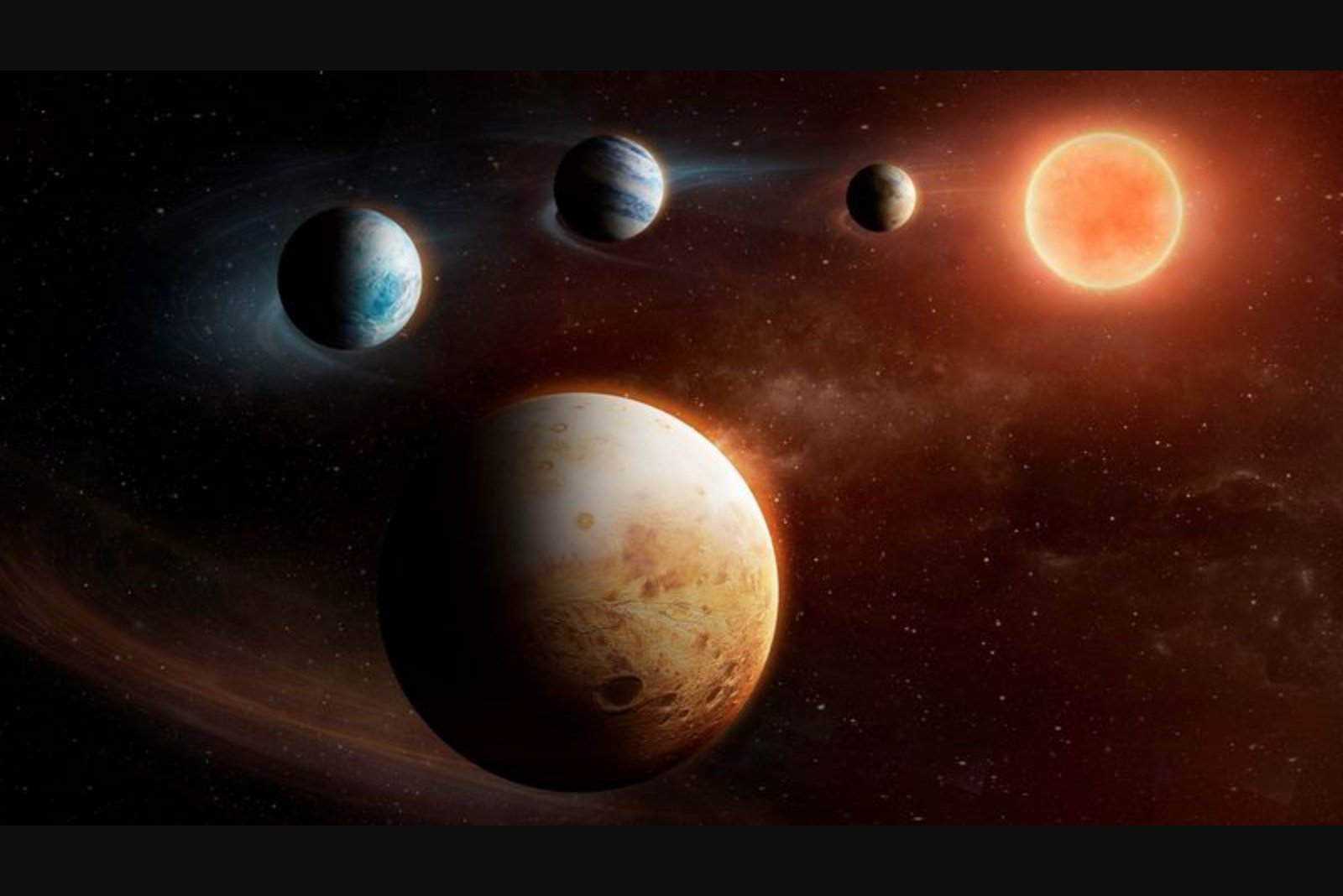
A compact planetary system observed with ESA’s Cheops space telescope presents a configuration that challenges prevailing models of how planets assemble. The host star, designated LHS 1903, is a red dwarf located about 117 light-years from Earth in the direction of the Lynx constellation. Researchers report four planets in the system: two rocky super-Earths and two gaseous mini-Neptunes. What stands out is the order of these worlds - a rocky planet at the innermost orbit, two gas-dominated planets in the middle, and a rocky outermost planet - an arrangement researchers describe as "inside-out."
Star and system properties
The star LHS 1903 is roughly half as massive as the sun and emits about 5% of the sun’s luminosity. All four planets complete their orbits much closer to their star than Mercury orbits the sun. In fact, the outermost planet circles LHS 1903 at only about 40% of Mercury’s orbital distance from the sun - consistent with compact architectures commonly seen around red dwarf stars, which are significantly less luminous than the sun.
Planet types and arrangement
Two of the planets are classified as rocky super-Earths - meaning they have compositions similar to Earth but possess masses between two and ten times that of Earth. The other two are mini-Neptunes - gaseous worlds that are larger than Earth but smaller than Neptune. The unusual element is that the sequence of planets deviates from the standard expectation that planets closer to the host star should be rocky and those farther out should be gas-rich.
Why the configuration is surprising
Standard planet-formation paradigms anticipate that the inner regions of a protoplanetary disk are too warm to retain substantial gas or ice during assembly. Close-in planets are therefore expected to be small and rocky, while planets forming farther out in colder regions have access to more gas and ices and tend to accrete thick atmospheres, producing gas-rich worlds. The LHS 1903 system subverts that sequence by hosting a rocky planet beyond two gaseous planets, a structure that researchers say challenges the classical picture.
Formation hypotheses consistent with the observations
Researchers put forward two primary explanations grounded in the available data. One is a sequential formation scenario in which the planets did not all assemble simultaneously from a single, well-populated disk of gas and dust. Instead, the planets may have formed one after another; gas that might otherwise have been available to form a thick atmosphere around the outermost planet instead was consumed by the middle planets as they assembled earlier. In that view, the outer rocky world is a "late bloomer" that formed when the local environment had become gas-poor.
The alternative consistent explanation is that the outermost planet originally acquired a substantial gaseous envelope but later lost it through a catastrophic event, such as a massive collision that stripped away its atmosphere and left a rocky core behind. The idea that giant impacts can remove atmospheres is part of the discussion because the Earth-moon system is often interpreted as the product of a similar collision.
Details on the outermost planet and habitability notes
The outermost planet in the quartet has a measured mass of 5.8 times that of Earth and an estimated equilibrium temperature of about 60 degrees Celsius (140 degrees Fahrenheit). Researchers note that 60 degrees Celsius is close to the highest temperature ever recorded on Earth and that such a temperature does not rule out habitability in principle. The team highlighted the prospect that future observations, notably with the James Webb Space Telescope, could probe the conditions of this planet and better constrain whether its environment might support life as we understand it.
Context within exoplanet discoveries
Astronomers have discovered roughly 6,100 exoplanets since the 1990s. Compact systems with planets orbiting well within the orbital distance of Mercury are typical around red dwarfs, reflecting the lower luminosity and smaller habitable zone scales of these stars. The LHS 1903 system is another example of a compact, multi-planet architecture, but it is notable because its radial ordering of compositions departs from the canonical pattern observed in our solar system and in many other systems.
Implications for research and observation
This system provides a clear case that planet formation can proceed in ways not fully captured by simple, monotonic models that tie composition strictly to orbital distance. By revealing a rocky world outside of gaseous neighbors, the observations invite more detailed modeling of sequential accretion, gas depletion timescales in disks, and the dynamical histories that might lead to late formation or atmosphere-stripping events. The team emphasized that targeted follow-up with powerful observatories could help distinguish between the formation scenarios that remain consistent with the current data.