
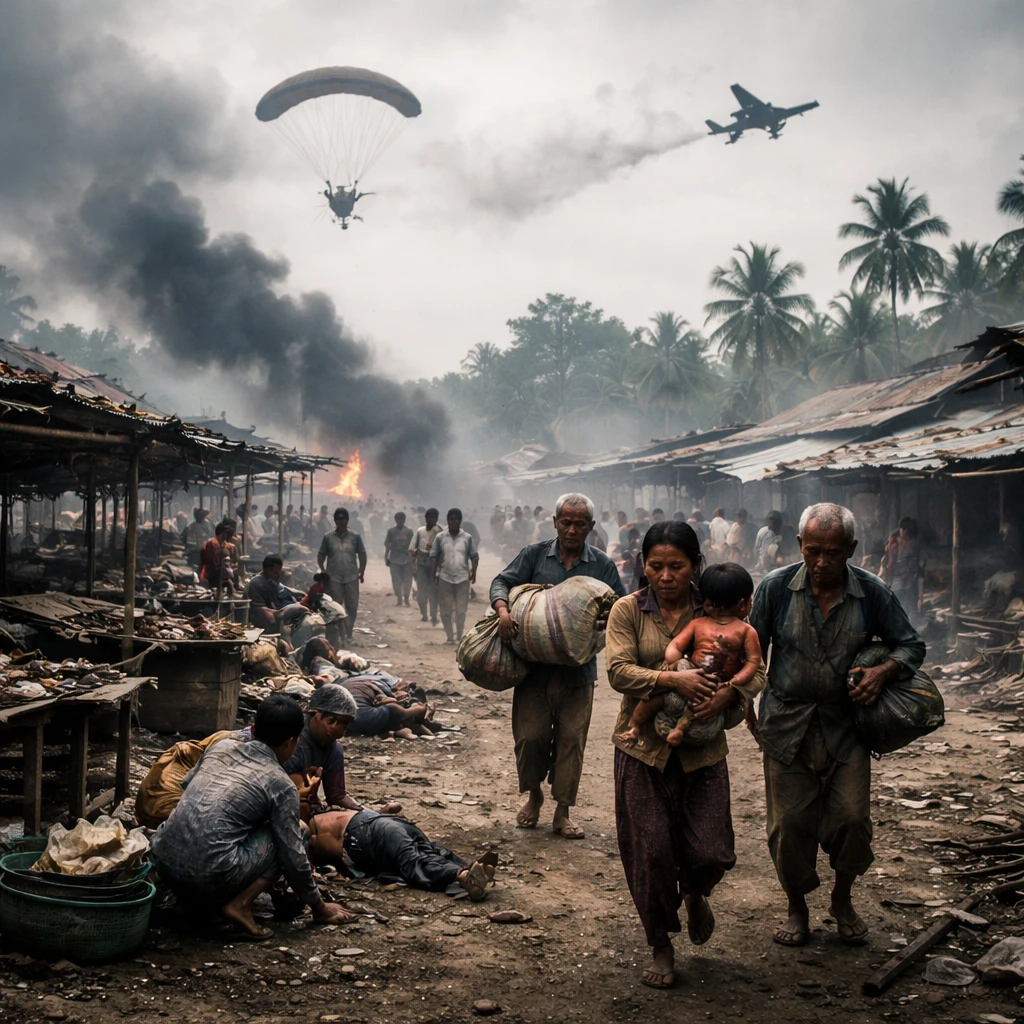
UNICEF has expressed deep concern after media and a rebel group reported that Myanmar military air operations this week struck populated areas, causing significant civilian casualties as the country's civil war intensifies.
According to reports by Myanmar Now and the Irrawaddy, paramotors dropped bombs on a village in the central Sagaing region on Monday. A day later, a fighter jet carried out an air strike in Rakhine state, about 320 km (199 miles) west of the Sagaing incident, with the two attacks together said to have killed at least two dozen people.
The Arakan Army, a rebel force engaged in fighting with the ruling junta in Rakhine, said the jet strike hit a busy village market and killed 17 civilians, including children, while injuring 14 others. Reuters was unable to independently verify these accounts, and a spokesperson for Myanmar's military government did not respond to calls seeking comment.
In a statement, UNICEF said it was "deeply alarmed" by the reports and urged all sides to uphold their obligations under international humanitarian law. The agency warned that "children and civilians are once again bearing the brunt of escalating hostilities" and added that "ongoing clashes continue to displace children and upend their access to vital services, including healthcare, education and protection."
The incidents come amid a broader surge in violence that followed the military's seizure of power in a 2021 coup. The military has been engaged in fighting with multiple armed groups across an ethnically diverse country of roughly 51 million people. United Nations estimates cited in reporting put civilian deaths at about 6,800 and the number of displaced people at 3.6 million, figures that underpin descriptions of the situation as one of Asia's worst humanitarian crises. The UN estimates also say food and aid shortages are affecting some 40% of the population.
Observers and rights groups have documented a notable expansion in the military's use of air power over the past year. The junta has employed conventional aircraft, drones and paramotors - crewed paragliders capable of carrying up to three people and dropping bombs - as part of its campaign. The military rejects accusations made by rights organisations, the UN and western governments that it is striking civilian targets such as residential areas, schools and hospitals, asserting that its actions are directed at armed groups it says are attempting to destabilise the country.
Responding to the recent reports, Khaing Thu Kha, an Arakan Army spokesperson, described the strikes as inhumane and said the deaths of civilians were deliberate rather than accidental. "Targeting and bombing civilian sites by the military is no longer an isolated occurrence ... We have seen a high frequency of deliberate attacks on civilians," Khaing Thu Kha said.
The combination of reported air strikes and the wider pattern of conflict has renewed focus on the immediate humanitarian consequences: displacement, interrupted access to healthcare and education, and constrained delivery of food and aid to large segments of the population. UNICEF's appeal for adherence to international humanitarian law highlights the acute risks facing children and non-combatants as hostilities persist.
Contextual note: Reporting on these incidents is based on accounts from local media outlets and the Arakan Army, and international agencies have highlighted the overarching humanitarian toll. Verification by independent international monitors was not reported at the time of these accounts, and official comment from the military government was not provided.