
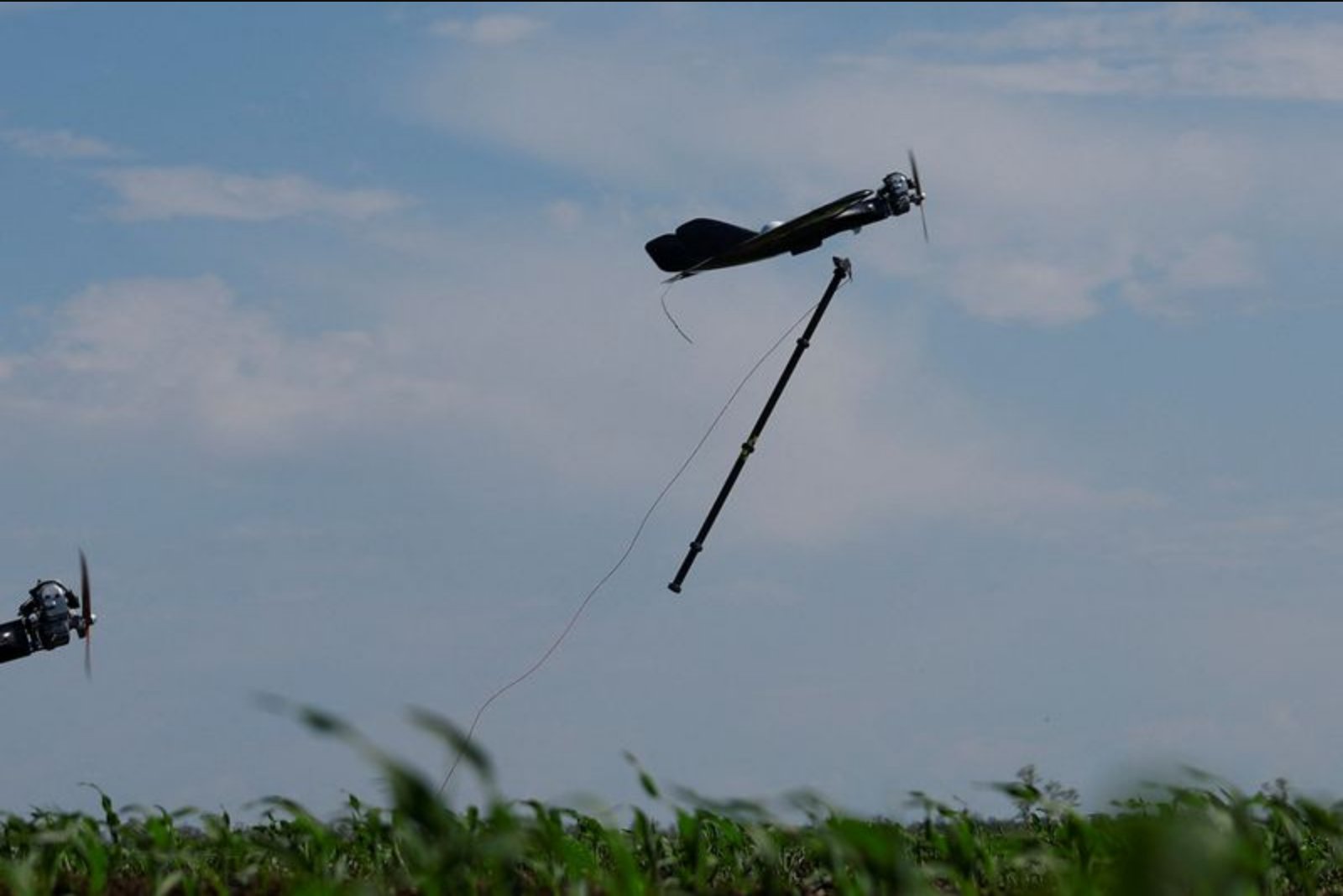
EASTERN UKRAINE, May 28 - In a corn field in eastern Ukraine, soldiers from an elite unmanned systems unit prepared and launched small, Ukrainian-built drones aimed at military targets deep in territory held by Russian forces. The unit’s commander, using the call sign "Kyt" - which translates as "whale" - described a mission profile centred on hits to bases in the field, ammunition storage sites and air-defence installations.
At the launch site, personnel unpacked drones from crates and assembled them by hand. Using a laptop, a soldier entered a flight profile for each airframe before the machine was placed onto a slingshot-style launcher. A teammate spun the propeller to life with an electric screwdriver and the drone was sent skyward toward its assigned objective.
These operations illustrate a stepped-up Ukrainian emphasis on what officials term "middle strikes" - attacks focused on targets positioned roughly 30 km to 180 km behind the front lines. Kyiv has been directing resources to these missions as part of a broader push to degrade Russian logistical chains and air-defence coverage in occupied areas.
President Volodymyr Zelenskiy has said the tempo of these strikes has quadrupled since February. Defence Minister Mykhailo Fedorov, described as a 35-year-old technology enthusiast, announced funding of an additional 5 billion hryvnias ($113 million) for the most capable middle-strike units. The minister framed the rear areas of Russian-controlled territory as increasingly vulnerable, saying that the enemy’s rear is no longer a safe haven.
"Kyt" said the field operation observed was one of hundreds of such mid-range missions. The locally produced drones, known colloquially as "Drakosha" or "little dragons," were portrayed by the commander as capable of striking across occupied parts of Ukraine and even into Russian territory, extending the depth at which Ukraine can impose costs on Russian military activity.
Open-source mapping referenced by Ukrainian analysts indicates that Russian forces captured about 50 square kilometres of territory in the current month. Since 2022, these sources estimate Russia has taken roughly 12% of Ukraine, which is presented as amounting to about one fifth of the country when including areas seized in 2014 such as Crimea and parts of eastern Ukraine.
Outside analysts note that middle strikes are affecting Russia’s ability to move personnel and materiel by targeting critical lines of transit. The Institute for the Study of War has pointed to strikes that hit arteries such as the M-14 highway - running from Rostov in Russia to Crimea and passing through Mariupol - as examples of how supply flows to the front can be disrupted.
Defence analysts caution that these operations, while consequential, are not by themselves a decisive solution to the broader conflict. Instead, they say, middle strikes are contributing to a layered effect: by degrading rear-area defences and logistics, they permit longer-range drone attacks that have damaged Russian oil infrastructure and other targets.
"Kyt" reflected on the technological contest that has marked the conflict: one side frequently gains an advantage until adversaries adapt. He warned that Russia brings extensive experience in air-defence systems and underscored the need to remain mindful of that capability. "You cannot underestimate the enemy," he said.
The exchange rate used for the defence funding announcement was $1 = 44.2940 hryvnias.