
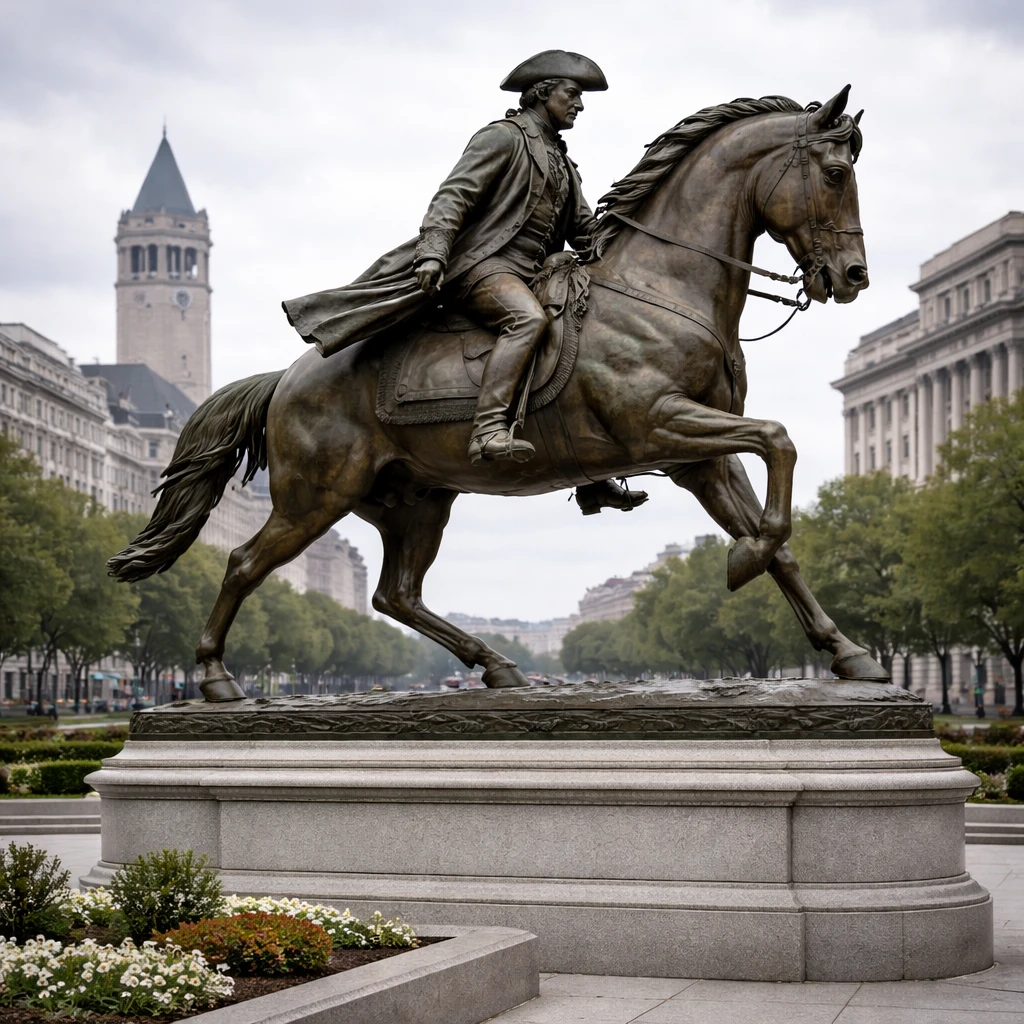
The Interior Department announced that the National Park Service will temporarily install a bronze equestrian statue of Caesar Rodney in Freedom Plaza, a federal park in downtown Washington, D.C., as part of the Trump administration's activities marking the 250th anniversary of the nation's founding.
The statue depicts Rodney, a Delaware plantation owner and a signer of the Declaration of Independence, and recalls his 1776 ride to Philadelphia to sign the document. The installation will remain in place for up to six months, the department said.
Rodney's monument was removed from its location in Wilmington, Delaware, in 2020 after 97 years on display. The removal occurred amid the racial justice protests that followed the killing of George Floyd, and officials say the bronze statue has been kept in a warehouse since being taken down.
The Interior Department's statement announcing the planned display did not mention that Rodney was an enslaver or that the statue had been previously removed in Wilmington. A department spokesperson said that presenting the statue in Washington was intended to reflect the administration's aim of "acknowledging the full breadth of our nation's history, including the story of Caesar Rodney."
The administration has described certain actions as part of a campaign against what it calls "anti-American" ideology. Those actions have included orders to dismantle slavery exhibits and to restore Confederate statues, steps that civil rights advocates warn could roll back gains achieved over recent decades.
The announcement noted Rodney's historical significance as a signer of the Declaration and the dramatic nature of his 1776 ride. It also noted that Rodney enslaved 200 people. Rodney died in 1784 after suffering from a disfiguring facial cancer, according to the information provided.
The move to reinstall contested monuments in public spaces follows other recent actions affecting controversial memorials. For example, a statue of Confederate General Albert Pike that was overturned during the Black Lives Matter protests in 2020 was reinstalled in Washington last year, the Interior Department said.
Officials said the temporary display in Freedom Plaza will be part of the broader set of commemorations planned this year. The department described the placement as a way to present historical figures and episodes in the context of the nation's 250th anniversary.
Summary
The National Park Service will temporarily place the bronze equestrian statue of Caesar Rodney in Freedom Plaza for up to six months as part of the Trump administration's 250th anniversary events. The statue, removed from Wilmington in 2020 during racial justice protests and held in storage since, depicts Rodney's 1776 ride to sign the Declaration of Independence. The Interior Department framed the display as an effort to acknowledge the full breadth of U.S. history, though its statement did not note Rodney's status as an enslaver or the prior removal.
Key points
- The Interior Department and National Park Service will install the bronze statue of Caesar Rodney in Freedom Plaza for up to six months as part of 250th anniversary commemorations.
- Rodney, a Delaware plantation owner and signer of the Declaration of Independence, enslaved 200 people; his statue was removed from Wilmington in 2020 amid racial justice protests and has been stored since.
- The administration characterizes some related actions as opposition to what it calls "anti-American" ideology, including orders to dismantle slavery exhibits and restore Confederate monuments.
Risks and uncertainties
- Potential for renewed public controversy: the statue was removed during mass racial justice protests in 2020, indicating the issue remains contentious.
- Incomplete historical framing: the Interior Department's announcement did not reference Rodney's role as an enslaver or the statue's prior removal, which may raise concerns about how history is presented.