
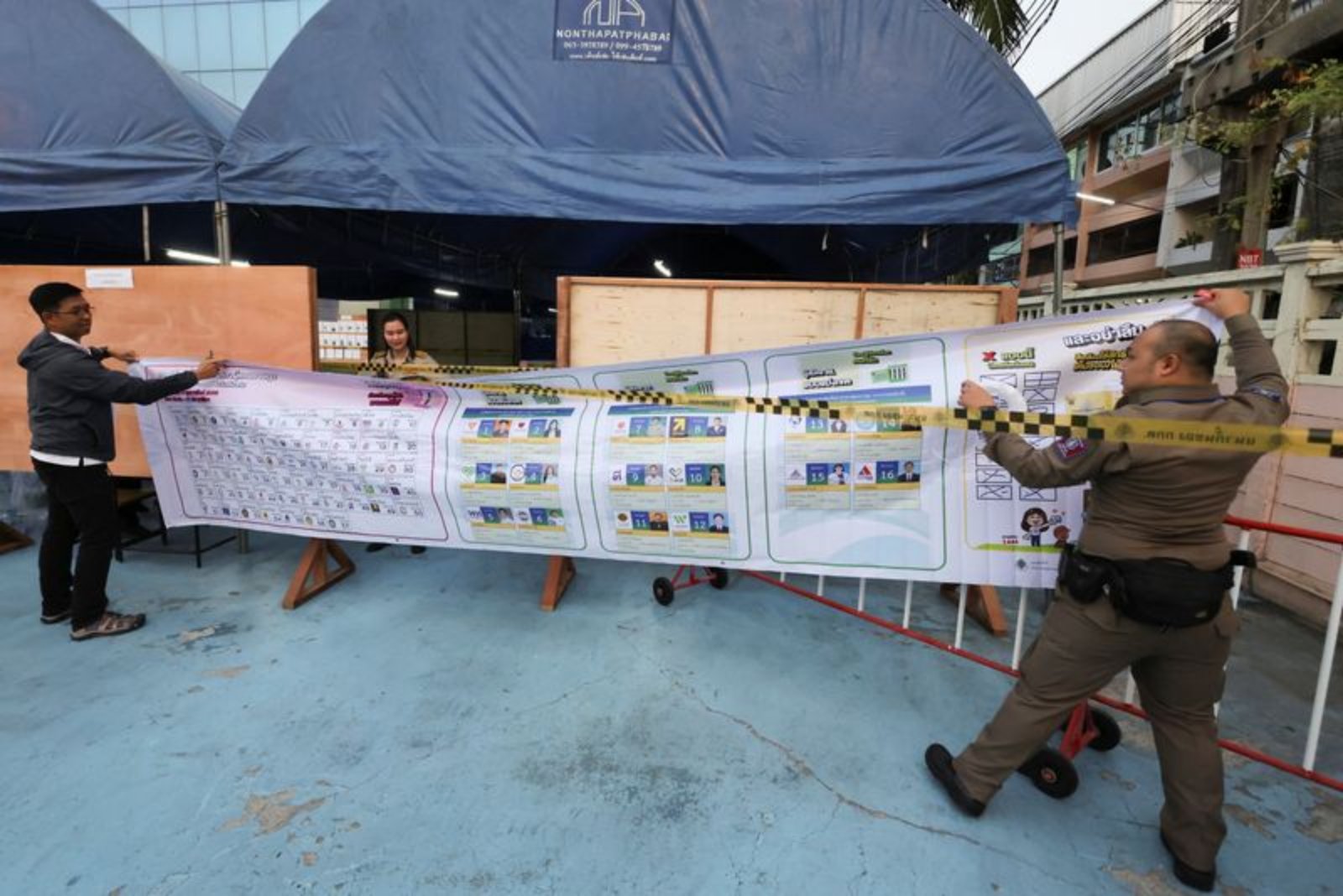
Polls opened in Thailand on Sunday in a general election dominated by a three-way competition among conservative, progressive and populist parties, an outcome that most analysts say is unlikely to produce a single-party majority and which leaves the prospect of extended political uncertainty intact.
The snap election was called in mid-December by Prime Minister Anutin Charnvirakul as the Thai-Cambodian border conflict escalated. Analysts quoted during the campaign viewed the timing as a political calculation by the conservative leader to take advantage of heightened nationalist sentiment. At the time he called the vote, Anutin had been in office for fewer than 100 days, having assumed power following the removal of Paetongtarn Shinawatra of the populist Pheu Thai party amid the Cambodia crisis.
Pheu Thai, associated with former Prime Minister Thaksin Shinawatra who was jailed shortly after his daughter was removed from office, remains weakened according to surveys but retains a presence in the race. Meanwhile, the progressive People’s Party, running on a platform of structural change and economic reforms for Southeast Asia's second-largest economy, was consistently ahead in opinion polls through the campaign season.
"This election is about whether Thailand will get out of its rut, whether Thailand will break out of its political instability and economic doldrums that have persisted," said Thitinan Pongsudhirak, a political scientist at Bangkok's Chulalongkorn University. "My preliminary conclusion, I’m afraid to say, is that it will not break out."
Despite leading many polls, the People’s Party faces the realistic possibility that it will not secure enough seats to govern alone. That raises the prospect of repeating the situation that followed the 2023 election, when Move Forward - the People’s Party's predecessor - won the most seats but was prevented from forming a government by a military-appointed Senate and conservative MPs, enabling Pheu Thai to assume power instead. Observers say that long-running contest between the royalist-conservative establishment and popular democratic movements has produced recurring periods of instability, including protests, violence and military interventions.
Voters are also being asked to decide on whether to initiate the drafting of a replacement for the 2017 constitution. The current charter was written with military backing and, critics say, centralizes power in institutions seen as undemocratic, notably a powerful Senate selected through an indirect process with limited public participation. Thailand has had 20 constitutions since the end of absolute monarchy in 1932, most of which followed military interventions.
If the referendum secures approval to draft a new constitution, the next government and parliament would be able to begin the amendment process. That parliamentary work would be followed by two additional referendums required to adopt a new national charter, if the process proceeds.
"I believe that the party that wins in the next election will have an outsized influence on the direction of constitutional reform, whether we move away from the junta-drafted constitution or not," said Napon Jatusripitak of the Bangkok-based Thailand Future think-tank.
Political dynamics during the campaign shifted as Bhumjaithai, the conservative ruling party, rose on nationalist sentiment tied to the Thai-Cambodia dispute. Pheu Thai's weakened position following events last year prompted a wave of defections and reshaped competitive areas, including agriculturally focused regions that are important to vote totals.
Parties responded with different strategies. Several recruited prominent local figures, including people from rival parties, aiming to capture personal loyalty networks that are influential in rural constituencies. The People’s Party adjusted its approach as well, tempering some of its anti-establishment rhetoric and recruiting external expertise to present itself as capable of governing.
Former Prime Minister Abhisit Vejjajiva re-entered the political mix, leveraging personal appeal to reinvigorate the Democrat Party, which had been struggling. Political watchers noted that the Democrat Party could play a decisive role in post-election coalition negotiations depending on the distribution of seats.
On the campaign trail, first-time voters expressed hopes for a fairer political environment. At the People’s Party final rally in Bangkok, 20-year-old Wish Witchudakornkul stood among a crowd wearing the progressive movement's orange and said he wanted Thailand to be fairer and for people to enjoy greater democracy, freedom and opportunities.
The election and the constitutional question together leave a range of possible futures for Thailand's political and economic trajectory. With no single party widely expected to command an outright majority, coalition-building and the influence of unelected institutions remain central uncertainties. Political actors and voters will now wait for results and for the decisions that follow those results on both parliamentary composition and the constitutional path ahead.