
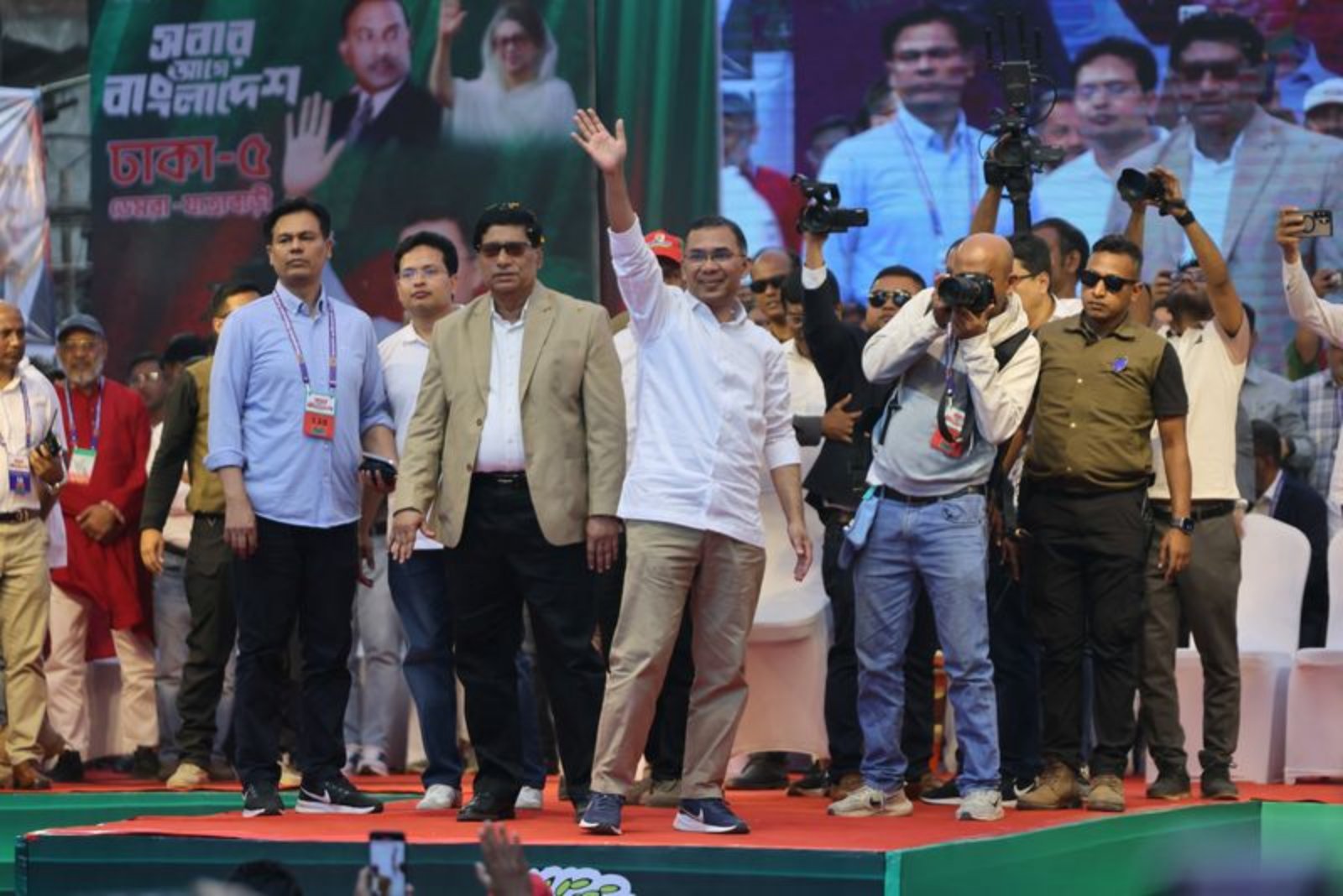
Less than two months after returning from almost two decades abroad, Tarique Rahman could emerge as one of the decisive figures of Bangladesh’s upcoming election and potentially assume the office of prime minister - a role his parents once held. If current opinion polls are accurate, Thursday’s vote would mark a dramatic turnaround for the soft-spoken 60-year-old.
Rahman left Bangladesh in 2008, citing the need for medical treatment following his release from detention under a military-backed caretaker administration after a crackdown on corruption. He came back to Bangladesh last Christmas to a celebratory reception after a youth-driven uprising in August 2024 toppled his Bangladesh Nationalist Party’s long-standing rival, Prime Minister Sheikh Hasina.
Hasina is now in exile in New Delhi, while Rahman’s mother, Khaleda Zia, and his late father occupy central places in the country’s modern political history. His father, a leading figure in Bangladesh’s independence movement, governed from 1977 to 1981 before being assassinated. Rahman has spoken since his return about reshaping Bangladesh’s international stance to draw investment without binding the country too closely to any single global power - a positioning presented in contrast to perceptions of Hasina as aligned with New Delhi.
On domestic economic policy, Rahman has emphasized broadening the nation’s export base beyond garments by promoting industries such as toys and leather goods, and expanding financial aid to poorer households. He has also proposed a constitutional constraint on executive power - a two-term, 10-year limit for prime ministers - which he frames as a safeguard against autocratic rule.
Rahman described the torrent of events since his arrival in Dhaka as overwhelming. "I don’t know how we have passed every minute since we landed," he told Reuters on the sidelines of an interview at his party office, where he was accompanied by his daughter Zaima, who has been actively campaigning for him.
Born on November 20, 1965, in Dhaka to Khaleda Zia and former President Ziaur Rahman, the BNP founder, Rahman studied international relations at the University of Dhaka before dropping out. He later built businesses in textiles and agro-products. Although he never held an official government position, critics during his mother’s 2001-2006 administration accused him of operating a parallel power centre - an allegation he rejects.
Since returning to the public stage, Rahman has sought to recast his image away from the more confrontational persona associated with the BNP’s earlier years. He has adopted an understated demeanor, eschewing inflammatory language and urging restraint and reconciliation. "What does revenge bring to someone? People have to flee from this country because of revenge. This does not bring anything good," he said. "What we need at the moment in the country is peace and stability."
Rahman’s legal history remains part of his public profile. Under Hasina’s administration he was a principal target of corruption prosecutions and convicted in absentia on several charges. In 2018 he was sentenced to life in connection with a 2004 grenade attack on a rally Hasina had been addressing that resulted in deaths and injuries. Rahman has consistently denied those allegations, calling them politically motivated. Following Hasina’s ouster he has been acquitted in all the cases.
From London, Rahman watched decades in which his party was repeatedly sidelined at the polls, with senior BNP figures jailed, activists disappearing and party offices closed. Returning to Bangladesh, he has steered clear of incendiary rhetoric and framed his message around restoring citizens’ stake in the state and rebuilding institutions, a refrain that has energized BNP supporters seeking a new beginning.
Personal touches have also tempered his public image. The family’s fluffy Siberian cat, Jebu, has become a social media sensation. "She’s 7. She’s half Siberian. We adopted her," Rahman’s daughter Zaima told Reuters.
Within the BNP, Rahman’s influence appears extensive. Party insiders say he is directly managing candidate selection, setting strategy and conducting alliance negotiations - roles he previously carried out from abroad. While some observers note his roots in a political dynasty, Rahman has framed his priorities in democratic terms, saying restoring and sustaining democratic practice would top his agenda. "Only by practicing democracy can we prosper and rebuild our country. If we practice democracy, we can establish accountability," he said. "So we want to practice democracy, we want to rebuild our country."
Summary
Tarique Rahman returned to Bangladesh after nearly 20 years in London and may soon become prime minister if opinion polls are borne out. He has promised to recalibrate foreign partnerships to attract investment without overreliance on any single power, expand financial aid to poor families, diversify exports away from garments toward industries such as toys and leather goods, and introduce a two-term, 10-year limit for the prime minister. Rahman has sought to soften his public image and to present himself as a leader focused on reconciliation and institutional rebuilding. His legal convictions from the period of his rival’s rule were overturned after her ouster.
Key points
- Tarique Rahman could become prime minister following his return from self-imposed exile and a youth-driven uprising that removed Sheikh Hasina from power - a change that may influence Bangladesh’s political direction and international alignments.
- Economic policy priorities laid out by Rahman include diversifying away from a heavy dependence on garment exports to sectors such as toys and leather goods, and attracting investment by avoiding alignment with a single global power - potential implications for export-oriented manufacturing and foreign investment flows.
- Rahman emphasizes democratic restoration, institutional rebuilding and expanded financial aid for poor families, positioning social welfare and governance reform as central to his platform.
Risks and uncertainties
- Legal and political legacies: Rahman was convicted in absentia on multiple charges, including a life sentence in a 2004 grenade attack case, though he has denied the allegations and has been acquitted following Hasina’s ouster - this legal history could continue to shape political dynamics.
- Implementation uncertainty: There is no guarantee that Rahman’s pledges - such as recalibrating international partnerships, expanding aid, promoting new export sectors and imposing a two-term limit on prime ministers - will be implemented if he attains office, creating policy uncertainty for sectors like textiles, leather, toys and foreign investment.
- Rapid political transition: Events since Rahman’s return have moved quickly, and he has said he has had little time to reflect - the speed of change introduces uncertainty about governance readiness and the stability of political transitions going forward.
Tags: Bangladesh, Politics, Economy, Exile, Elections