
Overview
Taiwan is moving to sharply increase the number of anti-ship missiles in its inventory, with a calculated target of more than 1,800 missiles by early 2029. The figure arises from a compilation of arms trade data, U.S. export approval documents, defense analyst estimates and interviews with senior Taiwanese officials. The expansion, centered on U.S.-supplied Harpoon missiles and indigenous Hsiung Feng family cruise missiles, is a central element of Taipei's shift toward an asymmetric defense model that favors numerous cost-effective, high-lethality systems over head-to-head parity with China.
Strategic intent and doctrine
Taiwanese military planners describe the growing stockpile as part of a drive to produce a resilient force capable of surviving an initial Chinese air-and-missile barrage and then targeting any invasion armada or naval blockade attempting to isolate the island. The stated goal is to prevent a successful landing and mission completion by an invading force rather than to destroy every vessel of the People's Liberation Army (PLA) navy. That approach reflects a broader move toward so-called asymmetric warfare tactics that rely on numbers, mobility and dispersed systems.
Defense analysts and current and former Taiwanese officers point to recent examples in other conflicts - notably the use of missiles and drones in Ukraine and strikes on shipping in the Strait of Hormuz - as demonstrations that smaller or less powerful forces can blunt or complicate an adversary's operations through the smart employment of precision weapons and unmanned systems.
Composition of the growing missile force
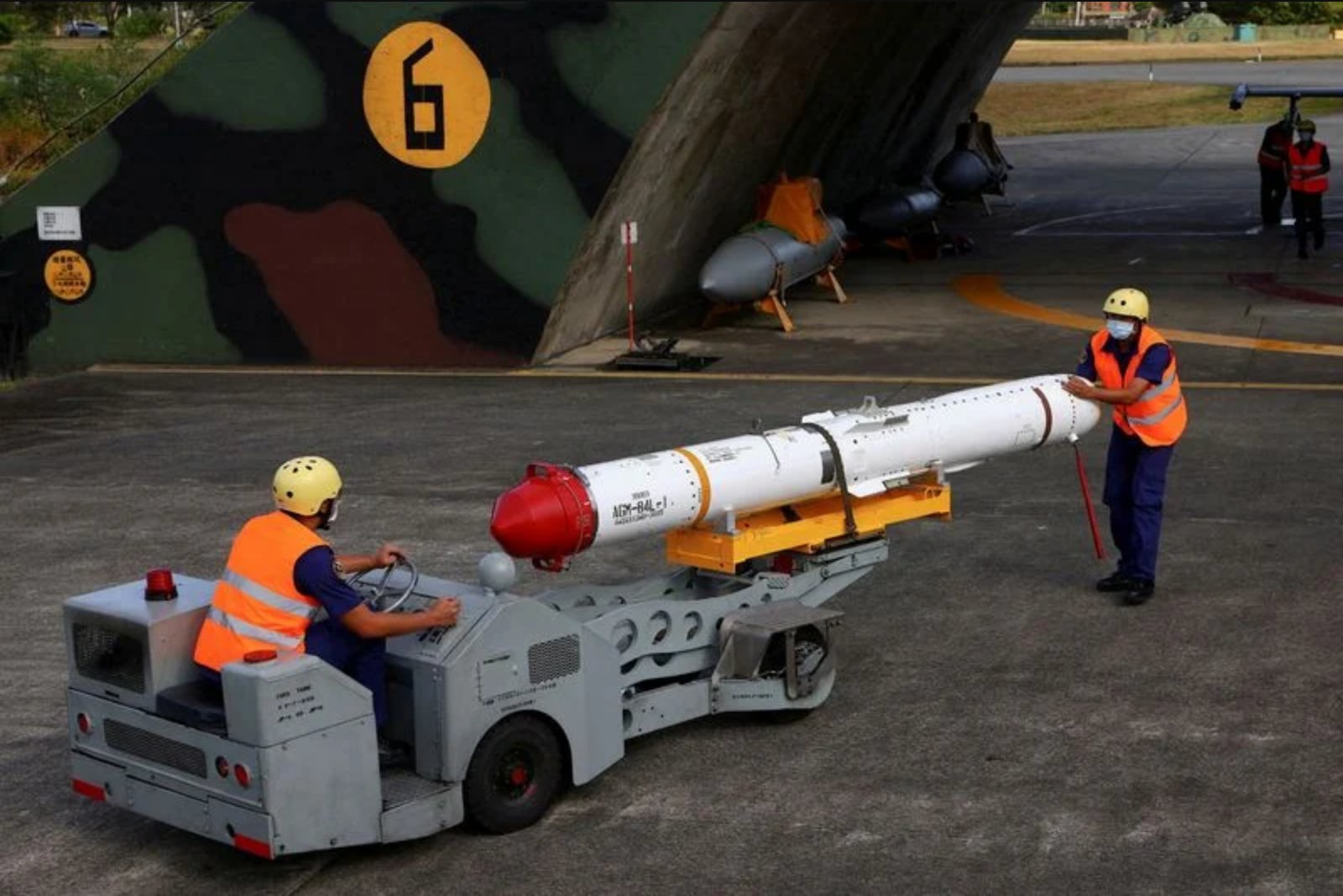
The spearhead of Taiwan's anti-ship build-up combines roughly two main families of weapons. The first comprises U.S.-supplied Harpoon sea-skimming cruise missiles. According to senior Taiwanese officials, 450 Harpoon missiles have been delivered to date. Under a U.S.-approved arms sale valued at $2.4 billion that was approved at the end of the first Trump administration in late 2020, another 400 Harpoon missiles are scheduled for delivery. U.S. government arms sales approval documents indicate those 400 missiles are expected to be delivered by the end of March 2029.
If deliveries proceed on schedule, Taiwan would hold about 850 Harpoon missiles by early 2029. Complementing the Harpoons, Taiwan plans to field about 1,000 or more domestically produced Hsiung Feng II and Hsiung Feng III anti-ship cruise missiles by the same period. Taken together, that would bring Taiwan's anti-ship inventory to around 1,850 missiles.
The projection assumes that U.S. deliveries occur largely on time and in full, and it does not account for possible production bottlenecks or wartime demands on U.S. inventory that could disrupt delivery timetables. One senior Taiwanese official indicated the timetable could slip, potentially pushing some deliveries to 2030.
Additional munitions and funding
Taiwan's opposition-controlled parliament recently approved an additional $25 billion in defense spending earmarked for U.S. munitions. Separately, Taipei is seeking U.S. presidential approval for an arms package in the pipeline worth up to $14 billion. The White House was reported to be considering that sale, and comments from Washington indicated a decision was imminent following high-level talks between U.S. and Chinese leaders.
Washington has also approved another package that would include 195 air-launched Harpoon missiles or derivatives worth a combined $1.36 billion. The two governments continue to negotiate terms for these additional sales, and no delivery timetable has been agreed, according to senior Taiwanese officials. Testimony by a senior U.S. official confirmed that Taiwan is a priority recipient for Harpoon deliveries.
Deployment concepts and survivability
Proponents of Taiwan's approach emphasize dispersal and mobility. Ground-based, mobile launchers carrying anti-ship missiles can be concealed and relocated, increasing their chances of surviving initial strikes and maintaining strike capability against an approaching invasion force. The ability to disperse missiles across the island and employ swarms of aerial and surface drones is seen by supporters as an essential part of creating a resilient denial capability.
However, there are persistent vulnerabilities. Some of Taiwan's missile stocks remain aboard warships or at fixed ground positions that could be exposed to pre-emptive targeting in the opening phases of a conflict, according to a retired Taiwanese naval officer who served on the National Security Council. He noted that the locations of such fixed systems are well known to Chinese intelligence and could therefore be prioritized in an initial strike plan.
Taiwan's defense ministry counters that many anti-ship missiles are already deployed in mobile and dispersed configurations to preserve combat effectiveness. The ministry added that missiles located at fixed sites are equipped with protective and backup mechanisms and can be converted to mobile setups as required to improve battlefield survivability.
Operational aims and expected effects
Analysts and retired officers argue that, if fielded in sufficient numbers and employed effectively, long-range precision anti-ship missiles present a substantial challenge to any invasion force. The logic is straightforward: a combined force of sea-launched, air-launched and ground-fired long-range missiles can create intense threats across approaches to the island, inflicting heavy losses on transport ships and escorts and raising the costs and risks of mounting a seaborne invasion.
As one analyst put it, the important objective is not to annihilate every enemy vessel but to impose losses and disruption severe enough to prevent an invading force from accomplishing its mission. This strategy would aim to buy time and space for the defenders and for potential allied intervention.
Political and diplomatic context
China maintains that Taiwan is part of its territory and has not renounced the use of force to achieve reunification. Taiwan rejects Beijing's sovereignty claim and insists that the island's people determine their future. High-level talks between U.S. and Chinese leaders have included warnings about the potential for conflict if Taiwan-related issues are mishandled. Reports indicate that the U.S. president said he would soon make a decision on a proposed arms sale after consultations with Chinese leadership, during which the Chinese president warned that missteps on Taiwan could risk a confrontation between the two powers.
Requests for comment on specific aspects of Taiwan's plans went unanswered by mainland Chinese institutions responsible for defense and Taiwan affairs. Officials in Washington declined to comment on Taiwan's detailed capabilities, delivery schedules or potential future assistance packages, while the White House did not supply a response to questions on the pending sale.
Command and integration
To coordinate its growing inventory and sensor networks, Taiwan will establish a new Littoral Combat Command on July 1. The new command will bring together coastal radars, anti-ship missiles and unmanned systems under one operational structure, with the purpose of improving the island's ability to detect, track and engage maritime threats in conjunction with other defensive elements.
Lessons cited from other conflicts
Supporters of the strategy cite recent conflicts to illustrate how missiles and unmanned systems can offset material imbalances. They highlight Ukraine's operations against Russian warships and transports in the Black Sea as an example of how precision strike weapons and surface drones have been used to challenge a superior naval power. Similarly, they point to strikes on shipping in the Strait of Hormuz as evidence that a smaller power can continue to contest maritime operations even after sustaining heavy air-and-missile attacks.
Those parallels are invoked to justify investing in large numbers of relatively affordable but capable weapons and in the dispersal and mobility practices necessary to preserve them in wartime.
Constraints and caveats
The projected inventory of close to 1,850 anti-ship missiles by early 2029 depends on multiple variables. It presumes U.S. deliveries will arrive largely on time and that planned domestic production will advance as expected. It does not reflect potential production bottlenecks, changed prioritization of U.S. stocks in times of crisis, or other disruptions that could slow shipments. One senior Taiwanese official cautioned that delivery schedules might slip, pushing some components of the build-up into 2030.
Meanwhile, negotiations remain ongoing for certain additional packages, including air-launched missiles, and no definitive delivery schedules have been settled for those items. Taipei's recently approved extra defense budget and its pending requests for major, multibillion-dollar arms packages are central to underpinning the planned expansion, but the timing of approvals and deliveries will determine how quickly the enhanced capabilities become operational.
Conclusion
Taiwan's planned increase in anti-ship missiles represents a deliberate effort to use quantity, mobility and integrated sensors to complicate any Chinese attempt at a blockade or seaborne invasion. The approach emphasizes survivability and the ability to impose attritional costs on a much larger adversary, with the stated objective of preventing an invading force from landing and completing its mission. Whether the projected inventories materialize on the planned timelines will depend on a mix of domestic production, foreign deliveries and the broader geopolitical and operational environment that governs arms transfers and military readiness.