
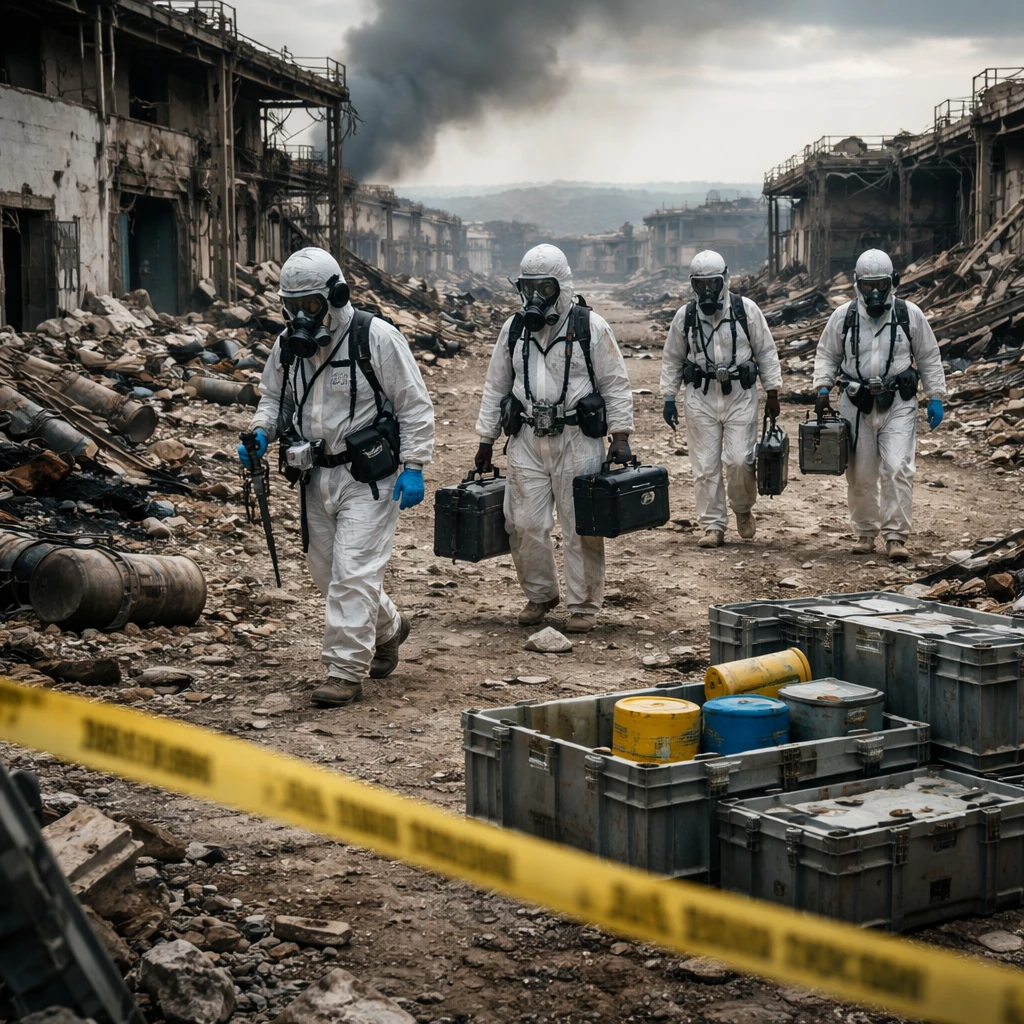
Syria on Wednesday set out a plan, backed by Washington and a coalition of Western partners, to identify and destroy remaining chemical weapons from the period when Bashar al-Assad ran an extensive program of prohibited munitions. The government said the initiative will be carried out under the supervision of the Organisation for the Prohibition of Chemical Weapons, or OPCW.
According to statements from Syria's ambassador to the United Nations, Ibrahim Olabi, an international taskforce supported by the United States, Germany, Britain, Canada and France, among others, will lead the search for leftover elements of the program and oversee their destruction. Olabi described the move as a break from Syria's previous posture of concealment, saying the country is now "leading the resolve" to eliminate banned chemical arms.
The Syrian government has acknowledged a history of a large-scale chemical weapons program that killed and injured thousands during the country's protracted civil war. Damascus signed the Chemical Weapons Convention in 2013 and declared a 1,300-ton stockpile at that time, but international investigations have continued to document the use of nerve agents such as sarin and choking and blister agents including chlorine and sulfur mustard gas.
OPCW experts have said as many as 100 sites across Syria may require inspection to determine what toxic munitions remain and the appropriate methods for their destruction. Olabi emphasized the opacity of the earlier program, saying, "We don’t know what’s remaining. It was a secret program. The job is on Syria to basically look for these things and then declare them."
Officials involved in planning the operation have warned that locating and destroying the remnants will be a complex undertaking. The task will be both time-consuming and costly, they said, as it aims to prevent the proliferation of weapons of mass destruction in a region marked by conflict and political volatility.
Those same officials highlighted broader security developments as a complicating factor. The expanding U.S.-Israeli war on Iran and heightened regional tensions were cited as elements that could make the mission's timing uncertain, while also reinforcing the urgency of ensuring that prohibited weapons are not reused.
The new Syrian government, formed after the overthrow of Assad in December 2024 and led by President Ahmed al-Sharaa, has pledged to provide inspectors with full access to sites and records. A diplomatic source, speaking on condition of anonymity because of the sensitivity of the process, said the roughly 100 locations could include military bases, laboratories or administrative offices. The source added that the work to locate and destroy remnants is likely to take many months, if not years.
Under the announced plan, the OPCW will supervise destruction activities once remaining weapons and materials are declared and identified. The international taskforce will be responsible for tracing the full scope of what was once a covert program and ensuring the materials are either neutralized or removed to prevent any future use.
Context and next steps
The initiative signals a formal commitment by the new Syrian administration to address legacy chemical weapons and to cooperate with international inspectors. However, the scale of the effort, the unclear extent of what remains from the former program, and the shifting regional security environment all pose practical obstacles to rapid completion.
Participants in the effort will need to conduct detailed inspections, make determinations about safe destruction or removal, and manage a costly logistical operation - all while operating in an unstable neighborhood where military escalations could delay progress.