
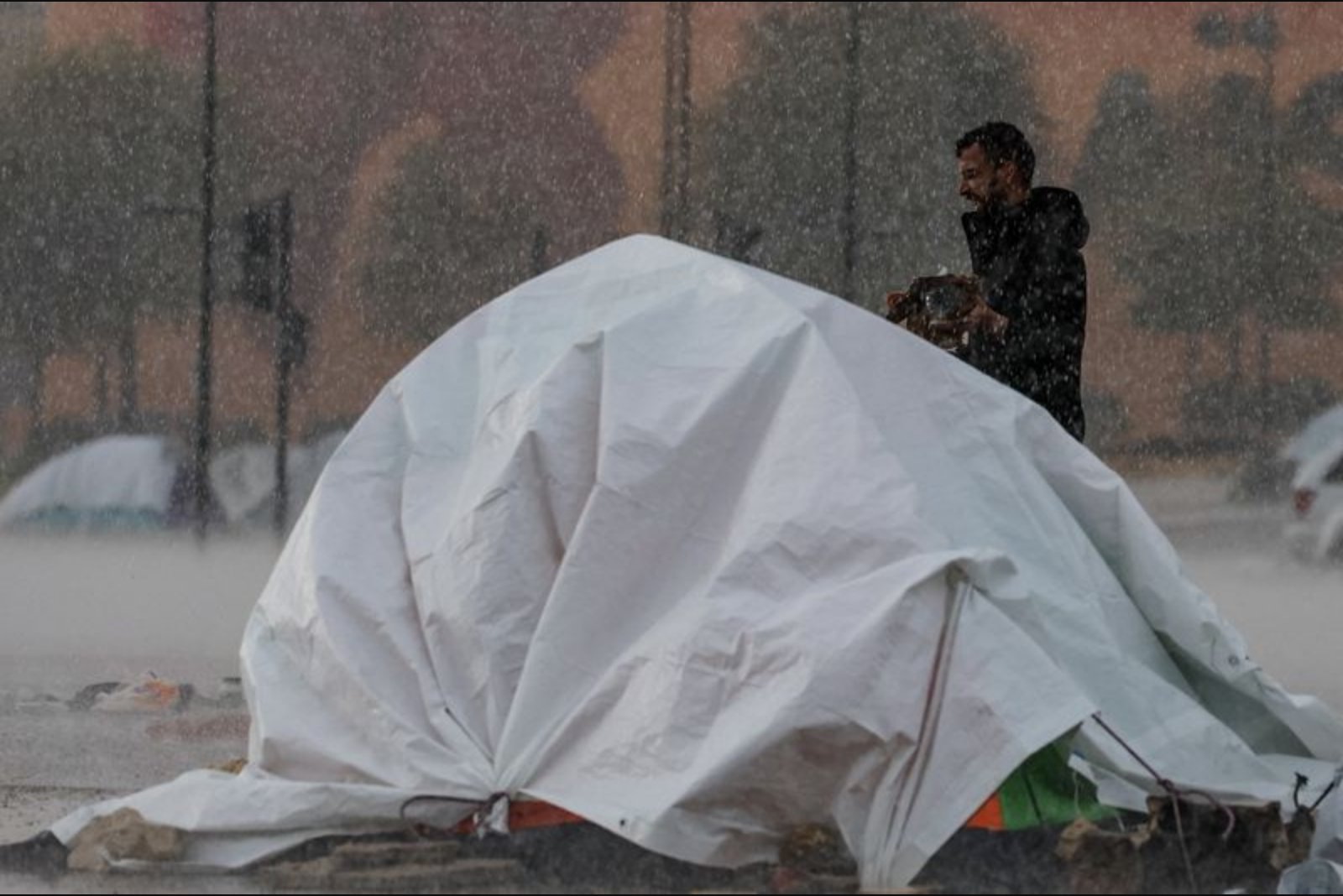
Rain and cold compounded the hardship for families forced from their homes by the recent escalation of violence along Lebanon's southern frontier. In Sidon on Sunday, Hussain Murtada and his relatives sheltered in the back of a small truck, attempting to protect themselves with a thin tarpaulin as collective shelters had no remaining space.
"We are putting tarp over it because we’re soaked," Murtada said as he tied a plastic sheet down with string over the vehicle parked along the seafront. Inside the makeshift refuge, an infant peered out from among pillows, blankets and the limited possessions the family brought. Murtada said he had fled Hanawiya, roughly 12 km (8 miles) from the border with Israel, with six other family members.
"I asked here at the schools and they are full, they’re all full," he added. "What should I ask for? I just want a shelter for me and the children." His description underscored the scarcity of available space in formal collective shelters for those uprooted by the conflict.
Authorities say more than 800,000 people - about 15% of Lebanon’s population - have been displaced since fighting intensified after March 2, when the Lebanese Hezbollah group opened fire at Israel in what officials described as support for its ally Iran. Only a fraction of the displaced population are in collective shelters; Lebanese authorities report some 132,000 people have been accommodated in such facilities.
The remainder are dispersed across a range of informal settings: staying with relatives, living in half-finished structures, joining host communities or remaining in the streets. That dispersal pattern has left many exposed to the elements as winter storms arrive.
On Beirut’s seafront Corniche, Mohammad Marie, who fled Nabatieh in the south, said he had been sheltering under a tree with a sheet of plastic for protection until the wind carried it away. "It might keep raining for a week, so where will I go? I will stay here, what else can I do? I have no shelter except here, under this tree," Marie said, his clothes wet through from the rain. He said he lacked money to rent accommodation and had no tent or other supplies.
The humanitarian situation prompted a United Nations flash appeal on Friday, with a call for $308 million to assist Lebanon in responding to the fallout from the fighting.
The Lebanese health ministry reported on Sunday that Israeli attacks have killed 850 people and wounded more than 2,100 since March 2. The ministry said the dead include 107 children and 66 women, and noted that its toll does not specify how many of the casualties were combatants.
On the Israeli side, two soldiers have been killed in southern Lebanon. Lebanese authorities reported no fatalities in Israel resulting from Hezbollah rocket and drone attacks since March 2.
Context and humanitarian pressures
The combination of heavy rain and limited shelter capacity has left many displaced people exposed to inclement weather and reliant on ad hoc arrangements. Reports from multiple locations in southern Lebanon and Beirut illustrate a pattern of families improvising protection where formal assistance is absent or insufficient.
Immediate needs highlighted by officials and affected people include:
- Safe, dry shelter for families who report schools and collective centers have reached full capacity.
- Basic household supplies such as blankets, tarpaulins and tents for those sleeping in streets, trucks, under trees or in incomplete buildings.
- Financial assistance for those unable to afford rental housing, as described by displaced individuals.
As displacement numbers remain high and casualties continue to be recorded by health authorities, humanitarian organizations and donors face urgent decisions about resource allocation to meet both immediate protection needs and medical care for the wounded.