
Spain’s latest push to regularise at least 500,000 undocumented residents is already placing heavy pressure on immigration services and prompting concern among would-be applicants, according to union officials, lawyers and migrants engaged with the process.
The government has said the special application window will run from early April through June but has released only limited operational detail. A number of people involved in preparing and administering the drive warned that the absence of clear guidance and additional state funding could jeopardise the mass legalisation effort announced last month.
On its website in January the migration ministry indicated that no extra budget or staffing had been allocated to absorb the expected surge in applications. That message has unsettled frontline workers who are already managing a backlog that stretches back months.
"Our offices are completely jammed. If there are no more people, if there is no technological reinforcement, without more money, this is impossible," said César Pérez, a union leader for Spain's immigration officers. Pérez said most of his colleagues were still working through legal status applications submitted in June 2025.
Public documents published by the government include a preliminary note on the drive. An unpublished draft of the full decree, dated February 18, states that "a specific, preferential and differentiated procedure" would be developed for the legalisation window, but it stops short of detailing application steps or the precise paperwork that will qualify applicants for the programme.
Spain's ministries of Inclusion, Interior and Territorial Policy declined to respond to detailed questions. A spokesperson for the ministry responsible for migration said the final decree was still being developed.
Operational squeeze and policy context
As other European countries tighten border controls, Spain's government has continued to defend a relatively inclusive migration stance that economists associate with much of the country's rapid economic expansion over the past four years. Prior administrations, including conservative governments, have used mass regularisations in previous decades.
The largest regularisation in recent memory took place in 2005, when 570,000 people who could show they had formal work contracts were granted legal status. That campaign was accompanied by a substantial, targeted administrative effort: a study cited the hiring of 1,700 additional employees and the establishment of 742 new information points to support applicants and alleviate pressure on the pre-existing system.
Official estimates cited by the government point to a longer-term fiscal incentive for such measures: Spain needs approximately 2.4 million additional contributors to social security over the next decade to sustain its welfare system. That objective informs the motivation for legalisation, but it also frames the scale of administrative capacity required to process a large number of applications in a short period.
Political dynamics have complicated the government’s ability to mobilise resources. Disputes with splinter parties eroded the governing coalition's majority in the lower house of parliament, halting the passage of a budget since 2023. That deadlock has constrained the government's capacity to implement its migration plans in the manner of earlier drives.
Plans to fill the gap and warnings from inside the system
Unlike the approach taken in 2005, the government has not publicly committed to hiring a comparable number of short-term staff or opening hundreds of new service points. To address the expected resource shortfall, officials are considering asking non-governmental organisations and trade unions to help process applications, according to sources familiar with internal discussions. Extending the opening hours of immigration offices has also been proposed.
None of these contingency measures has been formally adopted, leaving managers and frontline staff sceptical that the programme will be ready to launch as planned. "The government is optimistic, but coordinating everyone will not be easy. We can expect chaos at launch," said a person involved in migration ministry discussions.
Union leaders and administrators describe an already overloaded workflow and emphasise the technological, staffing and funding shortfalls that could prevent timely processing. The B2B-like choke points are familiar to anyone who monitors multi-tier capacity: without reinforced manpower or improved systems, bottlenecks at intake will cascade through case management, prolonging delays and increasing costs of backlog conversion.
Migrants scramble for clarity
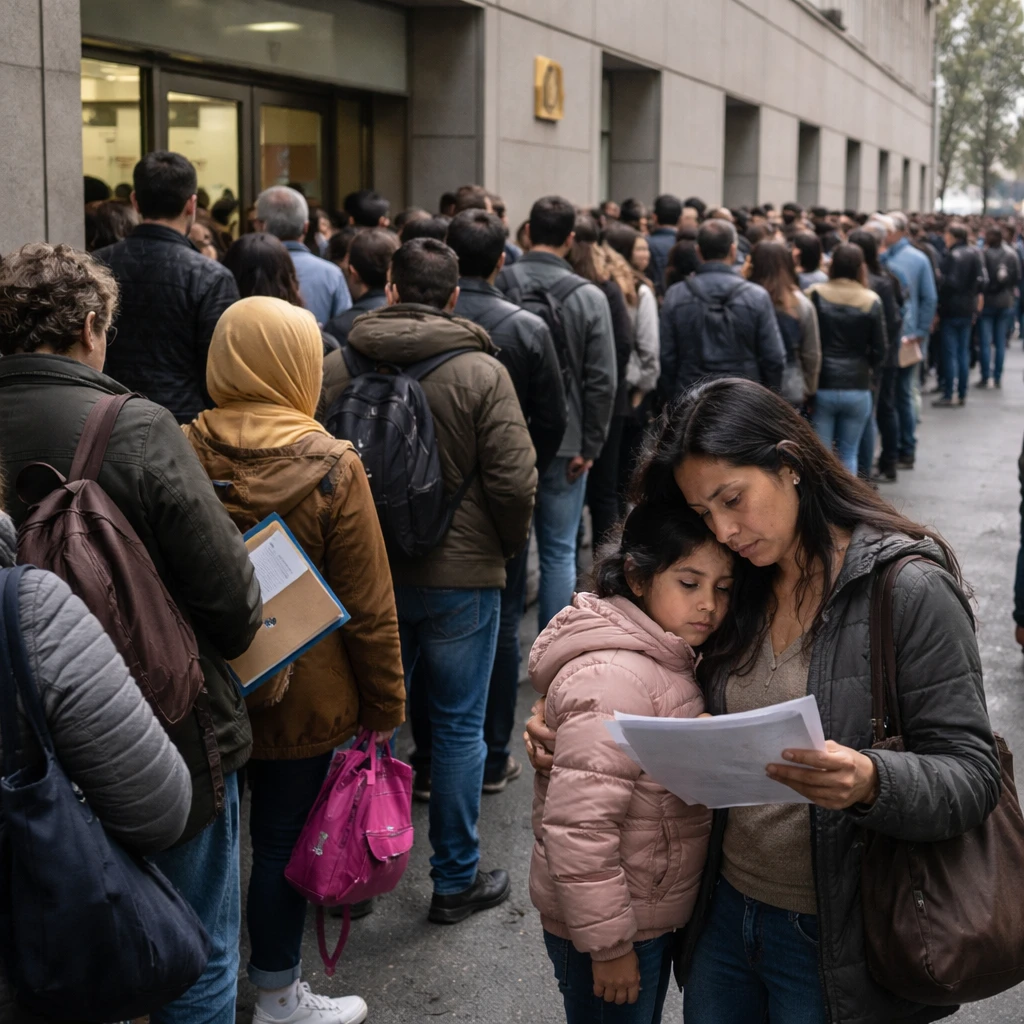
Prospective applicants are responding to the lack of clarity by seeking information in person at immigration offices, where staff are often unable to give detailed answers. Police and civil servant unions report queues forming outside offices as people try to establish whether they meet the eligibility criteria.
The government has stated that migrants could qualify if they have a clean criminal record and either have resided in Spain for five continuous months or have applied for asylum before the end of 2025. However, officials have not set out which forms of documentation will be accepted as proof of these conditions, leaving applicants uncertain about what they will need to submit.
"It’s still not clear what requirements we’ll have to meet. I’m afraid they will ask for something I can’t provide," said Iris Rocha, a 37-year-old Peruvian mother of two. Rocha attended a briefing held by a local migration-focused NGO in Barcelona, which many migrants see as the only reliable source of information at present. She said she fled Peru with her daughters in 2023 after suffering life-threatening abuse and lost her temporary work permit last year after her asylum claim was denied. "I would get my life back. Until then I have to survive," she said.
Immigration minister Elma Saiz told reporters in January that applicants would be able to work legally once they are notified that their application is being processed, a notification she said would be issued within 15 days of submitting documentation. Experts and practitioners remain sceptical, pointing to chronic delays already evident in the system.
Research from the think tank Funcas shows that migrants currently spend on average two to three years trying to obtain legal status, and that around 840,000 undocumented workers remain employed off the books while they navigate the process. "People become undocumented not because they don’t want to register, but because they can’t," said Gabriela Domingo, a lawyer at migration consultancy Legalizados.
In the absence of accessible appointment slots, some migrants are turning to intermediaries to secure April appointments at immigration offices, lawyers say. The practice is illegal; the government acknowledged in November 2025 that a shortage of appointment slots had driven such behaviour. "People are selling appointments even though the start date is only a rumour, which shows the fear this process has instilled in migrants," said Pilar Rodriguez, a lawyer with migrants' advocacy organisation Aculco.
What this means for services and labour
If the regularisation window proceeds without significant operational reinforcement, public administration will face a classic surge-capacity problem: a short spike in demand requiring temporary increases in personnel, systems and information flows. The absence of additional budget and staffing allocations complicates route-to-market for administrative output - here the 'product' being legal status and work permits - and raises the prospect of extended processing times that would blunt the programme's intended fast-tracking benefits.
For the labour market, the initiative is framed as a long-term need to bolster social security contributions, but in the short term the uncertainty around documentation, appointment availability and processing timelines risks prolonging informal employment patterns among undocumented workers.
Policy makers must reconcile the stated economic rationale for regularisation with operational realities. The government's ability to convert the stated intention into timely, verifiable legal status for applicants will depend on the degree to which it can mobilise extra staffing, technological support, NGO partnerships or extended hours to handle the surge in demand.
Next steps and open questions
The final shape of the decree remains under development. Key unknowns that will determine execution feasibility include which documents will be accepted as proof of residence or criminal history, whether extra funding will be allocated, how many additional staff or information points will be put in place, and whether NGOs and unions will be formally engaged to assist processing.
Until those operational details are resolved and resources committed, migrants and administrators alike will be left preparing for a window that could either provide a rapid route to legal employment and social security contributions, or become another bottleneck in a system already struggling to keep pace with demand.