
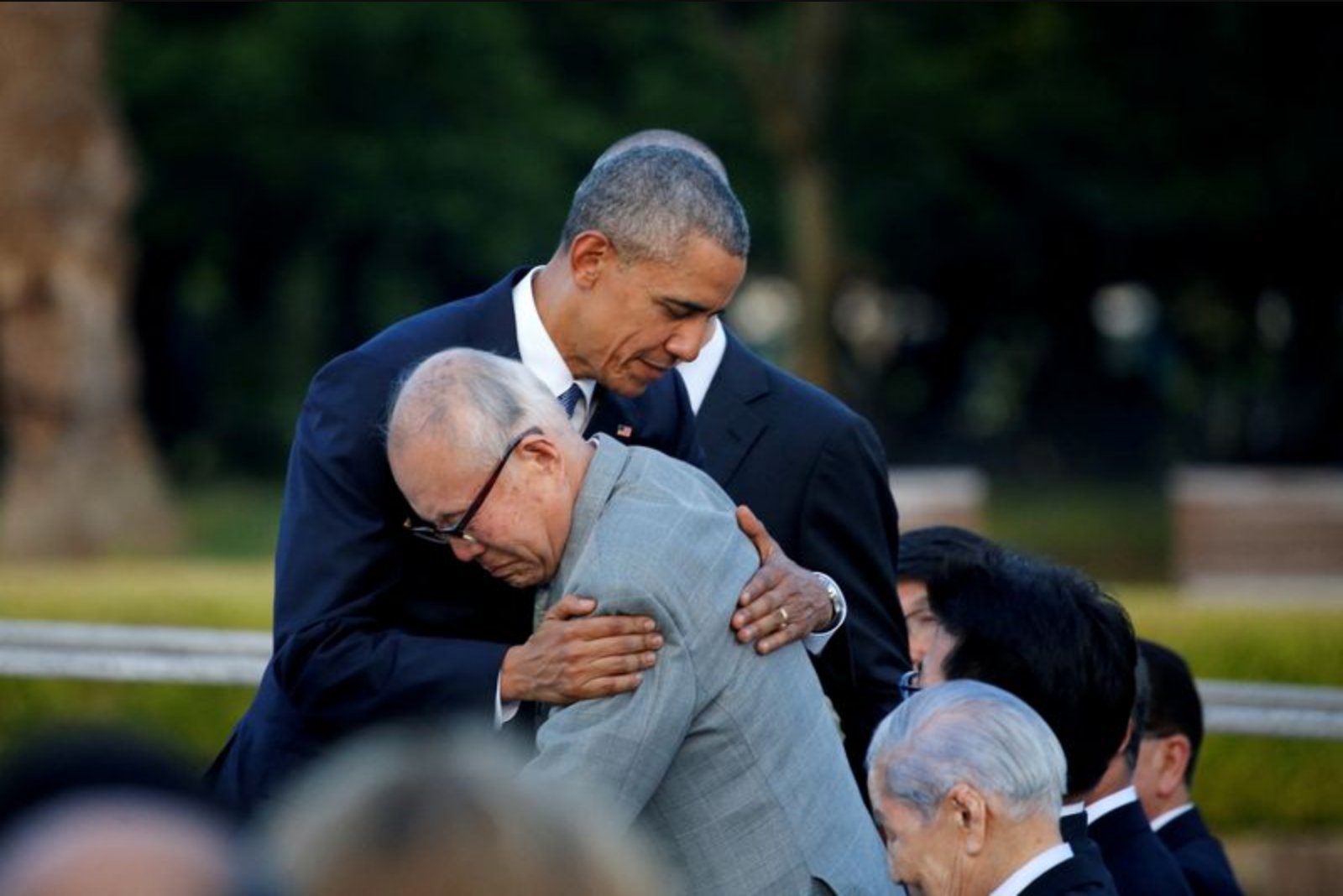
Shigeaki Mori, an 88-year-old survivor of the atomic bombing of Hiroshima whose embrace with former U.S. President Barack Obama in 2016 became a widely seen image of that presidential visit, has died. Mori was eight years old when the bomb was dropped on August 6, 1945, an explosion that flattened much of the city and knocked him unconscious with the blast.
Over the following decades Mori made the identification of bombing victims a central effort of his life. Beginning about 30 years after the attack, he devoted multiple decades to locating victims who had been cremated on his school playground. That work led him to identify 12 American nationals among those who died in the bombing.
Mori died in a hospital in Hiroshima on March 14. He was widely known both in Japan and abroad for the photograph taken at the Hiroshima Peace Memorial Park during former President Obama’s 2016 visit, in which Obama wrapped his arms around a visibly emotional Mori. That visit was the first time a sitting U.S. president had visited the city.
The population of surviving atomic bomb victims, commonly known in Japan as hibakusha, has been shrinking with age. Many of these survivors, despite their advanced years, have continued efforts to preserve the memory and legacy of Hiroshima and Nagasaki. The two cities are the only places to have suffered a nuclear attack, and authorities count some 550,000 deaths to date linked to the bombings, a total that includes fatalities from illnesses related to acute radiation exposure.
Mori’s decades-long search for the identities of those cremated at his school playground and his work identifying Americans who died in the blast added a personal, human dimension to the historical record. His passing marks the loss of another of the diminishing number of hibakusha who have carried firsthand testimony of the events of August 1945.
Context and legacy
Mori’s public profile grew in part because the 2016 photograph distilled a moment of shared grief and attention during a high-profile diplomatic visit. Beyond that image, his persistent efforts to document victims of the bombing formed a long-standing contribution to the record of Hiroshima’s wartime destruction and its human toll.