
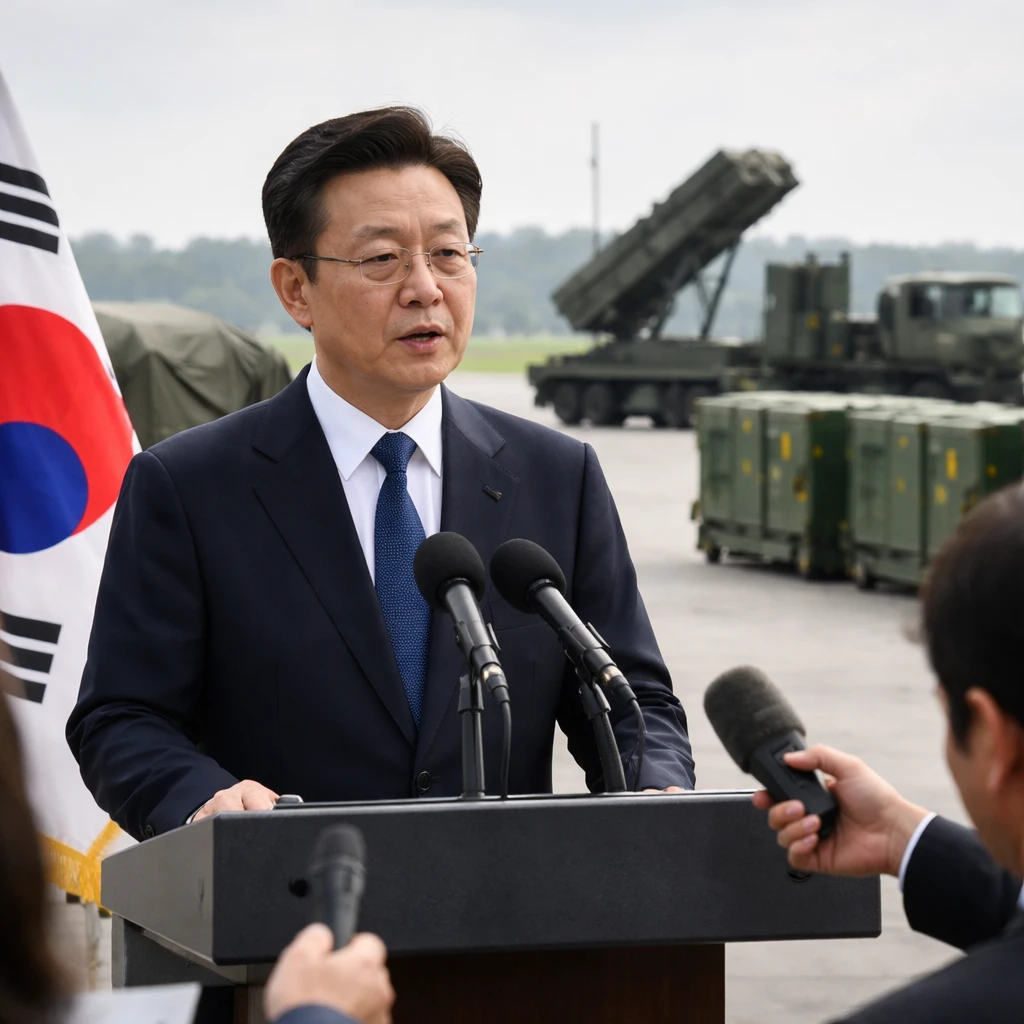
South Korea's president on Tuesday acknowledged that his government cannot prevent U.S. forces based in the country from shipping certain weapons abroad, while stressing that the movements would not undermine deterrence against North Korea.
"It appears that there is a controversy recently over U.S. Forces in Korea shipping some weapons out of the country," President Lee Jae Myung said, adding that Seoul had communicated its opposition but was not in a position to make demands on the U.S. military.
The comments followed remarks from South Korea's foreign minister, Cho Hyun, who said on Friday that the militaries of the United States and South Korea were in talks about a potential redeployment of some U.S. Patriot missile defence systems currently based in South Korea to be used in the conflict in the Middle East.
Lee's statement underscores a constraint in Seoul's leverage over U.S. forces stationed on the peninsula - a point he framed as a factual limit rather than a policy concession. At the same time, he made an explicit claim that any such redeployment would not weaken South Korea's deterrent posture toward North Korea.
The foreign minister's disclosure that the two militaries were discussing the possible movement of Patriot missile systems frames the issue as operational conversations between allied forces rather than a finalized decision. The language used indicates the discussion remains on the table and has prompted public debate in South Korea.
While the president emphasized that deterrence would remain intact, the public acknowledgement of limited influence over U.S. force movements and the existence of bilateral military consultations makes clear there are outstanding questions about equipment posture and allied coordination.
Summary
- President Lee Jae Myung said South Korea cannot stop U.S. forces in Korea from shipping some weapons out of the country.
- Lee added that such movements would not affect deterrence against North Korea.
- Foreign Minister Cho Hyun said U.S. and South Korean militaries were discussing possible redeployment of Patriot missile defence systems from South Korea for potential use in the Middle East.
Key points
- Seoul has expressed opposition to certain U.S. force equipment movements but acknowledges limited ability to demand otherwise - this affects defence posture discussions.
- The potential redeployment under discussion involves U.S. Patriot missile defence systems stationed in South Korea.
- The dialogue over redeployment is described as military-to-military discussions rather than a confirmed transfer.
Risks and uncertainties
- Uncertainty over whether the discussed redeployment will occur - the article reports only that the militaries were discussing the possibility.
- Public controversy and political sensitivity in South Korea stemming from the report of weapons movements - the president noted a recent controversy.
- Potential strains in allied coordination or domestic political debate due to Seoul's limited ability to direct decisions made by U.S. forces based in the country.