
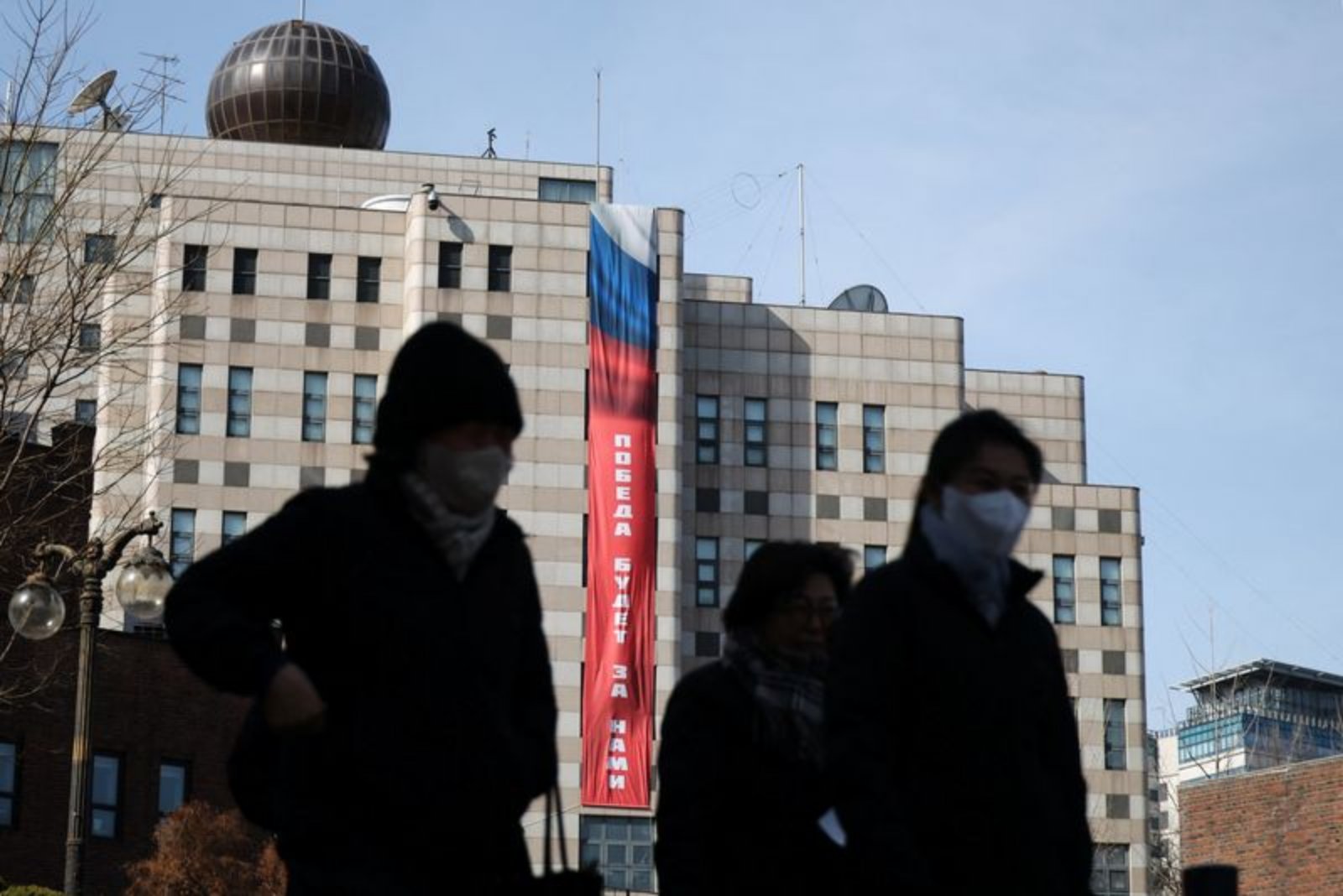
South Korea has asked the Russian embassy in Seoul to take down a prominent banner proclaiming "Victory will be ours", the foreign ministry said, as the fourth anniversary of Russia's invasion of Ukraine approaches. The ministry made the request public in a statement on Sunday and said it had shared its concerns with the embassy, without saying whether the embassy had replied.
The banner, measuring roughly 15 metres (49.21 ft) and rendered in the colours of the Russian national flag, was affixed to the outside wall of the embassy in central Seoul prior to the Tuesday anniversary. It remained visible on Monday, according to the ministry statement.
In reiterating its view that Russia's invasion of Ukraine is illegal, the ministry also addressed military ties between Russia and North Korea, calling for them to cease. The statement described such cooperation as a grave threat to South Korea's security and as a violation of the U.N. Charter and U.N. Security Council resolutions.
The ministry's comments follow media reports earlier this month that quoted Russian Ambassador to South Korea Georgy Zinoviev praising what he described as North Korean troops' role in fighting in Russia's Kursk region.
The article's source material states that, under a mutual defence pact with Russia in 2024, North Korea sent about 14,000 soldiers to fight alongside Russian forces in Ukraine, and that more than 6,000 of those soldiers were killed, according to South Korean, Ukrainian and Western sources. Those casualty figures and troop numbers were cited in the ministry's wider context for its security concerns.
The Russian embassy in Seoul was not immediately available for comment by telephone. An automated voice message indicated the embassy was closed on Monday because of a public holiday.
The diplomatic exchange over the banner and the ministry's wording underscore Seoul's insistence on the illegality of the invasion and its alarm over expanded military ties between Moscow and Pyongyang. The ministry's statement frames the military cooperation as both a direct security threat to South Korea and a contravention of international obligations.
Details provided in the ministry statement and in media reports form the basis of Seoul's public position in the run-up to the anniversary, but the embassy's position was not available at the time the ministry's note was described.