
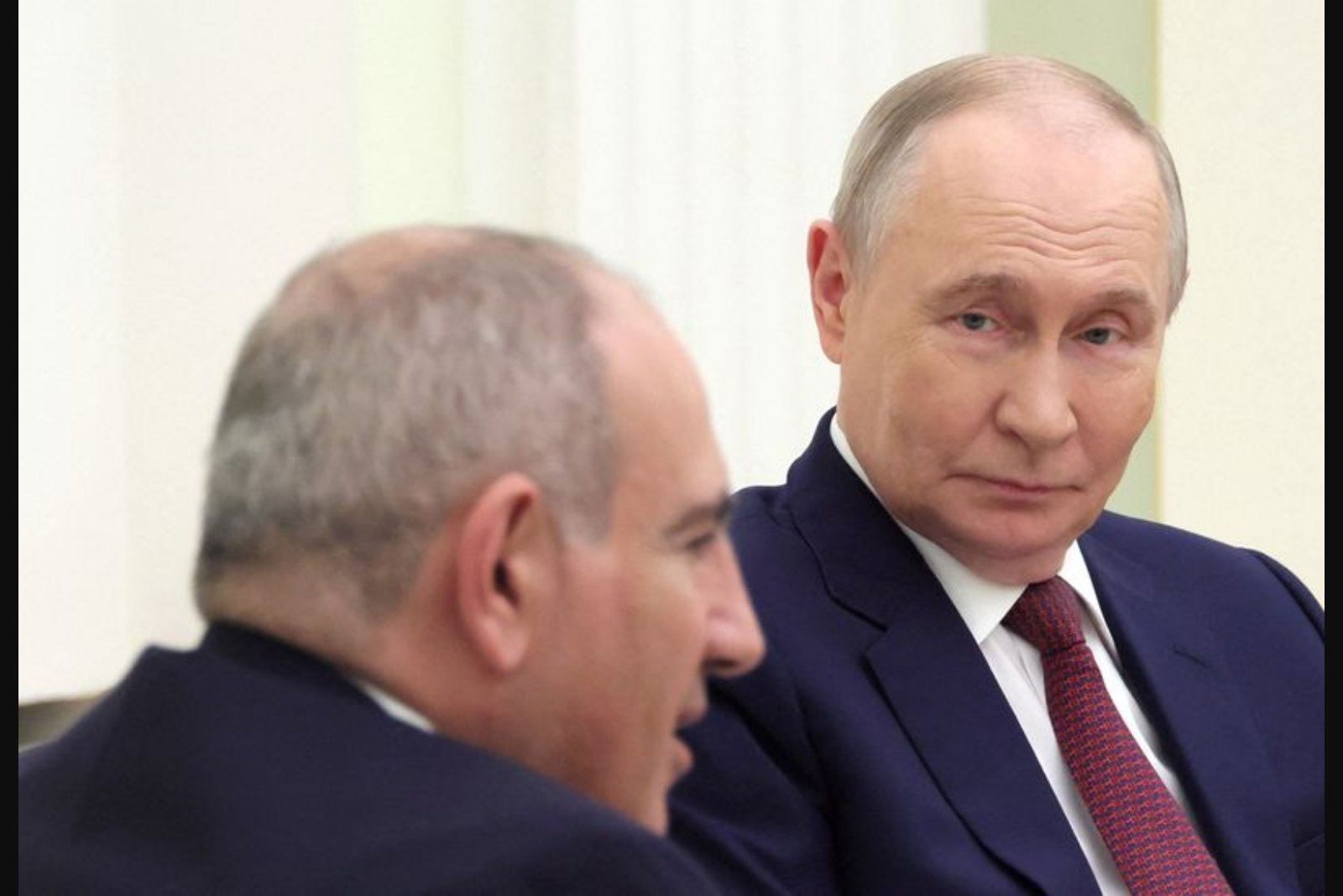
Western intelligence and government officials say Moscow has intensified secret efforts to undermine Armenia's incumbent leader as he seeks re-election on June 7, citing concerns in Moscow that a continued westward shift by Yerevan could permanently reduce Russia's influence in the small, landlocked nation.
The reported Russian playbook ahead of the vote spans a set of measures - from stepped-up online disinformation campaigns aimed at discrediting the government to a bold plan discussed by Russian officials to transport significant numbers of Russia-based Armenians into Armenia to vote for pro-Russian candidates, according to interviews with five Western intelligence officials and documents reviewed by officials. Officials who spoke described the actions as part of an effort to tip the electoral balance away from the incumbent.
Armenia, with a population of roughly 3 million, has traditionally been closely aligned with Moscow and hosts Russian troops. Yet Prime Minister Nikol Pashinyan, who leads in opinion polls, has in recent years moved his country closer to Europe and the NATO orbit. The prime minister has also emerged as a political ally of U.S. President Donald Trump, who publicly endorsed Pashinyan's re-election bid in the run-up to the vote.
In parallel diplomatic moves, U.S. Secretary of State Marco Rubio visited Yerevan this week to sign a minerals agreement and to formalize plans for the proposed Trump Route for International Peace and Prosperity - a transport corridor through Armenia that backers say would facilitate trade eastward toward Central Asia and reduce Armenia's dependence on Russia. Russia has signaled displeasure at these and other signs of Yerevan's diversification.
Pressure on Armenia from Moscow has included economic measures. Russian authorities have issued warnings suggesting Armenia risks losing access to heavily subsidized natural gas if relations deteriorate. In recent days, Russia has also imposed restrictions on imports of several Armenian agricultural products and drinks, including fruit, vegetables, flowers and brandy.
Analysts note that Pashinyan's policy of diversifying Armenia's international partnerships undermines the near-monopoly Moscow previously held over the country's economy and security arrangements. "What Pashinyan is trying to do is a threat to Russia," said Thomas de Waal, senior fellow with Carnegie Europe, commenting on the strategic implications of Armenia's pivot. Diversification, he said, would reduce Moscow's leverage in Yerevan.
According to three of the Western officials interviewed, Moscow's candidate of choice in the election is Samvel Karapetyan, a businessman who faces trial on charges of calling for the overthrow of the government. Karapetyan, an Armenian-Russian, denies the allegations. His lawyer stated that Karapetyan had no knowledge of Russian backing for his campaign.
Officials describe a Kremlin apparatus increasingly active in Armenia's political space. Sources said that in October, the Kremlin established a Directorate for Strategic Cooperation and Partnership to coordinate influence operations in countries of interest, including Armenia. Those same sources reported that Russian officials have discussed arranging for Armenians who live in Russia - a diaspora some estimates place at over 2 million - to travel to Armenia to cast ballots favoring pro-Russian candidates.
Armenians are not permitted to vote from abroad. That constraint notwithstanding, officials said the regular flow of people between Russia and Armenia, supported by dozens of daily flights, makes the logistics feasible in principle. A senior U.S. official said there is debate within intelligence circles over how many people Moscow could realistically move, but that the concept is being taken seriously. Russian planners, the officials said, estimated a cost of roughly $50 million to transport 100,000 voters. By mid-May, they added, Kremlin-directed quotas were circulated, assigning numbers of Armenians each Russian region should supply, and local administrators were asked to report on preparations.
It could not be established whether such a plan was actually underway or if it would be sufficient to bridge the gap between frontrunners in the polls. A survey earlier this month put Pashinyan's Civil Contract party at about 30% support and Karapetyan's Strong Armenia party at roughly 6% in a fragmented field.
Pashinyan first gained office in 2018 after mass protests toppled a Moscow-aligned government. Relations with Russia frayed further after Russian peacekeepers in Nagorno-Karabakh failed to prevent the region's return to Azerbaijani control in 2023. In August of last year, Pashinyan signed a U.S.-brokered peace deal with Azerbaijan intended to end the long-running conflict over Nagorno-Karabakh. The arrangement would facilitate a transport route across southern Armenia while giving Azerbaijan greater access to its exclave of Nakhchivan and to Turkey. Moscow gave a cautious welcome to the agreement but has been uneasy about certain elements.
One point of acute concern for Moscow, officials said, is that U.S.-backed security personnel could be placed to oversee the narrow transport corridor that would run along Armenia's border with Iran - an arrangement Russia views as unacceptable. Two Western officials said that if Pashinyan were removed from power, central components of the U.S. peace initiative would likely stall.
Concerns for Pashinyan's personal safety have been raised by several sources. In May, a video circulated online in which masked men speaking an Armenian dialect threatened to kill the prime minister. Investigators in Armenia are probing the origin and seriousness of that threat, but the organisation or individuals behind the clip have not been identified. Three sources, including a senior U.S. official, described ongoing and serious worries about Pashinyan's security without offering detailed public evidence.
According to current and former U.S. officials and a third person with knowledge of the matter, elements of the U.S. government have covertly assisted Pashinyan's personal protection in recent years. That support, the sources said, included sharing intelligence about potential threats. The White House, the State Department, the U.S. intelligence community and Pashinyan's office did not provide comments when asked about the prime minister's security arrangements, and the CIA declined to comment.
Officials said disinformation operations have been significantly amplified ahead of the vote. One described a Russian-backed online campaign that circulated a false story alleging a corrupt land deal involving Pashinyan and two U.S. senators who had publicly expressed concern about disinformation. The two senators did not provide comment on those claims. European sources mentioned the involvement of a Kremlin-affiliated bot network known by the handle "Storm-1516", which has been linked to previous interference efforts in other countries.
Three intelligence sources said the Kremlin has contracted Russian political consultancies and think-tanks to mount influence operations, including the Social Design Agency - an organisation sanctioned in the European Union and the United Kingdom for spreading disinformation related to Ukraine. Officials provided five Russian-language documents they said were prepared by the agency; the documents were reviewed by those officials and contained detailed proposals for influence efforts. Independent verification that the agency authored the documents was not available.
One of the documents recommended creating a media outlet called Yerevan1 aimed at Russia's Armenian diaspora. The proposed outlet was described as a vehicle to foment a "negative attitude" toward Pashinyan, framing the "core narrative" that "Armenia can only prosper in a close alliance with Russia and under its protection." The paper argued that Russia's Armenian diaspora could be decisive in the election if "high turnout among them can be ensured." Neither the Social Design Agency nor the proposed Yerevan1 responded to requests for comment.
Armenia's government communications office declined to comment on the specific allegations detailed by officials, but outlined steps being taken to combat disinformation and to ensure that the upcoming elections will be free, fair and transparent. Russia's foreign ministry dismissed the charges as "spymania" when questioned by reporters, rejecting allegations of interference in Armenia's internal affairs.
Officials and documents cited in this reporting present a picture of a broad, multifaceted effort by Moscow - combining economic pressure, propaganda and possible logistical operations - aimed at blunting Yerevan's move away from Moscow's orbit. How successful those efforts will be in the run-up to the June 7 vote remains an open question, one that Western intelligence agencies continue to monitor closely.