
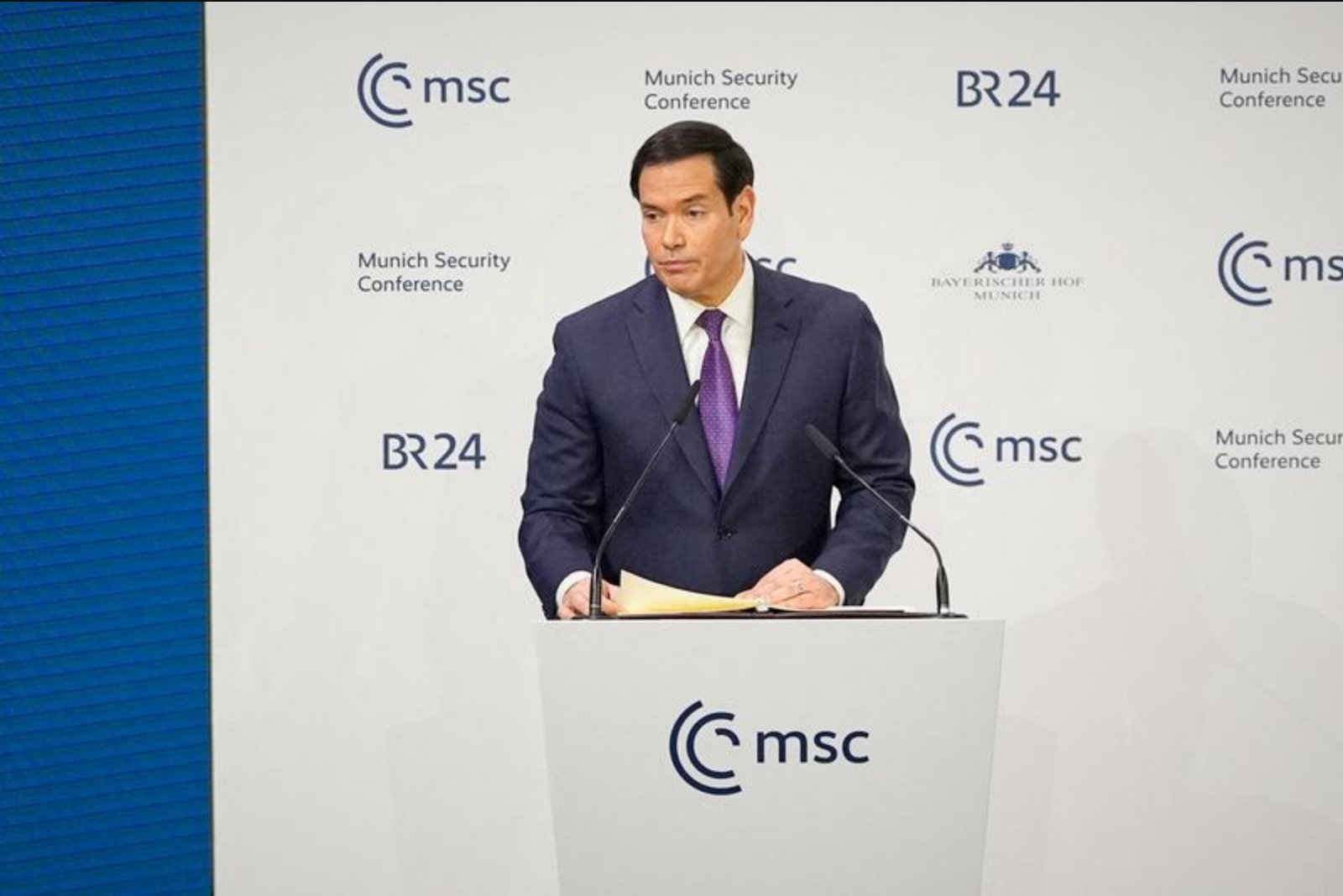
At the Munich Security Conference, U.S. Secretary of State Marco Rubio presented a dual message to the European audience: a reaffirmation of cultural and political ties with the United States, coupled with pointed criticism of policy directions pursued by some European leaders. Speaking on Saturday, Rubio stressed that Washington did not intend to walk away from the transatlantic partnership, even as he urged a change of course on several issues he characterized as mistakes.
Rubio's remarks were met with a largely receptive audience of European diplomats and security officials who welcomed the overall theme of unity and the reminder of shared heritage. Yet the address also echoed criticisms associated with the prior U.S. administration, particularly on topics such as mass migration and climate policy, and contained moments that could be read as barbs aimed at European policymakers.
Rubio placed his remarks within a personal and historical frame, telling the conference:
"In a time of headlines heralding the end of the transatlantic era, let it be known and clear to all that this is neither our goal nor our wish, because for us Americans, our home may be in the western hemisphere, but we will always be a child of Europe."He continued:
"For the United States and Europe, we belong together."
The secretary sought to temper growing perceptions that the U.S. had moved from an "America First" posture to one interpreted by allies as "America Alone." He described his presence as an appeal for renewed cooperation:
"I am here today to make it clear that America is charting a path for a new century of prosperity, and that once again, we want to do it together, with you, our cherished allies and oldest friends."
Despite the rhetorical emphasis on partnership, Rubio's address was notable for its lack of operational detail. During a speech of roughly 30 minutes, he did not mention Russia, which the article identifies as Europe's principal geopolitical adversary, nor did he invoke NATO by name or set out an explicit U.S. expression of support for European security arrangements.
European reactions combined relief with wariness, highlighting the fragile state of transatlantic relations after recent years of turbulence. The article notes that before the political shifts represented by Donald Trump's ascendancy, high-ranking U.S. officials typically offered a robust economic and military commitment to Europe. That consensus has been disrupted, leaving officials in Brussels and capitals across the continent to reassess ties.
Washington's shift in tone has also been reflected in U.S. strategic documents and public statements. The U.S. National Security Strategy released in December warned of dire prospects for Europe, using the phrase "civilizational erasure" and suggesting the continent might lose its standing as a reliable partner. Meanwhile, tensions flared in other episodes cited in the original coverage: the president at one point threatened tariffs on European allies over their reaction to his pursuit of Greenland from Denmark, though the coverage indicates that the confrontation over the island has since cooled.
European diplomats offered varied interpretations of Rubio's speech. One senior European diplomat, speaking on condition of anonymity, described the address as "soothing" and viewed its emotional framing as a signal that the alliance could continue in a reconfigured form. At the same time, a number of diplomats and U.S. lawmakers remained skeptical.
Democratic Senator Andy Kim told reporters that while Rubio's tone was less incendiary than a year-earlier address by U.S. Vice President JD Vance, it nevertheless touched on similar themes without engaging with pressing security questions. Kim said Rubio missed an opportunity to address challenges such as Ukraine, Russia and China, and instead focused more on internal issues like migration and historical shame.
Throughout his remarks, Rubio blended acknowledgement of common cultural inheritance with critiques of contemporary European leadership. He spoke of his own forebears and of Europe's cultural and architectural patrimony, and he urged allies to embrace pride in their heritage. As he put it:
"We want allies who are proud of their culture and of their heritage, who understand that we are heirs to the same great and noble civilization, and who together with us, are willing and able to defend it and this is why we do not want allies to rationalize the broken status quo."
Rubio's speech was delivered against a backdrop of European leaders articulating a desire for greater strategic autonomy. Speeches given by senior European officials the previous day demonstrated an appetite to develop independent defense capabilities while retaining ties to the United States.
German Chancellor Friedrich Merz, for example, told the conference that Berlin had begun discussions with France about a European nuclear deterrent. Meanwhile, President Emmanuel Macron argued that Europe must evolve into a geopolitical power because the Russian threat is not expected to disappear. Those statements underline a continental conversation about defense posture and strategic priorities that runs in parallel with appeals for continued cooperation with the U.S.
Embedded within the conference reporting was also a promotional-style passage addressing investment tools, which framed better data as an essential element for finding investment opportunities. That passage emphasized the role of institutional-grade data and AI insights in helping investors identify prospective winners in markets, and it invited readers to consider data-driven investment services to evaluate candidates for 2026. The article's core reporting does not link this advisory material to the substance of the Munich speeches, but it was included in the coverage as part of the broader presentation.
Rubio's address therefore left European audiences with mixed signals: an affirmation of shared identity and a willingness to cooperate side-by-side, paired with criticisms that indicate expectations for European policy change. The speech's notable omissions - the lack of explicit reference to NATO or to Russia - along with repeated public reminders of past tensions, contribute to an uncertain trajectory for transatlantic relations.
As diplomats and lawmakers parsed the speech, the contrast with last year's rhetoric underscored how the tone of U.S. engagement can vary markedly across high-level visits. Rubio's approach was less confrontational than some recent U.S. pronouncements but stopped short of the full security reassurances many European officials were seeking in Munich.
That mix of reassurance and critique appears likely to shape discussions in Brussels and national capitals in the near term, as Europe weighs both the appeals for unity from Washington and its internal debates about how to hedge, deepen, or reshape its defenses and strategic posture.