
(Correction: Israeli forces depopulated and demolished Rafah during the war, not after a ceasefire.)
Eatedal Rayyan had been waiting almost two years for this moment - to return to Gaza and be reunited with her husband after having fled the enclave with her mother and three children. The 29-year-old left because of a leg injury that medical staff said might require amputation if it was not treated. She spent months receiving care in Egypt and eventually regained the ability to walk.
On Thursday, Rayyan, her mother and the children were among a small number of Palestinians granted permission to re-enter Gaza after Israel reopened the Rafah border crossing, a point that had been largely closed since the fighting began in October 2023. Reuters followed the family as they travelled from Al-Arish, an Egyptian town hosting thousands of displaced Palestinians.
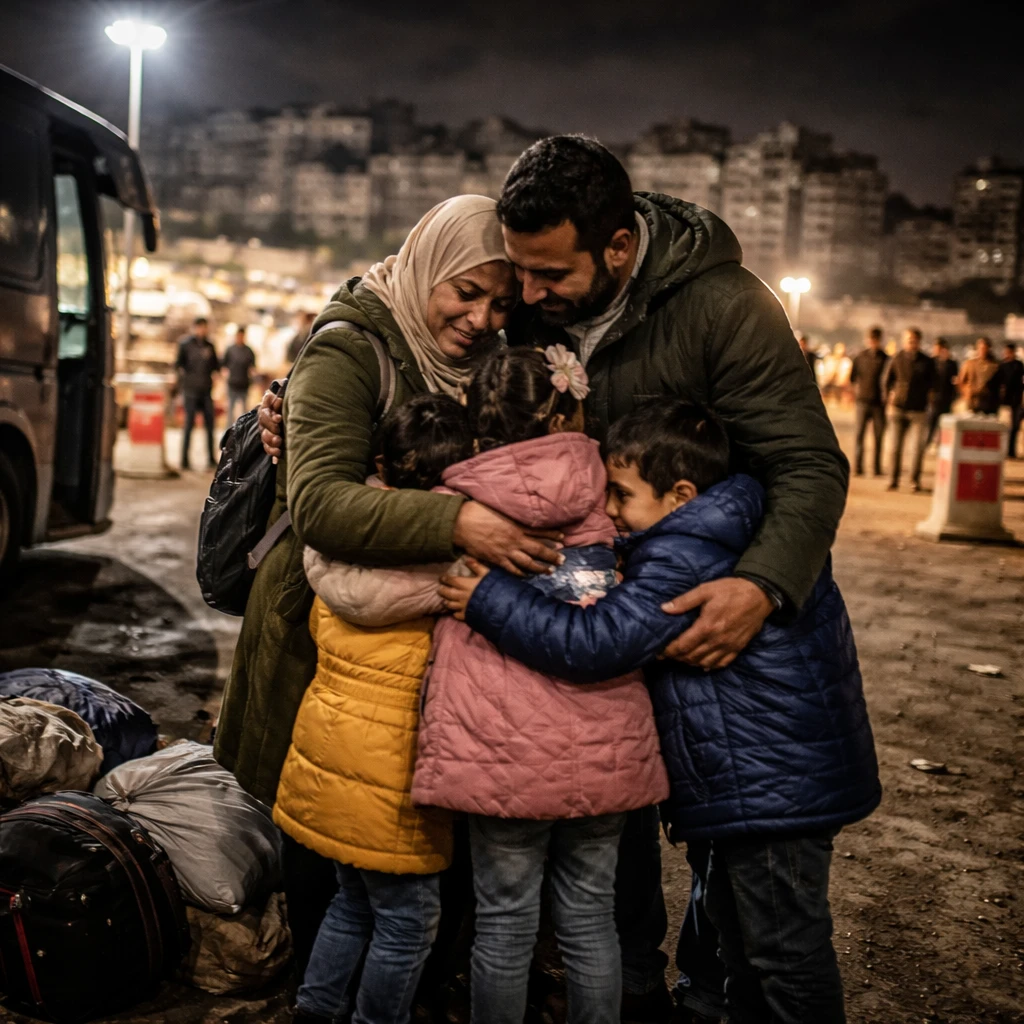
The children - Hanan, 8; Ezz, 5; and Mohammad, 4 - packed blankets and winter coats, smiling as they prepared. Hanan placed a bow in her hair in anticipation of seeing her father. Before leaving, the children chanted: "We are going to Gaza!"
The journey from Al-Arish to the Rafah crossing covered approximately 50 kilometres. At Rafah, travelers must pass three checkpoints - one operated by Egyptian authorities, a second by Palestinian and European officials, and a third overseen by Israeli security forces - before boarding a bus to Khan Younis in territory controlled by Hamas.
Rafah itself, once home to an estimated quarter of a million people, was depopulated and demolished by Israeli forces during the war. The bus trip took Rayyan’s family to Khan Younis, where Ahmed, her husband, waited for them late at night. The reunion was intimate and intense: the couple embraced for a long time and Ahmed greeted each child with hugs and kisses. Hanan clung to her father's leg.
Rayyan said she had known that much of Gaza had been destroyed during the conflict, but seeing it in person still struck her with force. "No building is standing," she said. "Everything is destroyed, destroyed. There is no electricity, or anything."
The family’s former home, a large house in the Al-Saftawi district near Gaza City in the north, was destroyed, Ahmed said. With their house gone, they planned to live together in a tent at an encampment in Gaza City. "I tried in every possible way and managed to get three mattresses for five people to sleep on," Ahmed said.
For the enclave’s more than 2 million residents, the Rafah crossing is the only practical exit and entry point for most people. Its limited reopening on Monday formed a key element of U.S. President Donald Trump’s plan to bring an end to the Israel-Hamas war. Authorities had anticipated around 50 people crossing in each direction per day, but actual numbers have been significantly lower.
On Thursday, only 21 Palestinians were recorded as re-entering Gaza, according to enclave authorities. Those who have crossed back reported abusive treatment by Israeli forces and by members of a local gang that they said operates with Israeli backing; the Israeli military denies these allegations.
Rayyan described instances of mistreatment she witnessed or heard about during the trip. "There were some people (who were traveling) with us, like young men, they abused them - for example, they tied their hands, blindfolded them, humiliated them, they kept interrogating them," she said.
Family members and friends in Egypt had asked Rayyan why she would give up the relative stability and kindness she had experienced there and return to Gaza, where many people are displaced, food and water are scarce, and repeated ceasefire violations have killed hundreds. She acknowledged that life in Egypt had been comfortable and that people there had treated her well. Still, she said, the pull of family and homeland was stronger.
"But still, you long for your country, your family, your relatives, your husband, your life. Being away from home is hard. Life in Gaza is still beautiful, even though it’s been destroyed," Rayyan said.
This small-scale return highlights the difficult choices facing many displaced Palestinians: remain in host communities like Al-Arish where services and kindness may be available but ties to home are severed, or return to devastated neighborhoods where basic infrastructure and housing have been lost.
As crossings continue in limited numbers, families like Rayyan’s confront immediate practical challenges - shelter, bedding, and daily necessities - as well as the long-term uncertainty of living amid rubble and scarce utilities. The journey back has been physically and emotionally taxing, and the reception at checkpoints and on arrival in Gaza has added to the strain.
For those who decide to return, the emotional value of reunion can coexist with bleak material conditions, a reality reflected in Rayyan's mixture of joy at seeing her husband and shock at the scale of destruction they found upon re-entry.
As limited humanitarian and population movements proceed, the territory’s residents, authorities and international actors will continue to face logistical and protection questions tied to the crossing’s operation and the safety and welfare of those moving in and out of Gaza.