
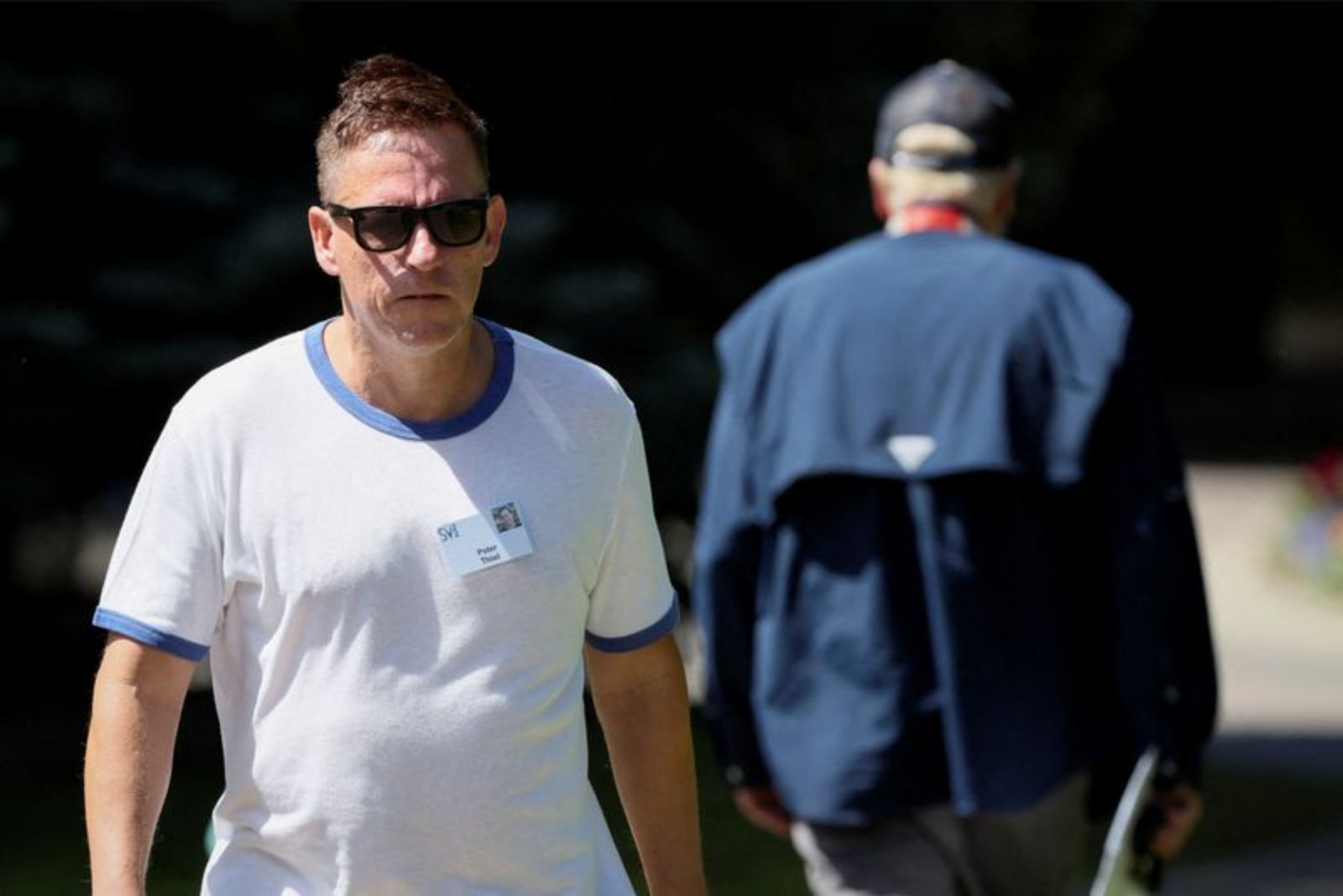
Peter Thiel, the U.S. billionaire venture capitalist and an early backer of President Donald Trump, inaugurated a sequence of closed-door lectures in Rome on Sunday that focus on the concept of the Antichrist. The invitation-only sessions, which will run through Wednesday, are not open to the press and the organizers have not disclosed the location.
Organizers quoted in media reports said attendees were being drawn from academic, technology and religious circles. Thiel, who co-founded Palantir Technologies, an artificial intelligence software firm with extensive links to U.S. defense and intelligence agencies, has in recent years devoted growing attention to religious and philosophical themes.
Last year, Thiel convened a comparable set of talks in San Francisco that explored the possibility of the Antichrist - a figure traditionally understood as one who opposes or denies Christ - emerging on the world stage. He has expressed concern that an Antichrist could arise promising solutions to catastrophic threats - such as nuclear, AI or climate-related disasters - and that such a figure might use assurances of preventing those perils to establish a one-world government.
Thiel, 58, was raised in an Evangelical Christian family and has said that Christianity shapes his worldview. His presence in Rome has attracted attention from figures within the Roman Catholic Church. Under Pope Leo, the first U.S. pontiff, the Vatican has publicly criticized aspects of President Trump’s right-wing policies and has also issued warnings about the risks associated with artificial intelligence.
Catholic universities in Rome publicly denied speculation in the press that they might be hosting the event, and the pope’s official agenda lists no meeting scheduled between Thiel and Pope Leo.
Criticism from Vatican adviser and Catholic press
Father Paolo Benanti, who advises the pope on artificial intelligence matters, published an essay on Saturday in which he characterized Thiel as acting in the role of a "political theologian" within Silicon Valley. In that piece, Benanti wrote that Thiel’s activities could be read as "a prolonged act of heresy against the liberal consensus: a challenge to the very foundations of civil coexistence, which he now considers outdated." The essay appeared under a headline that posed the provocative question: "American heresy: should Peter Thiel be burned at the stake?"
The Italian bishops’ conference newspaper, L’Avvenire, ran a series of strongly worded articles over the past week criticizing Thiel. One article cautioned against allowing technology leaders to set their own ethical boundaries and argued that governments must protect democratic oversight of digital platforms and counter the spread of disinformation.
Political connections and recent conservative visits to Italy
Thiel maintains close connections with figures in Washington, including Vice President JD Vance, who converted to Catholicism. His trip to Rome follows a succession of visits to Italy by prominent individuals associated with the U.S. conservative movement, including Steve Bannon, Elon Musk and Vance.
According to the schedule published by Italy’s prime minister, there is no meeting planned between Thiel and Prime Minister Giorgia Meloni during the visit.
Note on investment promotion included in original coverage
The coverage that appeared alongside reports of the Rome talks also included promotional material asking: "What are the best investment opportunities in 2026?" That promotional copy argued that better data supports stronger investment decisions and described a paid product as combining institutional-grade data with AI-powered insights, adding that it could not guarantee winners but could help identify more promising opportunities. The copy closed by inviting readers to ask an AI named WarrenAI before deciding.
This article reports the publicly available details about the lecture series, the public reactions from Catholic commentators and media in Italy, the absence of scheduled meetings with the pope or prime minister, and the background assertions about Thiel’s previous similar talks and stated concerns. Where information in the public reports was limited - for example, the identity of the Rome venue - that limitation is reflected here.