
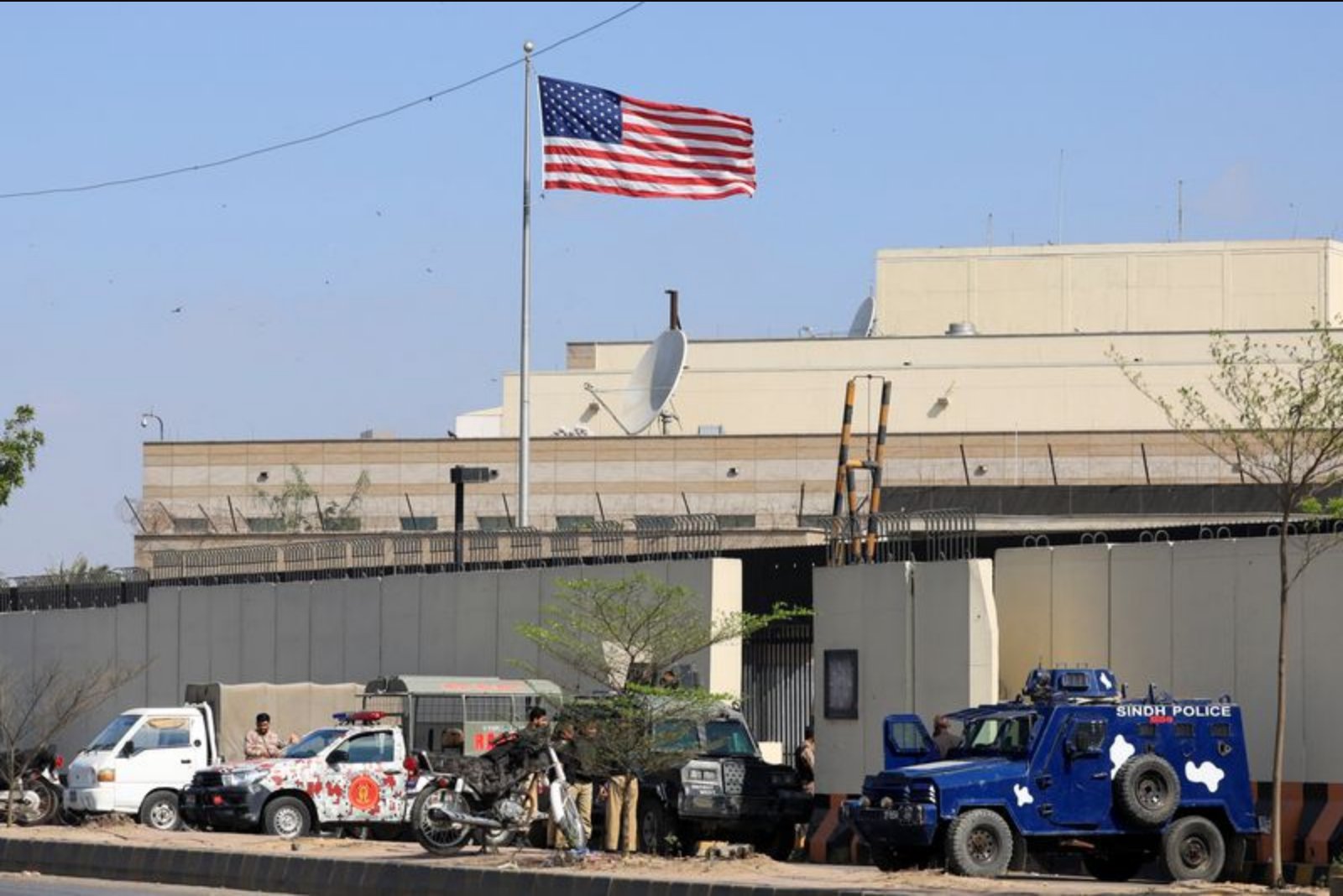
Pakistan is confronting a complex diplomatic and domestic security dilemma after widespread protests by its Shi’ite community over the reported killing of Iran’s Supreme Leader Ayatollah Ali Khamenei. Demonstrators in Karachi breached the walls of the U.S. consulate and unrest spread to other urban centres, compelling Islamabad to attempt a delicate balancing act between calming internal tensions and sustaining strategic relationships with foreign allies.
At the centre of the tension is Pakistan’s effort to preserve and even deepen its relationship with the United States while responding to the anger of a sizable Shi’ite minority. The community, which constitutes roughly one-fifth of Pakistan’s population of some 240 million people, regards Khamenei as a spiritual leader and rallied rapidly after news of his death.
Pakistan’s foreign policy choices are bound up with several recent and significant developments. The state has moved closer to President Donald Trump since his return to the White House last year - a shift that formally ended more than a decade of isolation from Washington’s strategic orbit. Pakistan’s calendar this year includes membership of the U.S.-led Board of Peace, where Israel also holds a seat, underscoring Islamabad’s renewed diplomatic engagement with Washington and its partners.
At the same time, Pakistan sustains longstanding and deep ties with Saudi Arabia and other Gulf states, including recent agreements that formalise strategic defence cooperation. Those accords emphasize mutual response to aggression, effectively treating an attack on one party as an attack on the other. The Gulf states have been directly affected by counter-strikes attributed to Iran following the U.S. and Israeli operations, further complicating Islamabad’s alignment choices.
Those overlapping relationships place Pakistan in a precarious position: domestic peace requires sensitivity to Shi’ite grievances and solidarity with Iran on certain issues, while geopolitical commitments and defence partnerships draw Islamabad into a closer orbit with the U.S. and Gulf monarchies. "Pakistan is trying to maintain domestic peace by expressing solidarity with Iran, while it also risks being pulled into the orbit of the war by the U.S. and Saudis," observed Arsalan Khan, an academic specialising in regional affairs. "If the war progresses, then it may find itself making trade-offs between domestic peace and its geopolitical commitments."
Government spokespeople have been largely silent on the finer points of policy, even as a senior security official described the situation bluntly: "Balancing relationships and blowback is the most pressing issue for Pakistan." The comment highlights the operational and diplomatic complexity facing Islamabad as it seeks to avoid escalation on either front.
Violence and mourning
At least 26 people were killed in clashes between protesters and police after the announcement of Khamenei’s death. In Karachi, U.S. Marines reportedly fired on demonstrators who had penetrated the consulate perimeter, according to two U.S. officials. Video footage of the incident showed some protesters armed and firing into the compound. Senior Shi’ite clerics in Pakistan declared days of mourning and warned that further demonstrations were likely, which analysts caution could result in episodic instability in major cities.
Shi’ite cleric Sajid Ali Naqvi characterised the reaction among his followers in stark terms: Khamenei’s death, he said, "has not weakened the Shi’ites but united them with a new spirit of revolution and independence from the slavery of the U.S. and its allies." That rhetoric underscores the intensity of sentiment among many in the community and the potential for sustained mobilisation.
Roots of the response
Analysts point to Pakistan’s sectarian and political history as integral to understanding the scale of the Shi’ite response. Commentators note that policies of state-promoted Sunni Islamisation in the 1980s, combined with the 1979 Iranian revolution, shifted dynamics for Pakistan’s Shi’ite communities. The revolution in Iran provided theological and political support that bolstered Shi’ite identity in Pakistan and offered a source of external backing for a community that had felt marginalised.
Scholars say those historical currents transformed how Pakistan’s Shi’ites view leadership in Iran. Kamran Bokhari, an analyst focused on regional politics, summarised the effect as a melding of religious solidarity with pronounced anti-American and anti-Israeli sentiment, forming what he described as a powerful political combination.
At the same time, Pakistan’s Shi’ites have endured targeted violence from extremist groups, including the Islamic State and Tehreek-e-Taliban Pakistan, feeding a long-standing sense of vulnerability. The deaths of protestors in recent clashes are likely to feed that sense of grievance: analysts caution that large funerals and public mourning rituals can become focal points for further mobilisation.
Political reactions and potential trajectories
Shi’ite political networks and clerical organisations, including groups connected to the Millat-e-Jafaria network and other leaders, have called for further demonstrations and demanded accountability for the deaths of protesters. Some leaders have urged legal steps, including calls for a criminal case against the U.S. consul general in the aftermath of the consulate breach and the fatal clashes. One organiser of vigils and online mourning activities described the representative as "like our pope," reflecting the depth of identification among some followers.
Pakistan’s prime minister issued a formal condemnation of Khamenei’s killing, calling it a "violation of international law," while stopping short of explicitly naming the United States. He also affirmed Pakistan’s solidarity with Saudi Arabia and other Gulf partners "in this perilous time," signalling Islamabad’s desire to maintain its external security relationships even as it responds to domestic unrest.
Analysts suggest the demonstrations could subside with time, but caution that the fatalities will remain a potent catalyst for further protest. As Madiha Tahir, an academic who studies sectarian politics, put it: "Each one of those deaths is a reminder of the embattled place of Shias within Pakistan." The persistence of large funeral gatherings, she warned, creates a clear potential for continued instability.
For Pakistan’s policymakers, the immediate challenge will be to manage public order and the perceptions of justice and representation among a sizable minority while preserving defence and diplomatic ties that are central to the country’s strategic posture. The unfolding events place an operational premium on careful crisis management, given the overlapping external commitments and the risk of domestic blowback.