
THITU ISLAND, South China Sea, Feb 23 - A Philippine Coast Guard plane carrying lawmakers and officials descended on the country's most strategically significant outpost in the disputed South China Sea as passengers received a roaming alert on their phones saying "Welcome to CHINA." Among those on the flight were Senator Risa Hontiveros and Coast Guard spokesperson Jay Tarriela, both known to be critical of Beijing's activities in the area.
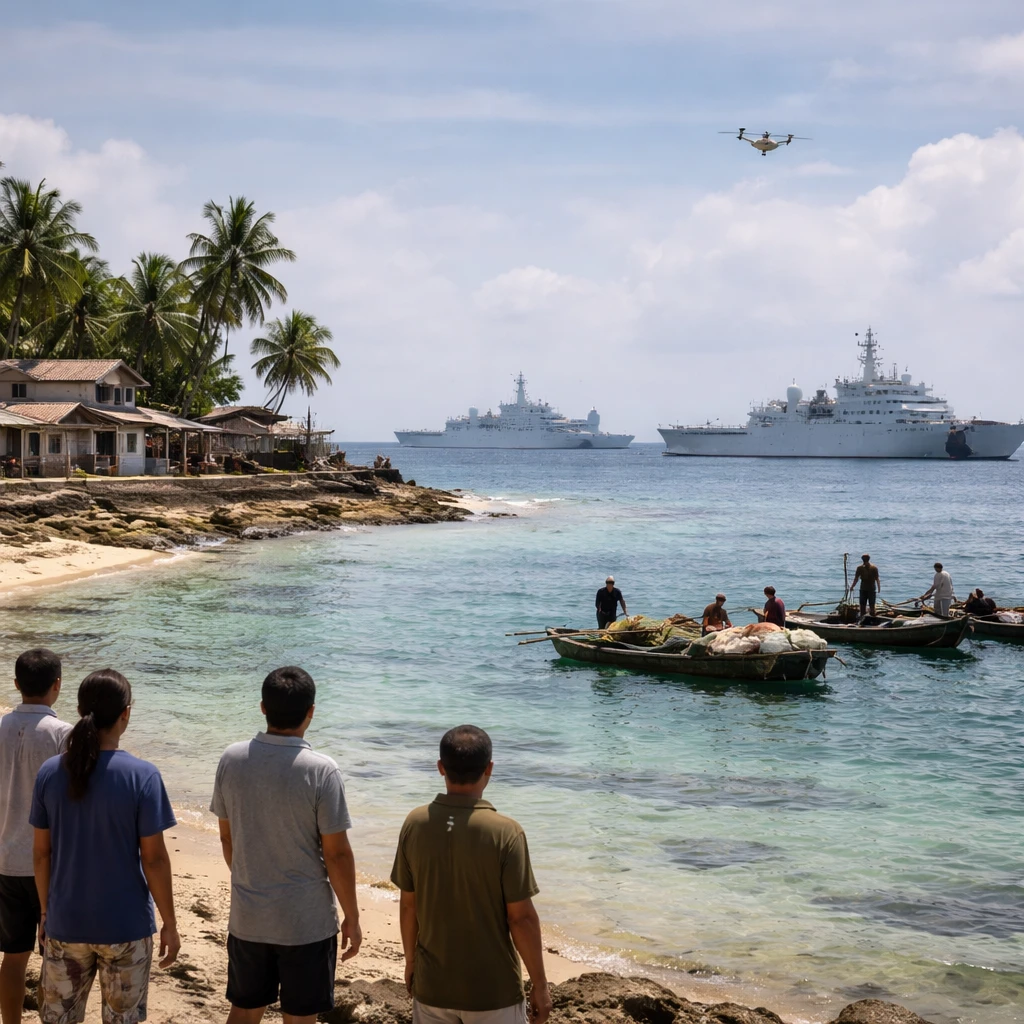
After arriving on Saturday, Hontiveros and Tarriela went ashore to speak with residents and to reiterate the Philippines' sovereignty over the island. The delegation's visit took place while Chinese Coast Guard ships, a People's Liberation Army Navy vessel and several Chinese fishing boats remained within sight from the shore.
At 37 hectares (0.37 sq km), Thitu - locally Pag-asa, meaning "Hope" - is the largest and most valued of the nine features held by the Philippines in the Spratly archipelago. Located about 450 km (280 miles) from the Philippine mainland, the island is home to roughly 400 residents who live simply and depend heavily on nearby waters for their livelihoods. Their daily presence on the island serves as a physical assertion of Manila's claim, even as pressure from China has increased.
"We will never give up the Kalayaan Island Group, including Pag-asa," Hontiveros told island residents, invoking the formal name used by Manila for the portion of the Spratly Islands it administers.
The visit is likely to attract attention in Beijing and could intensify tensions in a dispute where rhetoric has hardened on both sides. Hontiveros and Tarriela have been repeatedly singled out in Chinese Embassy statements and in online messaging campaigns, according to officials, a sign of a broader informational effort related to the South China Sea. Manila's creation of a dedicated foreign ministry spokesperson for maritime affairs reflects heightened sensitivity within government circles as both physical and informational pressures from China grow.
For islanders, the pressure from China is tangible. Fisherman Rando Asiado, 45, who has lived on Thitu since 2012, described how the prolonged presence of Chinese vessels has kept him and others from accessing productive fishing grounds such as those near Subi Reef and the Sandy Cays. "There are times when Chinese Coast Guard vessels would chase us away, so we are forced to stay on one side of the island. And when we try to fish on the other side, Chinese drones fly over us," Asiado said.
Subi Reef lies about 14 nautical miles from Thitu and is one of seven artificial islands China has constructed in the Spratlys that are used to bolster its sovereignty claims. Some of those artificial islands are equipped with surface-to-air missiles, aircraft hangars and runways, according to descriptions from officials and observers.
Filipino fishermen now frequently cast nets in less productive waters to avoid encounters with Chinese vessels, who have employed tactics such as water-cannoning and close-quarter manoeuvres. Those actions have, at times, resulted in collisions and injuries to Philippine crews.
China maintains its actions in the South China Sea are lawful and professional, and it accuses Manila's vessels of intruding into waters it claims. Still, local fishers say they lack the capacity to confront the vessels they encounter. "We’re not afraid because we know we’re in the right, but they’re using ships while we only have small boats. We don’t stand a chance, so to avoid trouble, we just steer away," said 51-year-old fisherman Ronnie Cojamco.
The recent visit by Hontiveros and Tarriela, arriving amid visible Chinese maritime activity and informational pressure, underscores the intersection of daily life on Pag-asa with broader geopolitical contestation. Residents' accounts of restricted access to traditional fishing zones and of encounters with Chinese drones and ships provide immediate examples of how the dispute affects livelihoods and reinforces Manila's argument for continuing a physical presence on the island.
Officials' public reiteration of sovereignty claims and the ongoing presence of Chinese maritime assets illustrate the dual nature of pressure in the area - operational at sea and digital or diplomatic onshore - that Manila is responding to with both local visits and institutional adjustments within its foreign ministry.
Key takeaways
- Philippine officials encountered a "Welcome to CHINA" roaming alert during a visit to Thitu Island as Chinese coast guard vessels, a PLA Navy ship and fishing boats remained visible offshore.
- The presence of Chinese vessels and drones has pushed Filipino fishermen away from traditional, richer fishing grounds, altering local economic activity and daily routines.
- Manila has increased its informational and diplomatic focus on maritime affairs while continuing to assert sovereignty through on-the-ground visits and resident presence.
Risks and uncertainties
- Ongoing maritime encounters - including water-cannoning and close-quarter manoeuvring - pose risks to the safety of Philippine crews and could lead to further collisions or injuries, affecting the fisheries sector and local economies dependent on catch.
- Persistent Chinese naval and coast guard presence near Philippine-held features increases the potential for escalation in a contested maritime environment, introducing political and operational uncertainty for regional administrations and mariners.
- Information campaigns and public messaging targeting Philippine officials contribute to an environment of heightened diplomatic tension and may complicate efforts to manage the dispute through official channels, affecting policy and communications strategies.