
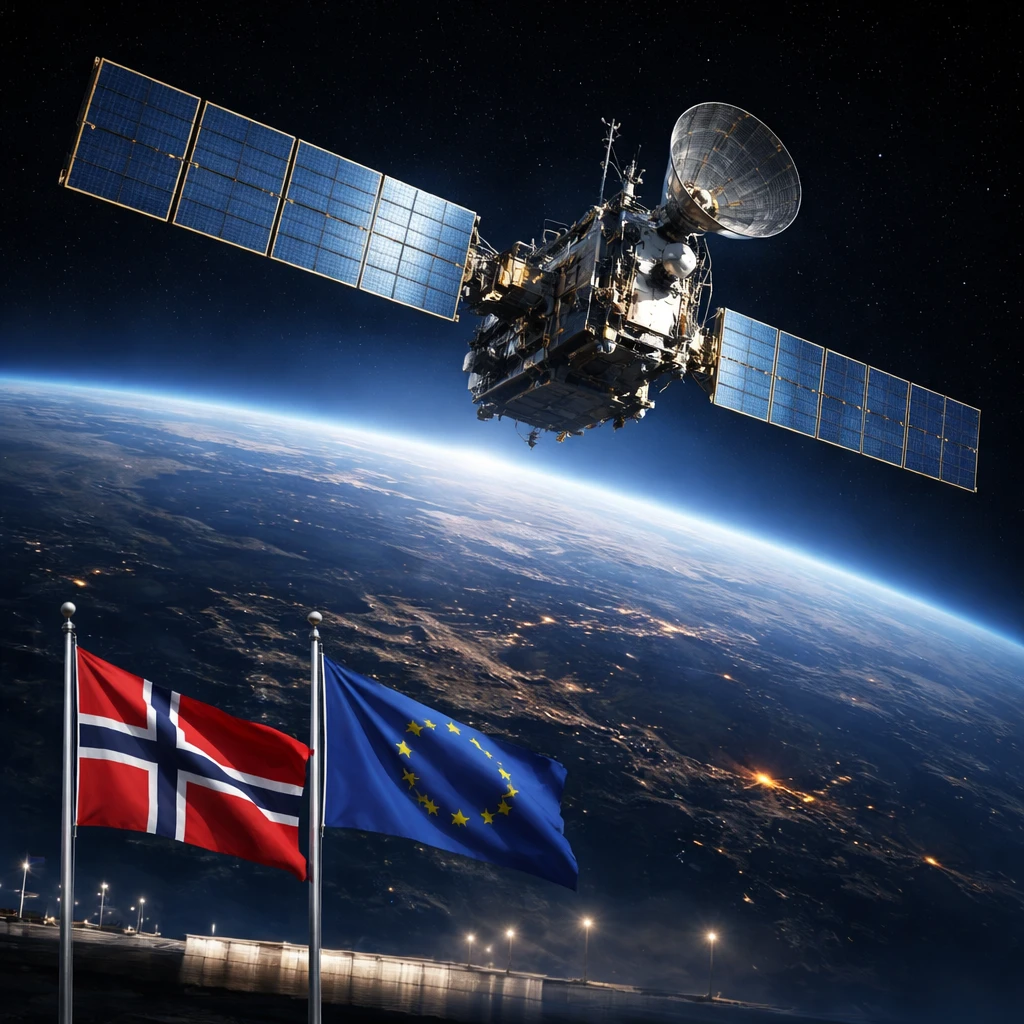
Norway anticipates joining the European Union’s IRIS2 secure satellite communications program within a matter of weeks, Trade Minister Cecilie Myrseth said in an interview in Oslo. She told Bloomberg that a signing is expected by Easter, which falls in early April this year, and credited recent discussions in Brussels with smoothing the way to a formal agreement.
The EU has already switched on portions of the IRIS2 network, positioning it as a secure-state alternative to commercial systems such as Elon Musk’s Starlink. While parts of the service are now live, the IRIS2 constellation still requires the launch of around 290 satellites that were initially planned to begin operations in 2030.
Norway is not a member of the European Union, but it participates in the single market and already takes part in EU space programs including the Galileo navigation system and the Copernicus Earth observation initiative. Myrseth framed the prospective accession to IRIS2 as part of a wider effort by Norwegian authorities in recent months to better align the country’s space activities with EU programs and with key European partners such as the United Kingdom and Germany.
Looking ahead, Myrseth said a white paper updating Norway’s longer-term strategy for the domestic space industry is scheduled to be published at the beginning of next year. The document is intended to set out updated plans for the sector and to reflect the government’s push to coordinate more closely with European allies.
The timeline and the formalities of Norway’s entry into IRIS2 remain subject to the completion of the pending agreement. At the same time, the EU’s activation of parts of the network underscores the continuing build-out of a sovereign communications capability alongside commercial offerings. The size of the remaining deployment - about 290 satellites - highlights the significant programmatic work still required to realize the full IRIS2 constellation.