
North Korea is expected to announce updated weapons development priorities at its Ninth Party Congress this month, after evaluations indicate that many of the broad targets set out by leader Kim Jong Un at the 2021 Congress remain only partially met. While the leadership has continued to prioritize nuclear arms and ballistic missile programs, observers and analysts identify a more mixed record for conventional and enabling systems that would improve target acquisition, force coordination and coercive options below the nuclear threshold.
In a public report to the Eighth Party Congress, Kim outlined an ambitious programme of defence advances, listing systems ranging from hypersonic weapons and a solid-fuel intercontinental ballistic missile to military reconnaissance satellites and drones, according to state media. The same document referred to the design phase of a new nuclear-powered submarine as being in its "final examination" stage, and stated that work had been completed on "unmanned striking equipment", "means of reconnaissance and detection" and a "military reconnaissance satellite", alongside other categories of electronic weaponry.
Despite the sweeping language of those declarations, assessments of progress vary markedly across capability areas.
Unmanned systems and drones
State media has repeatedly shown Kim observing tests of reconnaissance drones since 2021, and the leadership has publicly urged prioritization of unmanned systems and artificial intelligence for modern warfighting. Analysis in September from the U.S.-based think-tank 38 North indicated that North Korea is expanding its drone programme and its production capacity.
South Korea’s Institute for National Security Strategy, overseen by its National Intelligence Service, referenced Ukrainian officials' claims in a September report that Russia had established drone production capacity in North Korea. The institute commented that, if accurate, such cooperation would "go beyond simple technology exchange and carry significant strategic implications for the security environment on the Korean Peninsula and in Northeast Asia," and it described the arrangement as a "grave threat" to South Korea’s security apparatus.
Conventional artillery and exports
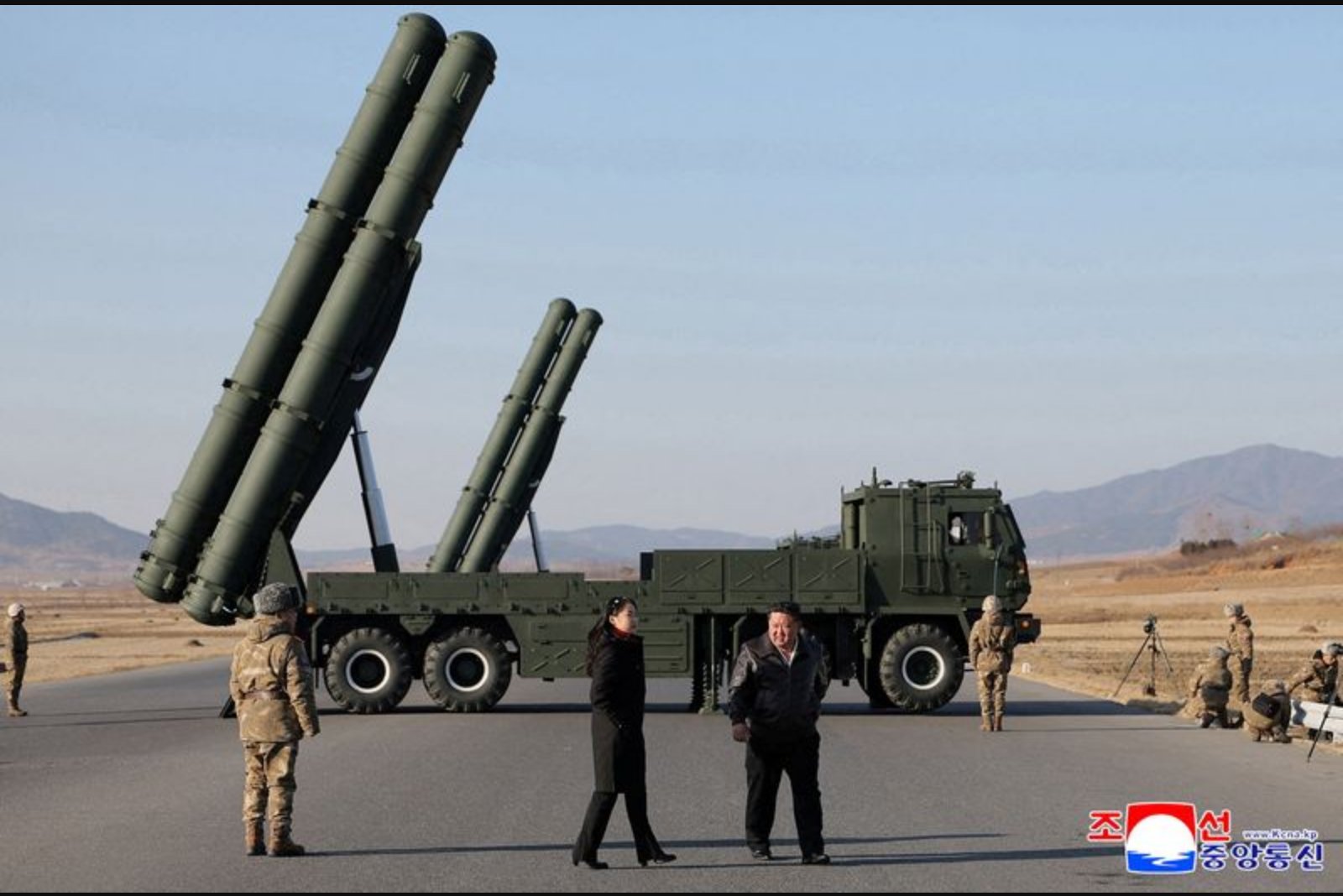
Conventional strike capability has been underscored as a central pillar by Kim, who has highlighted drills involving "super-large" multiple rocket launchers and issued orders in late 2025 to scale up production of rocket launchers that state media described as the mainstay of modernized long-range artillery.
South Korea’s military has reported that North Korea supplied Russia with conventional systems, including 240 mm rocket launchers and 170 mm self-propelled howitzers. Those assessments point to the existence of both stockpiles and industrial capacity despite sanctions.
Yang Uk, a military specialist at South Korea’s Asan Institute for Policy Studies, said the most significant achievement in conventional terms may have been arms exports tied to the Ukraine conflict. He argued that large-scale exports helped clear obsolete wartime stockpiles and freed resources that Pyongyang is now using to modernize its forces incrementally.
Submarine ambitions and technical limits
In 2023, the North unveiled what it labelled a "tactical nuclear attack submarine," a vessel analysts judged to be a modified Romeo-class design, though South Korean officials questioned whether it was fully operational. In late December 2025, state media published photographs showing what it said was Kim inspecting construction work on an 8,700-ton nuclear-powered submarine capable of launching surface-to-air missiles.
Analysts interpret the submarine push as signalling intent, but they caution that substantial technical hurdles remain for a heavily sanctioned state. Key challenges include propulsion, sensor suites, weapons integration and crew proficiency. Yang said, "With submarines, they seem to have failed," noting that after revealing a new vessel in 2023, North Korea had not demonstrated comprehensive sea trials, which he suggested points to significant problems with achieving reliable submergence.
Claims of Russian assistance in submarine development are difficult to verify, Yang added, and he identified integrating a nuclear reactor into a workable submarine design as a principal bottleneck.
Space-based reconnaissance
One of the more consequential ambitions set in 2021 was to field military reconnaissance from space. North Korea succeeded in placing its first military reconnaissance satellite into orbit in November 2023, though external observers, including analysts at the U.S.-based Heritage Foundation, described the satellite’s capabilities as largely unknown.
A subsequent attempt to launch another reconnaissance satellite in May 2024 failed when the launch vehicle exploded during flight. Kim vowed in public remarks that the programme would continue, but no new launches have been announced by Pyongyang since that failure.
Doo Jin-ho, who heads the Eurasia Research Center at the Korea Research Institute for National Strategy, said the cumulative record "essentially shows (North Korea) has not met its 2021 goals, though now Russia is likely hands-on in the effort." He added that Pyongyang may be delaying another launch until it can be confident of reliability because "if it fails again, it’s not just North Korea that loses face, Russia does too."
Outlook for the Ninth Party Congress
The upcoming Ninth Party Congress offers North Korea an opportunity to recalibrate its declared weapons-development agenda in light of uneven progress across programs. Nuclear weapons and ballistic missiles continue to figure prominently in the leadership’s strategy, but analysts point to mixed results in areas that would strengthen non-nuclear options and battlefield awareness - unmanned systems, conventional long-range fires, submarines and space-based reconnaissance.
Observers also note that some claims of external cooperation, particularly involving Russia, remain contested. Russia has denied engaging in military transfers that would violate a United Nations arms embargo on North Korea.
Whether the Ninth Party Congress will reflect a shift in emphasis, a reprioritization of projects, or a tempered timetable remains to be seen. What is clear from publicly available claims and external assessments is that Pyongyang’s 2021 ambitions have been realized selectively, with persistent technical and operational constraints shaping the pace and scope of follow-on programmes.