
DUBAI/JERUSALEM/WASHINGTON, March 1 - Israel reported carrying out another series of strikes on Iranian targets on Sunday as Iran confronted the fallout from an earlier air assault that it said killed Supreme Leader Ayatollah Ali Khamenei. Iranian state media confirmed the death of the 86-year-old leader on Saturday after U.S. and Israeli officials said an air strike had killed him in what they described as the most ambitious set of attacks on Iran in decades.
U.S. President Donald Trump described the strikes on Iranian facilities as intended to eliminate a long-standing threat from Tehran and to deny the country the capability to produce a nuclear weapon. The president framed the operation as a measure to end a decades-long danger, a rationale he offered to justify an operation that represented a marked escalation of U.S. and Israeli military involvement in the region.
Israel’s military said its Sunday morning operations were aimed at Iran’s ballistic missile inventory and air defense systems. Iranian state outlets reported that an explosion was heard in Tehran on Sunday morning.
The initial strikes prompted a major Iranian response on Saturday, when Iran launched hundreds of missiles and drones targeting U.S. forces deployed in the region as well as cities in Israel and in Arab states allied with Washington. Those counterstrikes led to widespread flight cancellations across the region.
The Pentagon reported that there were no U.S. deaths or injuries from the exchanges, but U.S. officials warned that the strikes increased the risk environment for Americans. A senior U.S. intelligence official told Reuters that, while the most immediate danger flowing from the assault was to U.S. military personnel in the Middle East, cyber attacks could also threaten critical U.S. infrastructure.
Damage to civilian infrastructure was reported across the Gulf. Dubai’s international airport and the Burj Al Arab hotel sustained damage and four people were injured, authorities said. Abu Dhabi Airports posted on X that an incident at Zayed International Airport resulted in one fatality involving an Asian national and seven injuries; the post was later deleted.
Iran signaled a potential broader economic effect by warning that the Strait of Hormuz - the narrow passage through which about a fifth of global oil consumption transits - had been closed. Tehran’s warning raised expectations of a sharp uptick in oil prices, given the strait’s centrality to international energy shipments.
The Islamic Revolutionary Guard Corps said in a statement early on Sunday that Iran’s armed forces would retaliate again with what it described as their biggest offensive operation ever, aimed at U.S. bases and Israel. Those remarks followed comments at an emergency U.N. Security Council meeting by Iran’s ambassador to the United Nations, Amir Saeid Iravani, who said hundreds of civilians had been killed and injured in the U.S. and Israeli strikes. Iravani characterized Iran’s counterstrikes as acts of self-defense and argued that the bases of hostile forces constituted legitimate military targets.
U.N. Secretary-General Antonio Guterres called for an immediate cessation of hostilities and told the Security Council that he deeply regretted what he said was a lost opportunity for diplomacy.
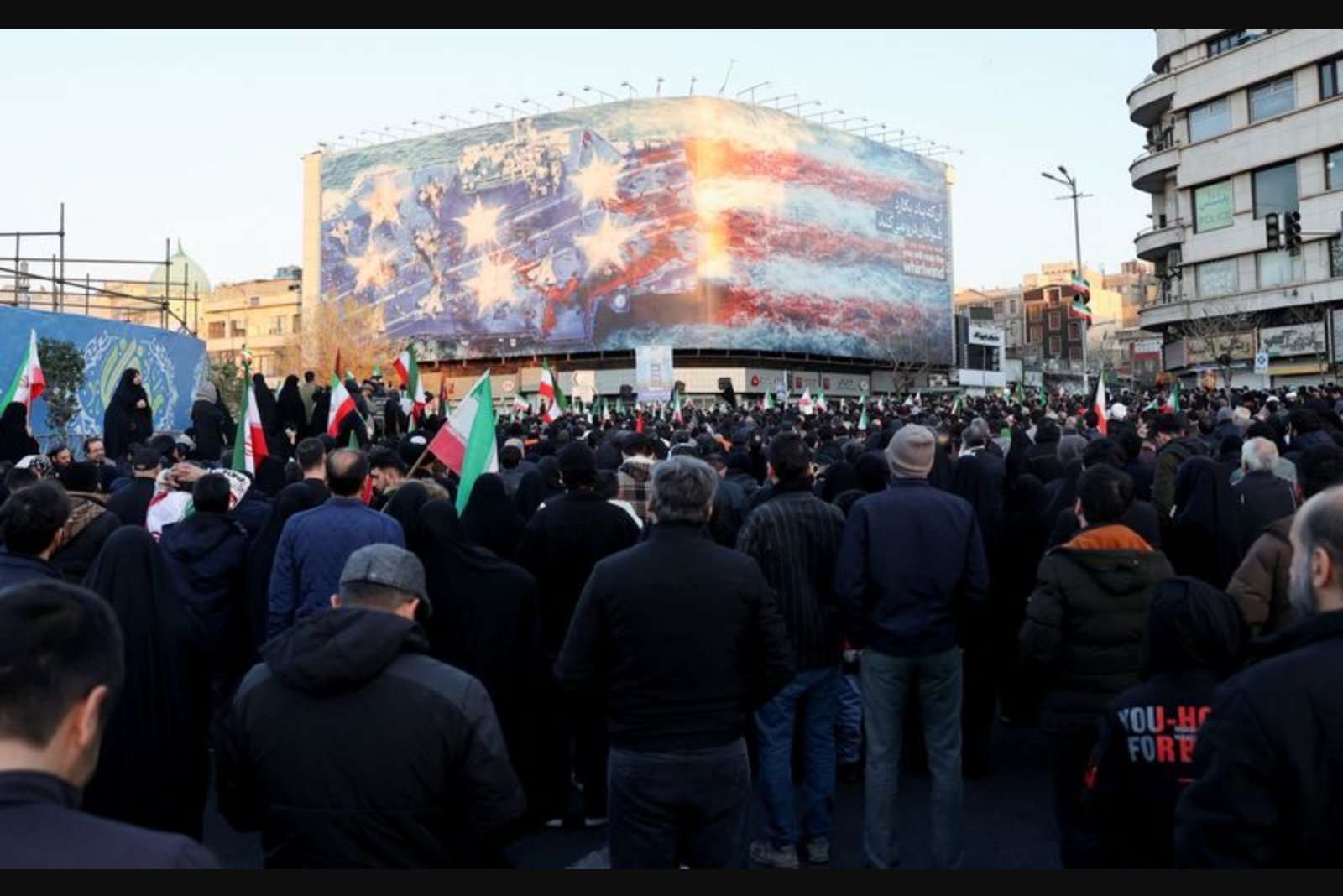
Witness accounts and social media posts - which were not independently verified at the time - described scenes of celebration in Tehran and other Iranian cities after reports of Khamenei’s death circulated. Iranian state media said Khamenei was at work in his office when the strike occurred on Saturday morning and reported that several family members, including his daughter, grandchild, daughter-in-law and son-in-law, were also killed.
The Revolutionary Guards issued a brief statement mourning the loss of what it called "a great leader." President Trump, in a social media post, labeled Khamenei "one of the most evil people in History." Both Mr. Trump and Israeli Prime Minister Benjamin Netanyahu urged Iranians to rise up and overthrow their government in the wake of the attacks, according to statements following the operation.
Israel’s military said the initial strikes killed at least seven senior Iranian military commanders. Analysts cited in official briefings suggested that while the deaths of Khamenei and other senior figures would represent a significant blow to Iran’s leadership, they would not necessarily end the entrenched clerical governance structure or the Revolutionary Guards’ influence over the population.
Officials and diplomats also pointed to the pattern of Israeli operations over the past two years, which they said had killed some senior Iranian military figures and weakened several of Tehran’s proxy forces across the region. The article noted that after a 12-day air campaign in June in which Israel - joined by the United States - carried out extensive strikes on Iran, U.S. and Israeli authorities had warned they would act again if Iran continued advancing its nuclear and ballistic missile programs.
At Saturday’s U.N. Security Council meeting, envoys from Russia and China criticized the U.S. and Israel for launching the attacks while diplomatic negotiations were reportedly underway between Tehran and Washington. Russia’s U.N. envoy, Vasily Nebenzya, said Iran had been "stabbed in the back" and challenged the U.S. justification that preventing a nuclear-weapon capability warranted the strikes.
Senior U.S. officials countered that recent discussions indicated Iran remained unwilling to give up its ability to enrich uranium - a capability Iran portrays as necessary for civilian nuclear energy but which U.S. officials say would allow Iran to build a nuclear bomb.
The attacks, the subsequent Iranian counterstrikes and the prospect of further retaliation have left significant uncertainty over regional stability, the safety of U.S. forces in the Middle East, the security of global energy shipments through the Strait of Hormuz and the operations of civil aviation in the Gulf. International organizations and national governments convened emergency sessions, while military commands on both sides prepared for the possibility of additional blows and reprisals.
The situation remains fluid, with official statements, battlefield reports and diplomatic interventions continuing to evolve as the parties weigh further actions.