
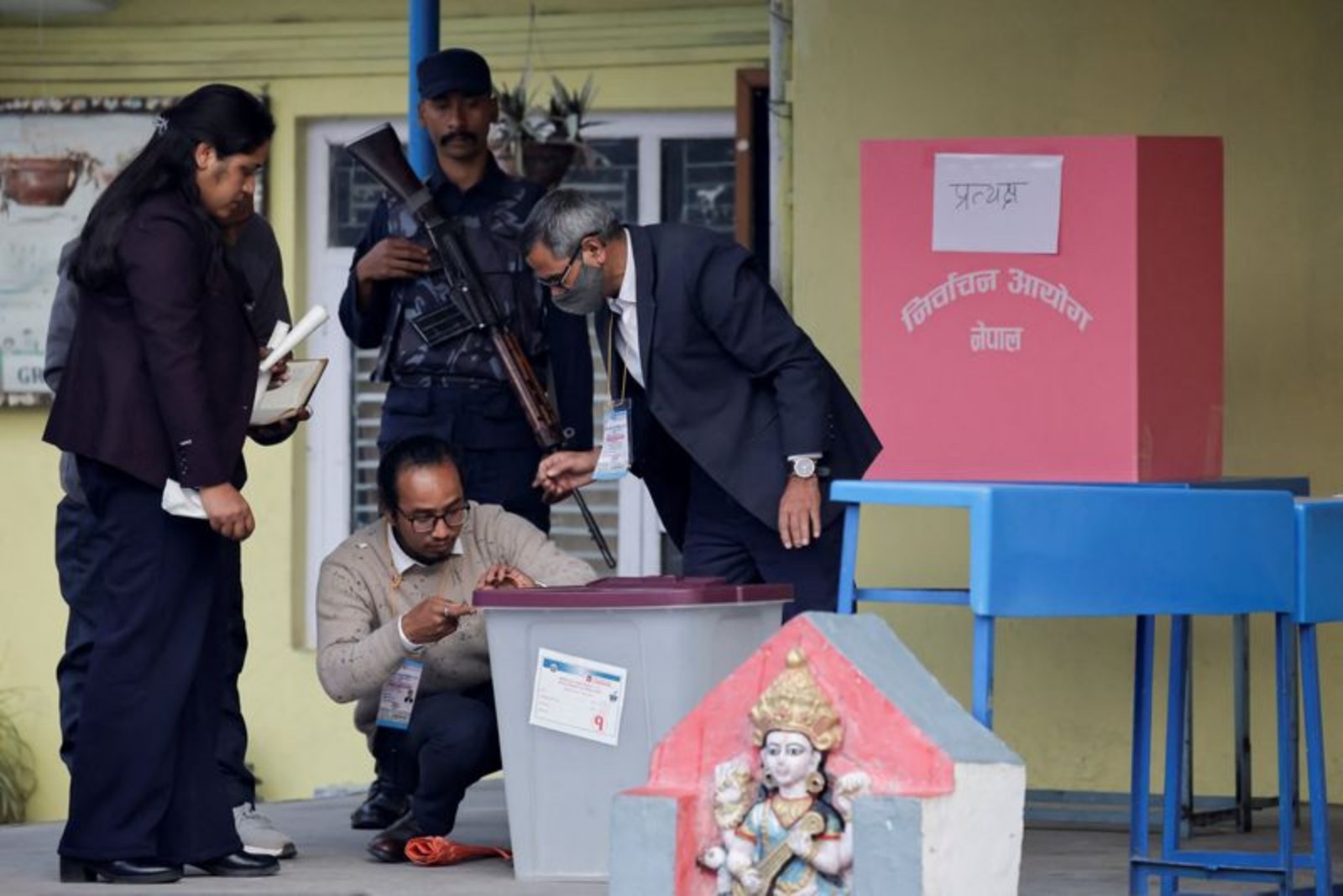
KATHMANDU, March 5 - Nearly six months after a wave of unprecedented youth-led protests and the deaths of 77 people forced Nepal's then prime minister to step down, voters started casting ballots on Thursday in a general election to select a new parliament in the Himalayan nation.
Sandwiched between China and India, Nepal is home to roughly 30 million people and has for decades struggled with political instability that has weighed on a largely agrarian economy and contributed to rising unemployment. Those structural weaknesses, officials and analysts say, have been compounded by pervasive corruption.
The unrest that erupted last September had its roots in a social media ban and swelled into a broad outcry led largely by young people. The demonstrations brought thousands into the streets, produced clashes that resulted in fatalities and ultimately prompted the resignation of Prime Minister K.P. Sharma Oli.
Oli, the leader of the moderate Communist Party of Nepal (Unified Marxist-Leninist, UML), has returned to the campaign trail for Thursday's vote. He is one of more than 3,400 candidates representing 65 parties competing for seats. These contenders include the Nepali Congress, led by 49-year-old Gagan Thapa, and the Nepali Communist Party (NCP), which comprises former Maoist insurgents who have since entered mainstream politics.
For the past three decades, the UML, the Nepali Congress and the NCP have been dominant forces in Nepal's political landscape, even as the country has seen 32 government changes in the past 35 years.
Challenging those established parties is the three-year-old Rastriya Swatantra Party (RSP). The RSP has nominated Balendra Shah, a charismatic rapper-turned-politician and the 35-year-old former mayor of Kathmandu, as its candidate for prime minister. Shah has drawn large crowds and built momentum among younger voters, both in person and online, positioning himself as an alternative to veteran figures such as Oli, who is campaigning in his traditional stronghold near the Indian border.
"The election is critical to address the aspirations of the youths expressed during the Gen Z protests," political analyst Puranjan Acharya said. "If the newly elected leaders are seen as unfit to do so, there is a risk of further trouble."
Electoral logistics will determine the composition of the next government. Some 19 million eligible voters can choose 275 members of parliament through a mixed system: 165 seats are decided by direct first-past-the-post contests and 110 are allocated by proportional representation.
Polling opened at 7 a.m. local time (0115 GMT) and is scheduled to close at 5 p.m., according to the country's election commission, with counting set to begin shortly afterward. Election officials said early trends could appear by Friday, but a full tabulation may take a week or more because the proportional representation ballots require additional time to process.
"Voting is not just about sending someone to victory," Interim Prime Minister Sushila Karki, who took office after Oli's resignation, said in a public broadcast this week. "It’s a decision you make about your future and that of your children."
Throughout the campaign, voters heard repeated promises aimed at the concerns that fueled the September demonstrations: job creation, curbing corruption and improving governance. The formal campaign period ended on Monday, followed by a two-day cooling-off interval before polling.
In the capital, candidates made final appeals to the electorate, appearing in public with traditional marigold garlands and vermillion on their foreheads, riding on trucks and greeting supporters through sunroofs and from vehicles. Despite the visible energy around some contenders, a segment of the electorate remains undecided.
"Old parties did nothing except corruption," said Ramkrishna Pandey, 50, speaking with several others at a newspaper kiosk on the outskirts of Kathmandu. "New ones don't seem any better. I have not decided who to support."
As ballots are cast and counting begins, the outcome will determine which politicians are entrusted with addressing long-standing economic and governance challenges. Observers say the capacity of new or returning leaders to respond to the demands raised by young protesters will be a key measure of whether this vote marks a real turning point or simply another chapter in Nepal's frequent political reshuffling.