
At the World Economic Forum in Davos, Switzerland, NATO Secretary Mark Rutte revealed that he and U.S. President Donald Trump exchanged views on safeguarding the Arctic from potential threats posed by Russia and China. The dialogue focused on reinforcing the transatlantic alliance's capabilities to protect the Arctic environment, with special emphasis on Greenland and the broader area of seven NATO nations possessing land within the Arctic Circle.
President Trump has publicly expressed interest in acquiring Greenland, appealing to national security concerns as justification. Although he dismissed any notion of achieving such an acquisition through military force, Trump indicated a potential resolution to this diplomatic matter might be forthcoming following his meeting with Rutte.
While Trump's proposition has introduced tensions within the NATO alliance, Rutte described their engagement as a "very good discussion," underscoring a shared commitment among members to collaborate on Arctic security.
These high-level conversations follow a recent assembly in Washington, where representatives from the United States, Denmark, and Greenland convened to further explore issues related to Greenland's economic and military spheres.
One specific outcome of the Davos discussion was the establishment of a working group focused on ensuring that neither China nor Russia gains footholds in Greenland's economy or military infrastructure. This initiative aligns with broader NATO objectives to guard against adversarial influences in critical Arctic territories.
Overall, the dialogue emphasized the importance of coordinated defense efforts among NATO countries with Arctic interests to maintain regional stability and deter expansionist maneuvers by rival powers.
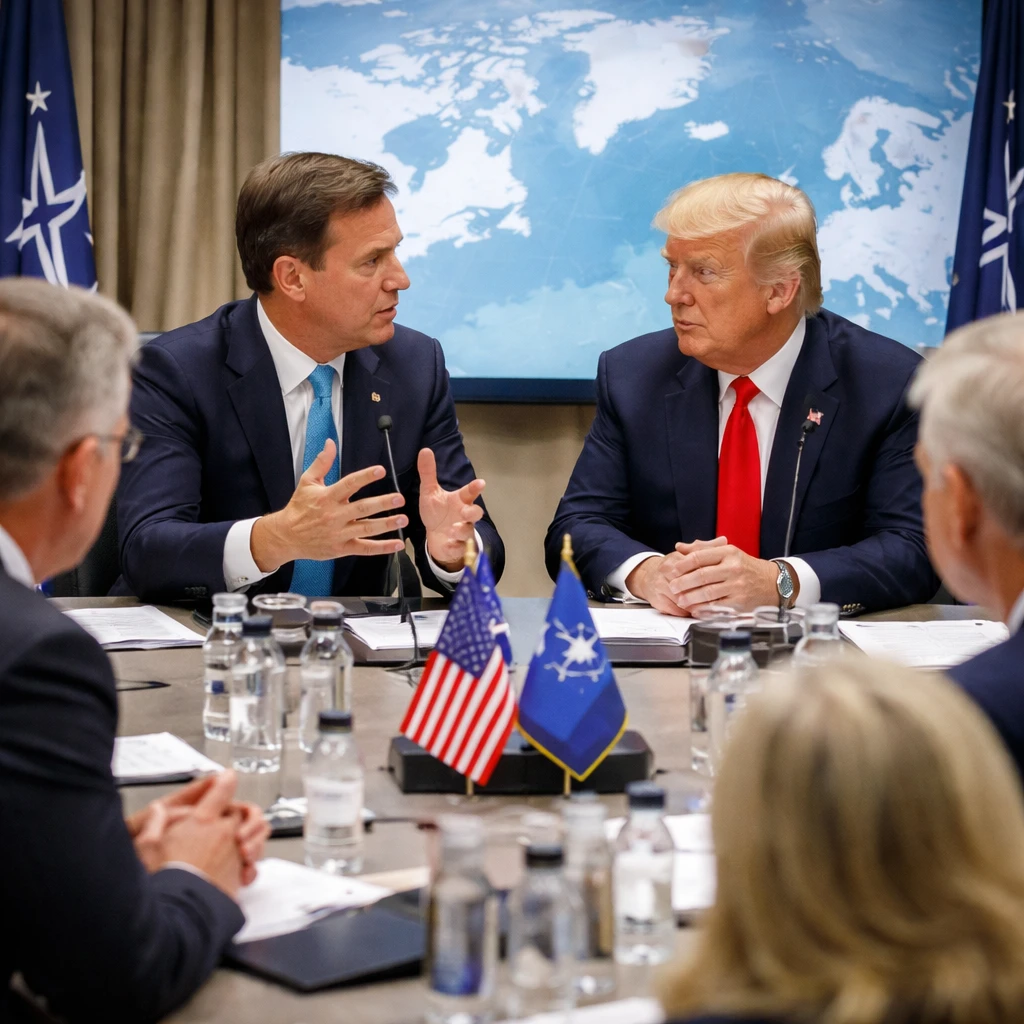
During the World Economic Forum in Davos, NATO Secretary Mark Rutte and U.S. President Donald Trump engaged in discussions aimed at strengthening NATO's defense posture in the Arctic. Central to their talks was preventing Russian and Chinese encroachment, particularly with regard to Greenland and the territories of other NATO member states located in the Arctic region. These talks build upon previous meetings involving U.S., Danish, and Greenlandic representatives to address concerns over foreign influence and security in the strategically important Arctic zone.
Key Points
- NATO leaders emphasize joint defense efforts to secure the Arctic region against Russian and Chinese influence.
- Discussions include protecting Greenland and the territories of the seven NATO countries that extend into the Arctic Circle.
- A working group has been formed to prevent economic and military access in Greenland by foreign powers, especially China and Russia.
Risks
- Potential strains within NATO due to differing views on Arctic territorial ambitions could impact alliance cohesion.
- Geopolitical competition in the Arctic may escalate tensions affecting regional security and NATO's strategic planning.
- Uncertainties remain around the outcomes of negotiations regarding Greenland’s status and defense policies, which could influence Arctic defense dynamics.