
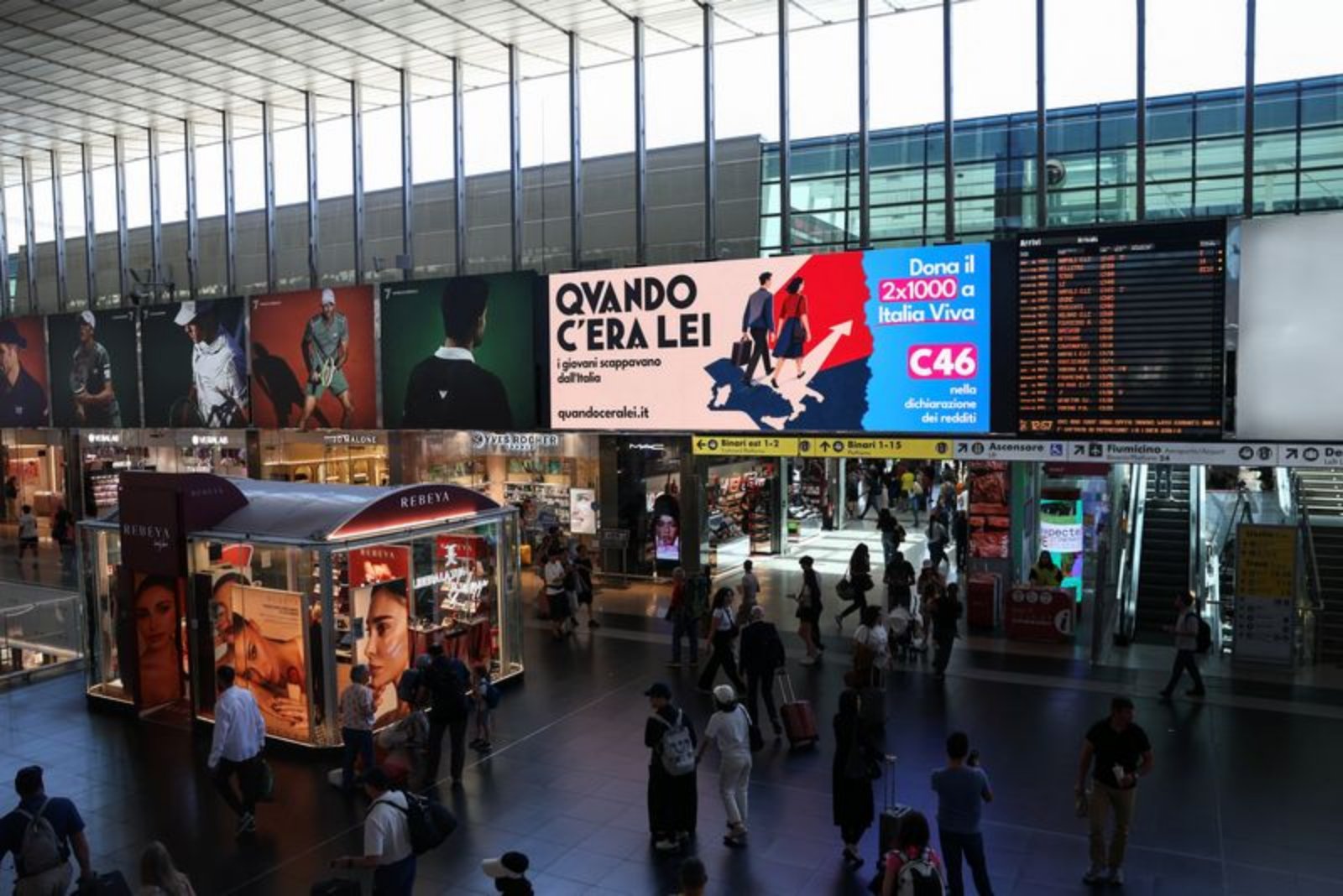
ROME, May 22 - A provocative advertising push by former Prime Minister Matteo Renzi’s Italia Viva has drawn public attention and stirred a debate over censorship after posters comparing Prime Minister Giorgia Meloni to fascist leader Benito Mussolini appeared in major train stations in Italy.
The ads adopt a typeface and visual style associated with 1930s fascist propaganda and carry the phrase "When she was around ...", a formulation reportedly used by admirers of Mussolini to suggest some services functioned better under his rule. One poster on display in Rome and Milan’s principal stations completed the phrase with: "When she was around, trains arrived late."
The poster referencing punctuality was removed after the company responsible for handling advertising in Italy’s stations said the image was "detrimental" to the reputation of the railway. Other campaign posters, which include barbs about taxes, inflation and the outlook for young people, remain in place.
The billboards form part of a fundraising effort by Italia Viva that asks taxpayers to allocate 0.2% of their annual income tax to the party - an option available to Italians who wish to support a political movement. Italia Viva’s social media posts amplifying claims of censorship have attracted thousands of views and dozens of comments, increasing the small party’s public visibility; the party currently polls at around 2.5%.
The campaign explicitly leverages Prime Minister Meloni’s political background. Meloni’s Brothers of Italy party is described as a descendant of the Italian Social Movement (MSI), which was founded by fascist veterans after World War Two, and Meloni began her political career in MSI’s youth wing. The posters appear designed to highlight that lineage while urging fiscal support for Italia Viva.
Ferrovie dello Stato, the state railway company, issued a statement on Thursday saying it had not received complaints from the government about the advertisements. Consumer group Altroconsumo is cited as saying that more than one in five high-speed trains arrived late last year - a statistic echoed in the punctuality-themed poster.
La Stampa published a letter from Prime Minister Meloni on Friday in which she denied being upset by the posters and said she had congratulated Renzi on the idea. Following that, Renzi released a statement saying: "I hope that, following the prime minister’s authoritative clarification, Italia Viva will be allowed to continue its campaign - including the one on late trains - without any censorship."
The episode has had the immediate effect of boosting attention to Italia Viva on social media and in transit hubs, as the party seeks contributions through a legally available tax allocation mechanism. At the same time, the removal of at least one poster and the advertising firm’s comment about reputational harm have focused debate on the boundaries of political advertising in public transport spaces.
Context and implications
The posters marry a highly charged visual reference to an explicit fundraising ask. They have prompted a mix of responses: removal of the most contentious image on reputational grounds, continued display of other critical messages, and public statements from both the prime minister and the campaign’s sponsor advocating for the continuation of the advertising effort.