
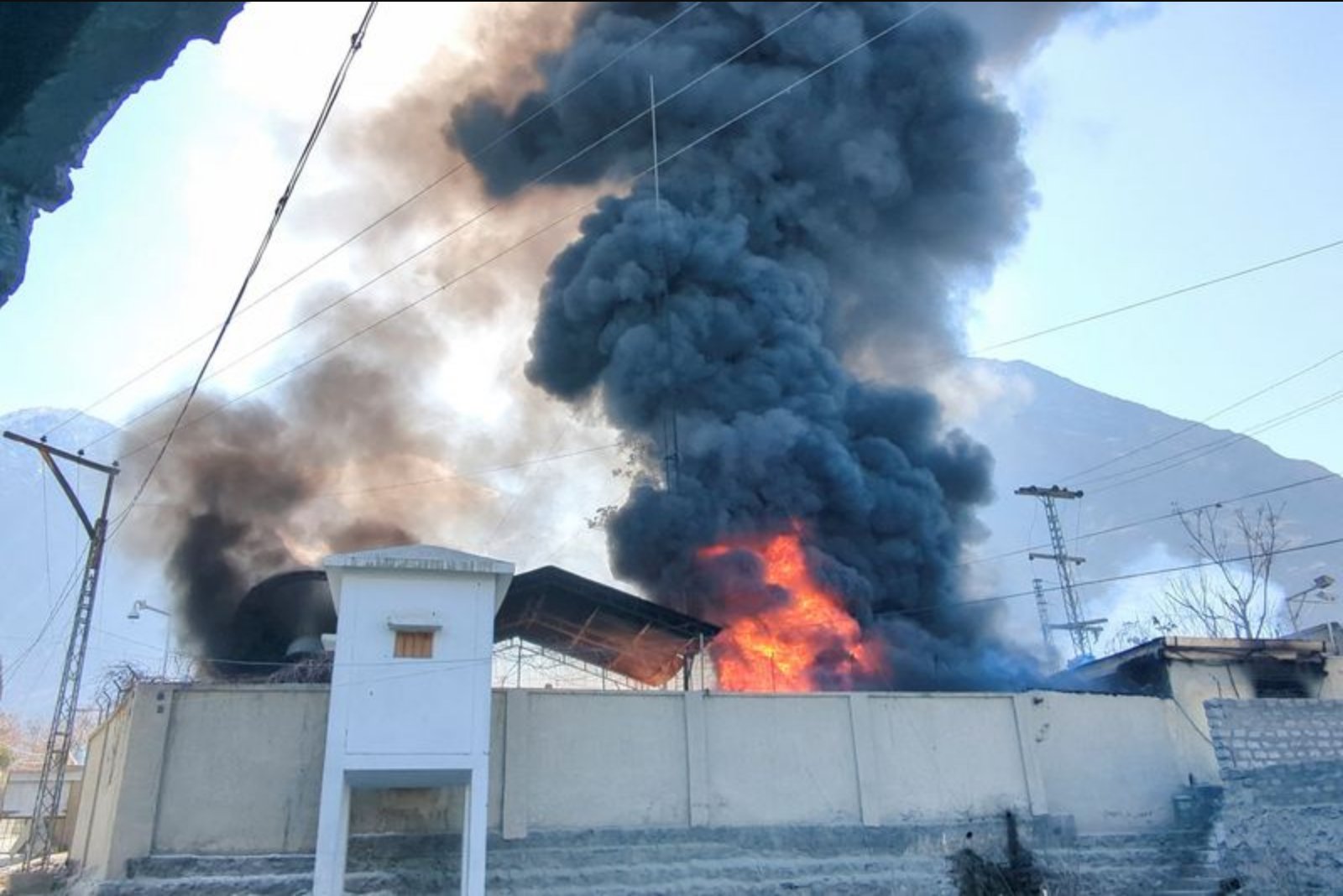
Pakistan announced on Monday that military forces were being sent into the Himalayan Gilgit-Baltistan region and implemented a nationwide prohibition on large assemblies after demonstrations against U.S. and Israeli strikes on Iran escalated into deadly confrontations, leaving 26 people dead so far.
Local officials reported that in Skardu, a city within Shi’ite-majority Gilgit-Baltistan which is normally a tourist destination, protesters set fire to a U.N. office on Sunday. The violence that followed in Skardu resulted in 14 fatalities, including a soldier, according to authorities.
Two people were killed in the capital, Islamabad, and ten others lost their lives on Sunday in Karachi, where demonstrators stormed the U.S. consulate and managed to breach the compound’s outer wall. Roads around the U.S. consulate in Karachi were sealed off and a strong police presence was deployed. Similar security measures were reported around U.S. missions in Lahore and Islamabad.
Thousands also demonstrated in the northern cities of Parachinar, Dera Ismail Khan and Peshawar, though officials said those gatherings did not result in clashes. Despite the government’s national ban on congregations and public gatherings, Shi’ite community leaders announced funeral processions for those killed in Gilgit-Baltistan, Karachi and Islamabad for Monday and called for further protests in Lahore and Karachi.
Officials said many protesters had described Supreme Leader Ali Khamenei, who was killed in the airstrikes, as akin to a spiritual leader for the community. Pakistan is home to the world’s second-largest Shi’ite community after Iran.
Ghulam Abbas, the Gilgit-Baltistan information minister, said authorities were summoning the military for a three-day period and were imposing "a three-day curfew in Gilgit and Skardu to maintain law and order". The curfew and military deployment are intended to restore order in the wake of the unrest.
Residents and witnesses described scenes of blocked roads and distressed communities. One Karachi resident, Dodo Chandio, said: "People were martyred, there were riots. Road are blocked for the second day in Karachi, people are distressed." Authorities have placed additional restrictions and stepped up security around diplomatic missions while managing the funerals and public responses to the deaths.
Context and dynamics
The disturbances have unfolded across multiple urban centers, combining targeted attacks on international facilities with local clashes in a region that draws tourists under normal conditions. The invocation of the military and the imposition of curfews in Gilgit and Skardu highlight the intensity of the incidents in the north and the government's immediate focus on re-establishing order in affected areas.
Ongoing developments
- Security forces have been mobilized to Gilgit-Baltistan for at least three days, with curfews put in place in Gilgit and Skardu.
- Heavy policing and road closures surround U.S. consular facilities in Karachi, Lahore and Islamabad.
- Funeral processions and calls for further protests were announced by Shi’ite leaders despite the nationwide ban on public gatherings.