
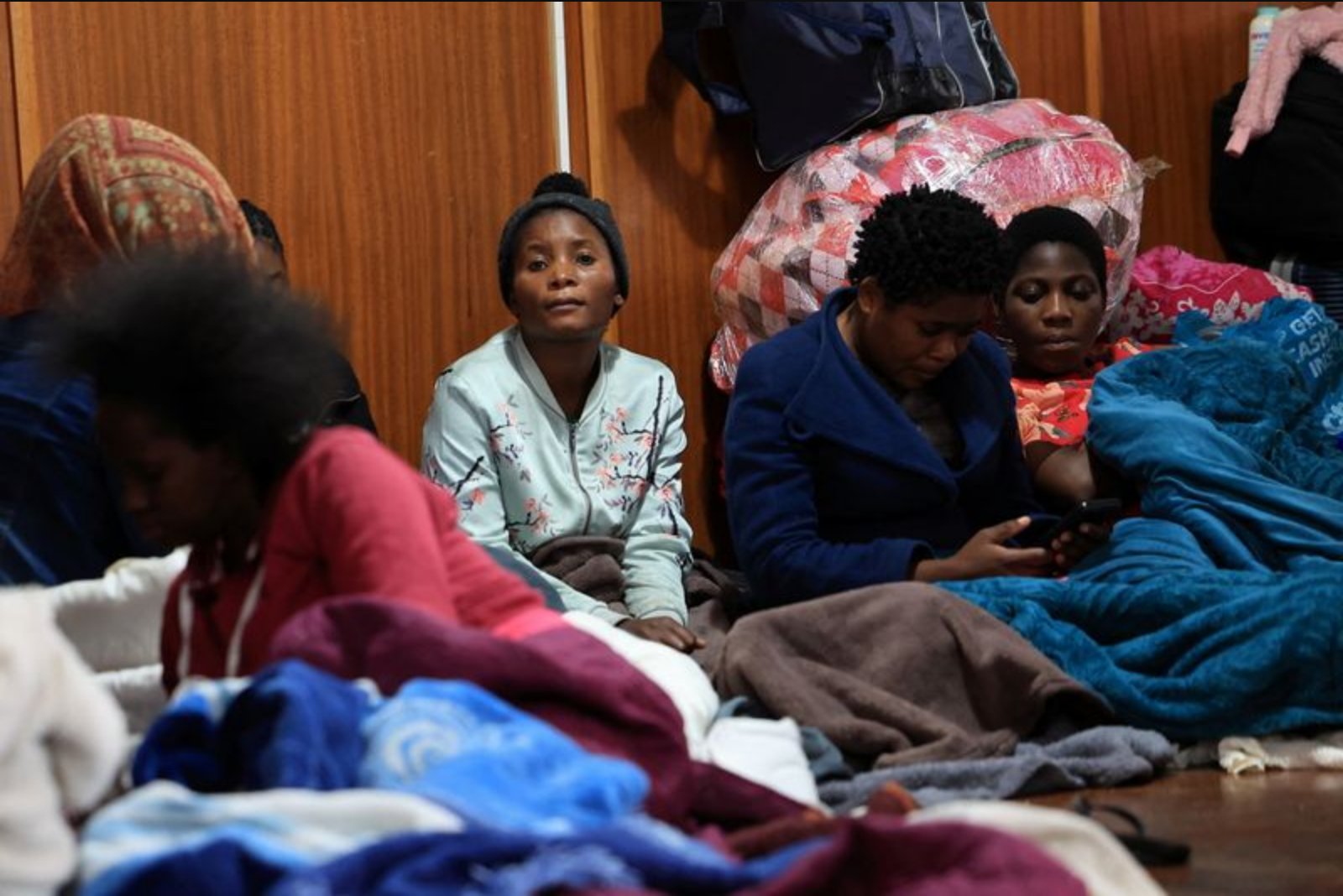
In recent days, foreign nationals in several coastal towns of South Africa's Western Cape have fled their homes after crowds urged, and in some cases forced, them to leave. Dozens of migrants have spent nights in the mountains or taken refuge in municipal buildings after anti-immigrant protests spread through towns along the coast.
One of those displaced, 49-year-old Mozambican national Lado Amido, said he answered a knock on his door and was told he had to leave. "On the 31st, people came to my house, knocked on the door, and then took all my belongings," Amido said. He had been in the country since February searching for work. After spending two nights in the mountains, he is now sheltering in a Kleinmond town hall alongside about 100 other immigrants, including people from Malawi and Mozambique.
Across the province, local officials and migrants reported similar scenes: people moving from informal settlements or private homes into public buildings or hiding in surrounding hills to avoid confrontations with angry crowds. Mozambique reported that five of its citizens were killed in xenophobic attacks in the town of Mossel Bay over the weekend.
Many of the immigrants who have taken refuge in the town hall said they would prefer to travel home but lack the funds to do so. Some hope to access voluntary repatriation programmes organised by their home governments.
Local checks and political context
Grant Cohen, a ward councillor for Kleinmond, said immigration officials had visited the town in the weeks leading up to the unrest to inspect restaurants and other businesses for undocumented workers. Cohen told Reuters that despite these inspections, many of those sheltering at the town hall are legally in the country. He added that there are children among the displaced who had been attending school in Kleinmond but now wish to leave the country out of fear and intimidation. "I don’t believe that residents should take things into their own hands," Cohen said.
Political leaders have spoken about migration while condemning the attacks. President Cyril Ramaphosa told parliament that "As we work to build a safer ... and more prosperous society, we need to address the challenge of migration," while also denouncing recent xenophobic violence. The reporting notes that xenophobic attacks are a recurring issue in South Africa and that immigrants are often blamed for economic problems such as high unemployment and crime. It also states that politicians from nearly all parties have tended to lend credence to those claims as a way to court populist votes ahead of upcoming local polls.
Personal accounts from those displaced
Michael Markson, 31, who is from Malawi, said he fled his informal settlement on Saturday after being warned by his landlord that his life would be at risk if protesters found him. He spent a night in the mountains, saying one friend contacted his employer, who brought food as they hid in the woods. Markson said he could see a large crowd of protesters in town, some armed with knives and sticks. He is seeking assistance to travel home but cannot afford the journey. "In our country there’s no-good economy... (but) it’s better than living in a community where your life is under threat," he told reporters.
Other migrants in the town hall echoed the sense of vulnerability and uncertainty. For some, the choice is between staying in South Africa and facing threats to personal safety or returning to countries with limited economic opportunities but comparatively more security.
Immediate situation and options
At the Kleinmond town hall, municipal staff and local councillors are dealing with a group of roughly 100 displaced migrants. Some are awaiting government-organised repatriation schemes, while others remain in limbo because they lack the funds to return home. Local checks of businesses for undocumented workers continue to take place even as communities grapple with the recent spike in violence.
The incidents underscore the recurring problem of xenophobic violence in South Africa, and the acute consequences for individuals and families who find themselves targeted by local mobs. Displaced migrants say their immediate needs include shelter, food and assistance to return home if they choose to do so.